Author: Neville

  • Billionaire island owners get microgrids; planet now safe for supermodels

    Billionaire island owners get microgrids; planet now safe for supermodels

    By on 7 February 2014
    Print Friendly

    Greentech Media

    branson_310_207

    NRG Energy’s Twitter feed promised a big announcement this morning. But instead the news is that Sir Richard Branson is liberating the kite-surfers of Necker Island from the oppression of diesel gen-sets.

    Branson, founder of the Virgin Group, along with NRG Energy, is developing “a renewables-driven microgrid for the entire island, supplying high-quality, reliable electricity powered at least 75% by an integrated array of solar, wind and energy storage technologies,” according to a release.

    Necker Island is a 74-acre resort island in the British Virgin Islands owned by Branson. The Necker microgrid will allow 30 guests to reduce their reliance on diesel at a rate of $322,000 for seven nights (five-night minimum stay). There is an odd 2 a.m. peak on Necker island, with guests using energy for things you and I cannot afford or even understand.

    The effort at Necker is connected to the Ten Island Renewable Challenge which is looking to move islands away from fossil fuels.

    A microgrid is a self-contained system of power generation (typically diesel generators or small-scale turbines), along with distribution and load. Adding non-spinning renewable sources such as wind and solar or storage adds a level of complexity to the system, but microgrids are seen as a natural fit for islands.

    David Crane, the CEO of NRG, said, “With oil setting the marginal price of electricity, retail electricity prices in the Caribbean are among the highest in the world, hindering economic development, job creation, and quality of life. By tapping into each island’s specific, readily available and ample renewable energy resources, we can achieve an immediate and significant reduction of operating expenses, imported fuel cost, carbon footprint and other air emissions and noise pollution. The renewables-driven microgrid solution being designed and installed on Necker is intended to demonstrate this and provide a scalable real life application relevant to other islands of the Caribbean.”

    On the subject of billionaire island-owners with microgrids, Larry Ellison’s Hawaiian island, Lanai (population 3,000), will soon boast a microgrid with design help from University of California San Diego Professor Byron Washom, the Director of Energy Initiatives at the school. UCSD’s microgrid generates most of the energy used on campus.

    Billionaire Peter Thiel’s libertarian island’s energy needs could also be helped by a microgrid.

    Vanity projects and nonprofit efforts aside, here is some real microgrid news, as recently reported by GTM:

    • Primus Power, a developer of flow batteries, is going to deploy an energy storage system for a microgrid at the Marine Corps Air Station (MCAS) in Miramar, California. CEO Tom Stepien said that 20 percent of the backup diesel gen-sets at Miramar did not start on the day of the San Diego blackout in 2011. When a military site like MCAS loses power, “Planes are grounded and training missions are canceled. You can’t even open the gates.”
    • New York governor Andrew Cuomo has put $40 million in prize money behind a push to bolster the state’s post-Hurricane Sandy storm resilience with community microgrids, writes GTM’s Jeff St. John. The projects are meant to support communities of about 40,000 residents and to operate in conjunction with the grid most of the time. But during emergencies, the microgrids will be able to disconnect from the grid and power themselves, providing islands of stable power for hospitals, police department, fire stations, gas stations and other critical systems.
    • In 2012, Connecticut created a statewide microgrid program with $18 million dedicated to fund nine projects. Connecticut is considered the leader in the region in terms of microgrid support, although other governments are putting funds behind emergency backup power and community energy sufficiency.
    • New Jersey is partnering with the DOE on a $1 million study aimed at supplying microgrid capabilities for New Jersey Transit.
    • New York City is studying a microgrid project for the Rockaway Peninsula as part of its climate change response plan.
    • ABB’s grid stabilizing generator combines the inertial properties of a flywheel, the power management functions of advanced inverters, and software to make it all work together. This combination is especially important for microgrids. ABB has installed PowerStore devices in a dozen microgrids across the world. The earliest deployments are in Australia, where Powercorp, the developer of the PowerStore technology, used them to integrate wind power into diesel generator-powered remote grids. ABB started working with the technology in 2006, and bought Powercorp in 2011 for an undisclosed sum, as reported by Jeff St. John.
    • Danish utility Dong Energy has an island showcase for its Power Hub technology in the Faroe Islands, a North Atlantic archipelago. This project, dubbed “Grani,” is balancing an increasing amount of wind power with pumped hydro storage, as well as two sets of variable loads on the island: heat pumps for a salmon breeding facility and two cold-storage facilities for the island’s fishing industry. Adjusting the timing and intensity of heating and cooling to match wind power fluctuations is one example of how supply and demand can be matched.
    • ABB and Schneider are collaborating on the Swedish island of Gotland to combine wind and solar power, grid control systems and advanced load management.

    Diesel-dependent grids in remote areas or on islands remain the most economically attractive setting for microgrids, since they’re reliant on expensive imported fuel, which makes the payback on investing in renewables come more quickly.

    Truly modern microgrids are meant to go beyond diesel generators, incorporating clean, renewable energy resources like rooftop solar PV with energy storage and on-site energy management systems. These could offer not just emergency backup power, but could also serve as models for integrating a range of grid-edge technologies into the grid at large.

    That’s how the New York State Smart Grid Consortium, a group including state agencies, universities and research labs, big utilities and smart grid vendors like General Electric and IBM, would like to see Cuomo’s microgrid push develop. It described the promise of community microgrids as “the means to increase reliability and give local communities more control of their energy systems, while also allowing for the adoption of clean and efficient distributed energy sources such as solar or combined heat and power,” not to mention electric vehicle adoption.

    One of the key challenges for the microgrids as grid resilience resources is the fact that they’ve got to find ways to pay for themselves that extend beyond keeping the lights on during emergencies. But many of those alternative revenue streams can come into conflict with existing regulations, as well as posing a threat to utility business models that rely on selling power to customers.

    As Jeff St. John has reported, “To make the system financially viable requires intelligent design to integrate multiple fuel sources seamlessly and optimization through robust demand management to minimize system size. Renewables-driven microgrids typically use diesel generation — which currently is the primary source of electricity on most islands in the Caribbean — as a backup to solar, wind, geothermal and other renewables, drastically reducing diesel consumption while making the model compatible with existing infrastructure.”


  • Australia may lose last mainland state supportive of renewables

    Australia may lose last mainland state supportive of renewables

    By on 7 February 2014
    Print Friendly

    The public feuding within the ruling Labor Party in South Australia in this past week confirmed to many that the last Labor state government in mainland Australia is about to lose power. And with it will go the last government openly supportive of renewable energy.

    Voters go to the polls in South Australia and Tasmania on March 15, and the Labor Premiers in both states may be replaced by their conservative opponents.

    In Tasmania, this may not mean a lot for renewables because the state is mostly powered by hydro anyway, but it will be interesting to see if a Liberal government pursues such projects as the King Island win project and a second interconnector to the mainland (to sell more green energy) with the same vigor, or indeed its aim to be “100% renewable”.

    In South Australia, the circumstances are different. The Labor government has been in power – and the state has become the nation’s leader in both wind energy and rooftop solar PV.

    Former Premier Mike Rann announced a state target of 33 per cent by 2020, an initiative that helped the state gain nearly half of the wind farms in the country, and the highest penetration of rooftop solar, but it has already nearly met its  target giving it a combined contribution of 31 per cent from variable sources in 2012/13.

    The state’s strong push into renewables was made possible by the fact that the local fossil fuel industry in that state is not strong. This is a circumstance shared by Tasmania and the ACT Labor government, the only other with strong renewables policy – 90% renewables by 2020. The other mainland states, WA, Victoria, Queensland and NSW, feature strong fossil fuel interests and conservative governments that have shown – particularly in WA and Queensland, and in Victoria in the case of wind – open hostility towards renewable energy.

    But in the current campaigning South Australia, renewables are hardly mentioned. They do not yet feature in any of the major parties policy platforms, and nor are they likely too. This is despite the fact that in South Australia nearly one in five houses has modules on the roof, and rooftop solar contributes more than 15 per cent of electricity on some days, and recently has been contributing more than 10 per cent for more than 6 daylight hours.

    Even with the likely roll-out of rooftop solar, and more wind farms (depending on the fate of the RET, which is not an election issue yet either), the state is likely to be the first to reach 50 per cent, and could do this by 2020, as several government reports have also concluded.

    The failure to embrace such targets is disappointing, but probably not surprising. Politicians have yet to get their mind around rooftop solar, despite the obvious attraction to households and its ability to reduce bills. And in South Australia, there is plenty to boast about – jobs, the biggest reduction in wholesale prices in any state, less coal-fired electricity made locally and less coal imports, and a big reduction in emissions.

    The issue about solar thermal has also been “neutralized” by an agreement to conduct a two year “feasibility study” co-founded by ARENA and the state government. Essentially, this is designed to postpone any decisions on new technology until after Alinta, the owner of the Port Augusta coal generators where the solar thermal power station could be located, is sold by its private equity owners.

    The one positive note to the campaign so far is the Liberal’s focus on home energy consumption, costs and awareness. It proposes introducing monthly billing, and a voluntary rollout of smart meters.

    It recognizes that the current system of billing and metering is based on an antiquated system that provides little data, and makes it impossible for a family to understand when it is using its energy and how it can shift consumption patterns to get costs down. That awareness will be crucial as more households look to install solar, or even battery storage systems, and distributed energy emerges as a viable alternative in a state with one of the most elongated, and expensive, network of poles and wires in the world.

    It’s interesting, though, to look back at some of the advice that laid the foundation of Rann’s 33 per cent target. At the time, it was thought that a large part of the target (600MW to 900MW) would be met by geothermal energy.  There will probably be little or none by 2020.

    It was also though that solar PV, at most, would contribute 100MW. The state is already at 450MW and likely to at least double that by 2020. And it was thought that wind energy would cause grid instability if it went over 20 per cent. As it turns out it is at 27 per cent, and doing fine – even if it is clipping the earnings of aggrieved coal and gas generators.

  • No warming “pause” says World Meteorological Organization head

    Why this ad?
    EA Solar Panelsenergyaustralia.com.au/solarsaver – Quality Solar Systems from $2,399 We are the Solar Power Experts!

    Courtesy david spratt

    climate code red

    Inbox
    x
    Climate Code Red noreply@blogger.com via google.com
    8:21 PM (1 hour ago)

    to me

    climate code red


    No warming “pause” says World Meteorological Organization head

    Posted: 05 Feb 2014 10:14 PM PST

    The head of the World Meteorological Organization says there is no standstill in global warming, which is on course to continue for generations to come.
    By Alex Kirby, Climate News Network

    The planet is continuing to warm, with implications for generations ahead, and temperatures are set to rise far into the future, the World Meteorological Organization (WMO) reports.

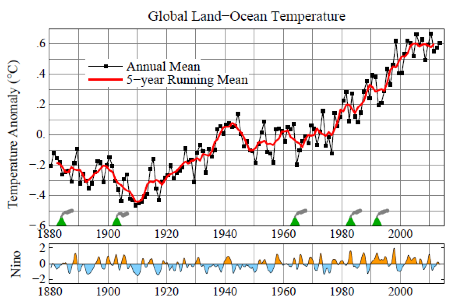
    Global surface temperatures relative to 1951-1980. The Niño index is based on sea surface temperature in the Niño 3.4 area (5N-5S, 120-170W) in the eastern tropical Pacific for 1951-1980 base period. Green triangles mark times of volcanic eruptions that produced an extensive stratospheric aerosol layer.

    It says 2013 was among the ten warmest years since modern records began in 1850, equalling 2007 as the sixth warmest year, with a global land and ocean surface temperature 0.50°C above the 1961–1990 average and 0.03°C higher than the most recent 2001–2010 average.

    Thirteen of the 14 warmest years on record have all occurred in this century. The warmest years on record are 2010 and 2005, with global temperatures about 0.55 °C above the long-term average, followed by 1998, which also had an exceptionally strong El Niño event.

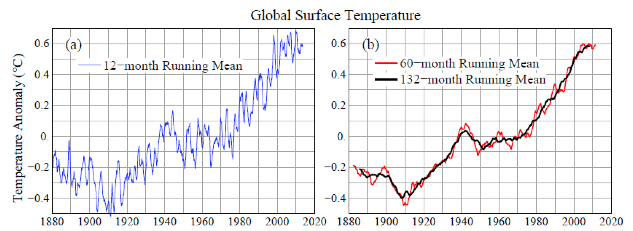
    Global surface temperature relative to 1951-1980 mean for (a) 12-month running mean, and (b) 5- year and 11- year running means

    El Niño events (which intensify warming) and cooling La Niñas are major drivers of natural climate variability. Neither occurred during 2013, which was warmer than 2011 or 2012, when La Niña exerted its cooling influence. 2013 was among the four warmest neutral years recorded, when neither El Niño nor La Niña affected temperatures.

    “The global temperature for the year 2013 is consistent with the long-term warming trend”, said WMO Secretary-General Michel Jarraud:

    The rate of warming is not uniform but the underlying trend is undeniable. Given the record amounts of greenhouse gases in our atmosphere, global temperatures will continue to rise for generations to come.
    Our action – or inaction – to curb emissions of carbon dioxide and other heat-trapping gases will shape the state of our planet for our children, grandchildren and great-grandchildren.

    Asked by Climate News Network how WMO regarded claims by some critics that there has been a “global warming standstill since 1997”, Mr Jarraud said: “Which standstill? The coldest year since 2001 is warmer than any year before 1998:

    Each decade is warmer than the previous one. There is global variability from year to year. You have to look at the longer period. If you do that, then the message is beyond any doubt…Despite the fact that there was no El Niño in 2013, it was still the sixth warmest year. This is significant.

    The WMO says surface temperature is just part of a much wider picture of climate change. “More than 90% of the excess heat being caused by human activities is being absorbed by the ocean”, it says.

    It has released the temperature data in advance of its full Statement on the Status of the Climate in 2013, to be published in March. This will give more details of regional temperatures and other indicators.

    Consistent findings

    In contrast with 2012, when the US in particular experienced record high annual temperatures, the warmth in 2013 was most extreme in Australia, which had its hottest year on record.

    WMO’s global temperature analysis is based mainly on three independent and complementary datasets. One is maintained by two UK centres, the Met Office Hadley Centre and the Climatic Research Unit at the University of East Anglia. The other two are based in the US: NOAA’s National Climatic Data Center, and the Goddard Institute for Space Studies (GISS), operated by NASA.

    Each dataset uses slightly different methods of calculation and so each gave 2013 a different temperature ranking, but they were consistent on the year-by-year changes and the longer warming trends globally.

    WMO also uses reanalysis-based data from the European Centre for Medium-Range Weather Forecasts (ECMWF), which showed annual global land and ocean temperature to be the fourth highest on record.

  • How we can beat this terrible news for the Reef GET-UP

    2 of 35
    Why this ad?
    Landscape Garden Edgingwww.kwikkerb.net.au/Garden-Edging – Make Your Garden Look Amazing. Call Us For Free Onsite Quote!

    How we can beat this terrible news for the Reef

    Inbox
    x
    GetUp!
    7:10 PM (1 hour ago)

    to me
    The legal fighting fund for the Reef is up! An incredible 10,000 GetUp members have donated in just days. 5 million tonnes of dredge spoil has been approved for dumping in World Heritage Area Reef waters, but together our donations are funding legal challenges against the project – and fueling explosive local campaigning too. Will you be part of the citizen-funded fight to protect the Reef? https://www.getup.org.au/reef-legal-battle

    —–

    NEVILLE.

    It’s a terrible moment for the reef — but we have a plan.

    The Great Barrier Reef Marine Park Authority has caved to the pressure of the mining industry and the Federal Government. The agency charged with “the protection, wise use, understanding and enjoyment of the Great Barrier Reef in perpetuity” has allowed it to be sold out for short-term profits.

    Late yesterday, they granted a permit to dump five million tonnes of dredge spoil inside the Great Barrier Reef World Heritage Area.

    This destructive project is now allowed to go-ahead — unless we make a last ditch effort to challenge it in court. Click here to learn more, and help fund the legal challenge to save our Reef:

    https://www.getup.org.au/reef-legal-battle

    We’re not lawyers, but we’ve taken on big legal fights before — and won. In 2010, GetUp members challenged Howard-era electoral laws in the High Court. Together, and with the help of some of the best legal brains in the country, we stopped hundreds of thousands of Australians from losing their right to vote. Now we can step up again, this time to protect our Reef.

    Our lawyers will be the Environmental Defenders Office (EDO) of Queensland, an independent community law centre dedicated to public interest advocacy in environmental matters. They’ll be representing North Queensland Conservation Council. Both groups have got what it takes to tackle the project, but need the backing of GetUp members from right across Australia.

    It’s as if the Federal Government saw this fight coming. Just before Christmas, and without warning, they inexplicably cancelled $10 million in federal funding to EDOs nationwide. But they aren’t expecting people to fight back. Let’s unite, and gather the resources we need to use the full power of the law to protect our Reef. Click here to make it happen: https://www.getup.org.au/reef-legal-battle

    The best legal analysis says this case is strong, and we won’t be alone. Other environmental groups are planning to chip in as well.

    We all know legal battles can be long and expensive. If we can raise $80k together as GetUp members – that’s about 16,000 of us chipping in $5 or more — the project will be confident of covering the considerable legal fees involved in a long fight. That money pays for court fees, printing and overhead costs, and allowing expert witnesses to provide evidence.

    If we raise more than $80k together, we will use the extra to build our Reef Fighting Fund to power further campaigning, or for further legal costs.

    Can you chip in as little as $5 to kick off the all-in citizen-funded legal fight to protect our Great Barrier Reef?

    https://www.getup.org.au/reef-legal-battle

    The mining industry, the Abbott Government, Campbell Newman and everyone else with vested interests expect this decision will be a kick in the guts for the environment movement – something that will deflate us, put us in our place and mark the end of this campaign.

    They obviously don’t know us well enough.

    For everything you’ve done so far — thank you. Now here’s to our Reef and the fight ahead,

  • Our retirement nest eggs: Time to go fossil free! 350 ORG

    Why this ad?
    PhD in Managementtua.edu.au/Management_PhD – Study Online at Torrens University. Request Information Right Now!

    Our retirement nest eggs: Time to go fossil free!

    Inbox
    x
    Charlie Wood – 350.org Australia charlie@350.org
    7:41 PM (30 minutes ago)

    to me

    Dear friend,

    As the managers of our retirement nest-eggs, superannuation funds should be investing in the companies of the future.

    Sadly, most aren’t. In fact, 55% of the world’s pension money is invested in climate-exposed industries, while less than 2% is invested in clean energy. [1] The good news is that all of this money belongs to individuals like you and me. If each of us agitates our super funds to change or moves to a fossil free fund, think of the money we could leverage for climate solutions!

    In 2014, we’ll be supporting you to do just that – ramping up our pressure on Australia’s superannuation funds to stop investing in climate destruction and start investing in climate solutions. This will include a tool to help you rank your fund’s exposure to fossil fuels and pressure them to change or switch to a cleaner fund.

    As part of the campaign, we’ll be putting some extra pressure on the industry’s most fossil-loving funds. In 2014, that fund is UniSuper

    Watch and share this short informational video we made to learn more.

    With 435,000 members spread across 37 universities, UniSuper has more than 3 times the shareholdings of Australia’s universities combined, with over $1 billion invested in the fossil fuel industry. UniSuper’s top investments including some of the world’s largest fossil fuel companies, whose activities will turn the Great Barrier Reef into a dumping ground, forests into coal mines and the climate into a disaster zone.

    If you’re with UniSuper, click here to take action today!

    If that wasn’t troubling enough, most university employees can’t choose their super fund – they’re stuck with UniSuper. Although UniSuper offers a “socially responsible” option, it includes the same companies (including BHP, Woodside Petroleum and Rio Tinto) as their default option and their environmental fund is a high-risk option which invests exclusively in foreign-owned companies. So much for choice!

    We believe that everyone deserves to know and choose where their super is invested. We also believe that, as the stewards of our nest-eggs, superannuation funds like UniSuper should be investing in the companies of the future not companies whose business models assume climate change isn’t happening.

    If you agree, you can join a live webinar tomorrow – Thursday the 6th of February at 1pm AEST with UniSuper’s Chief Investment Officer to ask about UniSuper’s fossil fuel investments. Click here to register a question before the webinar.*

    And if you’re also a UniSuper member, click here to tell UniSuper that it’s time to go fossil free.

    Not a UniSuper member? Stay tuned for our super fund rating tool and action platform, which our elves are busily working on as we speak!

    Yours for a fossil-free future,

    Charlie, Blair, Aaron, Simon and Josh and the rest of the 350.org Australia team

    * You don’t have to be a UniSuper member to register a question


  • Greenland Glacier Races to Ocean at Record Speed

    A photo of the Jakobshavn Glacier.

    Chunks of ice litter the ocean in front of Greenland’s Jakobshavn glacier.

    PHOTOGRAPH BY PAUL SOUDERS

    Jane J. Lee

    National Geographic

    Published February 4, 2014

    A Greenland glacier named Jakobshavn Isbrae, which many believe spawned the iceberg that sank the Titanic, has hit record speeds in its race to the ocean. Some may be tempted to call it the king of the glacier world, but this speedy river of ice is nothing to crow about.

    A new study published February 3 in the journal Cryosphere finds that Jakobshavn’s averaged annual speed in 2012 and 2013 was nearly three times its rate in the 1990s. Its flow rate during the summer months was even faster.

    “We are now seeing summer speeds more than four times what they were in the 1990s on a glacier which at that time was believed to be one of the fastest, if not the fastest, glaciers in Greenland,” Ian Joughin, a researcher at the University of Washington in Seattle, told the BBC.

    In summer 2012, Jakobshavn reached speeds of about 150 feet (46 meters) per day.

    Other glaciers may periodically flow faster than Jakobshavn, but Greenland’s most well known glacier is the bellwether of climate change in the region and likely contributes more to sea-level rise than any other glacier in the Northern Hemisphere—as much as 4 percent of the global total, Joughin and his colleagues found in an earlier study. (Read about glacial meltdown in National Geographic magazine.)

    In Too Deep?

    When glaciers flow into the ocean, their floating edge, or terminus, slows the river of ice behind it. Where the terminus is grounded on the seafloor, it can act like a doorstop, slowing the glacier’s flow even further.

    As warming temperatures in Greenland cause the Jakobshavn glacier to retreat up a long fjord, however—shedding icebergs in the process—the depth of the seafloor directly beneath the terminus varies.

    In 2012 and 2013, the study authors say, the glacier’s terminus retreated over a trough in the fjord that is 4,265 feet (1,300 meters) deep. As ice flowed into this deeper terminus, they think, the glacier behind the terminus accelerated and thinned—much as taffy thins in the middle when it’s pulled from one end. The thinning in turn causes the glacier to melt faster. (See pictures of icebergs from James Balog’s Extreme Ice Survey project.)

    The Jakobshavn terminus now seems to be retreating up a hump in the seafloor, and that may slow the ice loss a bit in the coming years. But beyond that hump lies 30 miles (48 kilometers) of deep fjord.

    The researchers suggest that in the coming decades Jakobshavn’s speed could hit ten times that seen in the 1990s, slowing down only when the glacier has retreated to the head of the fjord.

    The good news, says Penn State glaciologist Richard Alley, who was not involved in the new study, is that “the scariest possibilities are not happening.” The Greenland ice sheet does not seem to be collapsing wholesale into the ocean over a timescale of years or decades.

    Nevertheless, Alley says, the changes detected by Joughin and his colleagues “are not good news for the ice sheet or for people living near sea level.”

    “As the retreat of Jakobshavn ‘unzips’ this part of Greenland to let the warm waters in along the fjord,” Alley says, it will allow more ice from the sides and the head of the glacier to fall into the sea. If other fjords around Greenland follow suit, he explains, the country’s glaciers could accelerate sea-level rise.