Author: Neville

  • Heat-related deaths will rise 257% by 2050 because of climate change

    Heat-related deaths will rise 257% by 2050 because of climate change

    Number of heat-related deaths projected to increase in UK as temperature rise, with elderly people most at risk

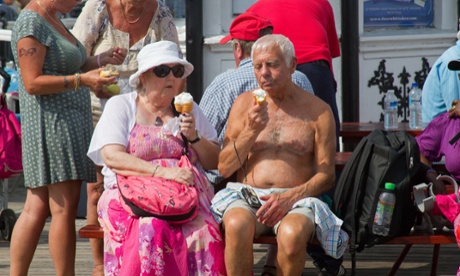
    An elderly couple enjoy an ice cream on Brighton Pier in the summer heatwave of 2013. Heat-related deaths are expected to rise by 2050, as global warming causes temperatures to rise
    An elderly couple enjoy an ice cream on Brighton Pier in the summer heatwave of 2013. Heat-related deaths are expected to rise by 2050, as global warming causes temperatures to rise Photograph: Keith Larby/Demotix/Corbis

    Deaths as a result of hot weather are to soar over the next four decades as a result of climate change, researchers have predicted.

    The number of annual deaths in the UK that occur as a result of the heat will rise by 257% by 2050, they said. Elderly people are most at risk, according to the new study.

    While the number of excess deaths seen in the summer months will rise, those recorded in winter will actually decrease, they said.

    Researchers wanted to try to determine the effect that climate change will have on temperature-related deaths in the coming decades. Their study, published in the Journal of Epidemiology and Community Health, examined fluctuations in weather patterns and death rates between 1993 and 2006 to characterise the associations between temperature and mortality.

    The researchers, from Public Health England (PHE) and the London School of Hygiene and Tropical Medicine, then looked at projected population and climate increases so they could estimate temperature-related deaths for the UK in coming decades.

    Researchers noted a 2.1% increase in the number of deaths for every 1C rise in the mercury and a 2% increase in mortality for every 1C drop in temperature. The number of hot weather days is projected to rise steeply, tripling by 2080, they said. Meanwhile the number of cold days is expected to fall, though at a less dramatic pace.

    At present there are around 41,000 winter-related deaths and 2,000 excess summer deaths.

    The authors predicted that without adaptation, the number of heat-related deaths will increase by 66% in the 2020s, 257% by the 2050s and 535% by the 2080s. Cold weather-related deaths will increase by 3% in the 2020s, then decrease by 2% in the 2050s and by 12% in the 2080s, they added.

    This means by 2080 there will be around 12,500 heat-related deaths and 36,500 cold-related deaths.

    The authors said that the burden of extreme weather remains such higher in those over the age of 75, particularly in the over-85s.

    At present there are regional variations in excess temperature-related deaths and these are likely to persist, they added. The south and the Midlands are the regions most vulnerable to heat while Wales, the north west, the east of England and the south are most vulnerable to the cold.

    “The most direct way in which climate change is expected to affect public health relates to changes in mortality rates associated with ambient temperature,” they wrote. “In the UK, thousands of preventable deaths occur naturally from cold weather and a smaller burden is also associated with hot weather. Future changes in climate are likely to lead not only to an increase in heat-related deaths in the UK, but also a proportionally smaller decrease in cold-related deaths.”

    They added: “Our results indicate that health protection from hot weather will become increasingly necessary this century, and measures to reduce cold impacts will also remain important. Air conditioning is likely to become more widely used in the UK, which will reduce heat vulnerability. However, the distribution of cooling systems may reflect socio-economic inequalities unless they are heavily subsidised, and rising fuel costs may exacerbate this.”

    Dr Sotiris Vardoulakis, head of the PHE’s air pollution and climate change group and co-author of the paper, said: “During periods of warmer weather higher temperatures can lead to greater-than-usual stress on the body caused by heat and higher levels of air pollution, which can aggravate the symptoms of those with chronic conditions, such as cardiovascular and respiratory conditions.”

    “This paper has again pointed to the anticipated growth of the UK’s elderly population, broadly the most at-risk group from the effects of heat, and again states that because the UK elderly population will grow over the coming years, it will be even more important to plan how the country will cope with forthcoming temperature rises.”

    David Spiegelhalter, professor of the public understanding of risk at the University of Cambridge, said: “It seems clear from this analysis that the reduction in cold-related deaths per 100,000 people in each age group easily outweighs the projected increase in the heat-related death rate.”

    “So, were the population make-up to stay the same into the 2080s, temperature-related deaths would actually fall. “Therefore it would be more accurate to say that increased number of future temperature-related deaths was wholly driven by projected population growth and ageing.”

    Green light

    close

    Sign up for the Green light email

    The most important environment stories each week including data, opinion pieces and guides.

    Sign up for the Green light email

  • Macrosystems ecology: New scientific field looks at the big picture

    Featured Research

    from universities, journals, and other organizations

    Macrosystems ecology: New scientific field looks at the big picture

    Date:
    February 3, 2014
    Source:
    Michigan State University
    Summary:
    Big data is changing the field of ecology. The shift is dramatic enough to warrant the creation of an entirely new field: macrosystems ecology. “Ecologists can no longer sample and study just one or even a handful of ecosystems,” said author and macrosystems ecology pioneer.

    Big data is changing the field of ecology. The shift is dramatic enough to warrant the creation of an entirely new field: macrosystems ecology.

    “Ecologists can no longer sample and study just one or even a handful of ecosystems,” said Patricia Soranno, Michigan State University professor of fisheries and wildlife and macrosystems ecology pioneer. “We also need to study lots of ecosystems and use lots of data to tackle many environmental problems such as climate change, land-use change and invasive species, because such problems exist at a larger scale than many problems from the past.”

    To define the new field and provide strategies for ecologists to do this type of research, Soranno and Dave Schimel from the California Institute of Technology’s Jet Propulsion Lab co-edited a special issue of the Ecological Society of America’s journal Frontiers in Ecology and the Environment.

    They worked with many other researchers, funded from the National Science Foundation’s MacroSystems Biology program, who have written nine papers showing the advantages of taking such an approach to solve many environmental problems. Data-intensive science is being touted as a new way to do science of any kind, and many researchers think it has great potential for ecology, Soranno said.

    “Traditionally, ecologists are trained by studying and taking samples from the field in places like forests, grasslands, wetlands or water and measuring things in the lab,” she said. “In the future, at least some ecologists will need to also be trained in advanced computational methods that will allow them to study complex systems using big datasets at this large scale and to help integrate fine and broad-scale studies into a richer understanding of environmental problems.”

    Ecologists have many decades of accumulated data to which to apply this new perspective. The sources include, many small, individual projects from university researchers, government agencies that have been monitoring natural resources for decades, terabytes of data collected from new or existing field sensors and observation networks, as well as millions of high-definition satellite images, just to name a few.

    Paired with the near-endless data deluge is easy access to supercomputers. Analysis that once took months or years to complete can now be conducted in hours or days. Ecologists also have access to the latest statistical modeling and geographic information system tools.

    “Even ten years ago, it would have been much harder to take this approach,” Soranno said. “We didn’t have the wonderful intersection that we have today of great tools, volumes of data, sufficient computing power and a better developed understanding of systems at broad scales.”

    A significant part of these new approaches involves the integration of biology with other fields, involving scientific, engineering and education areas across NSF, said John Wingfield, NSF assistant director for biological sciences The makeup of newly minted macrosystems ecology research teams should reflect the new demands of data-intensive ecology. Teams should include database managers, data-mining experts, GIS professionals and more.

    “An important question we’re facing right now is whether ecologists will be the leaders in solving many of today’s top environmental problems that need a broad-scale approach,” Soranno said. “Seeing the research that has been done to date by macrosystems ecologists already doing this work and reading the papers that make up this issue, the answer is an emphatic ‘yes’,” Soranno said.


    Story Source:

    The above story is based on materials provided by Michigan State University. Note: Materials may be edited for content and length.


    Journal Reference:

    1. James B Heffernan, Patricia A Soranno, Michael J Angilletta, Lauren B Buckley, Daniel S Gruner, Tim H Keitt, James R Kellner, John S Kominoski, Adrian V Rocha, Jingfeng Xiao, Tamara K Harms, Simon J Goring, Lauren E Koenig, William H McDowell, Heather Powell, Andrew D Richardson, Craig A Stow, Rodrigo Vargas, Kathleen C Weathers. Macrosystems ecology: understanding ecological patterns and processes at continental scales. Frontiers in Ecology and the Environment, 2014; 12 (1): 5 DOI: 10.1890/130017

    Cite This Page:

    Michigan State University. “Macrosystems ecology: New scientific field looks at the big picture.” ScienceDaily. ScienceDaily, 3 February 2014. <www.sciencedaily.com/releases/2014/02/140203122829.htm>.

    Related Topics


    Related Articles


  • Adapting to sea level rise could save trillions

    Adapting to sea level rise could save trillions

    By on 4 February 2014
    Print Friendly

    Climate Central

    Floods already pose major problems for coastal communities each year. Those issues are only likely to grow as oceans continue to rise, due in part to climate change, threatening millions of people and trillions of dollars in infrastructure. But new research suggests that building levees could stave off huge losses at a minimal cost.

    Coasts are home to more than 1 billion people across the globe and up 310 million of those live in a 100-year floodplain. In addition, $11 trillion in assets also sit below the 100-year flood mark.

    The slow creep of sea level rise is putting more and more of these people and assets at risk. Since the start of the 20th century, sea levels have risen roughly 8 inches. That number is also expected to increase into the next century as ocean waters warm and expand and more water is added from melting glaciers.

    A new study in the Proceedings of the National Academy of Sciences on Monday projects sea levels could rise from 9 to 48 inches by 2100. The wide range of uncertainty is due to the Antarctic and Greenland ice sheets, which appear fairly stable but if they were to start melting, could contribute as much as 25 inches to sea level rise.

    The study projects that even with conservative economic and population growth, $17 trillion in coastal assets could be sitting below the 100-year flood level by 2100. In a wealthier, more populous world, that number would balloon to $210 trillion.

    While these factors have been considered individually in previous studies, this is the first time sea levels, including contributions for the Greenland and Antarctic ice sheets, have been modeled in relation to both population growth and coastal development over the course of the 21st century. The results show that unless something is done, coastal flood could cause catastrophic losses every year.

    “If we don’t adapt to sea level rise, the consequences will be quite dramatic through the 21st century. Up to 5-10 percent of global GDP will be damaged in 2100 on a yearly basis,” Jochen Hinkel, a senior researcher at the Global Climate Forum, said in an interview.

    In the high-development, high-sea level rise scenario that translate to nearly $19 trillion in losses annually. In comparison, the entire U.S. GDP in 2012 was $15.68 trillion.

    Levees offer a simple defense against flooding. The new research estimates that it would cost $12-71 billion a year to build levees high enough to keep pace with rising seas.

    Though flooding would still cause damages just as it does today, Hinkel said it would be a fraction of the cost.

    “It’s a very ambitious project they’ve taken on and it’s a good attempt to address something of importance,” said Bob Kopp, a Rutgers University climate scientist not affiliated with the study. “They don’t account for all of the local factors so the details of the picture are going to get a little grainy if you zoom into a global model.”

    Those missing details could reduce some of the benefits of levees while also increasing the costs of flooding.

    Land is sinking in coastal areas due to groundwater use and oil and gas extraction could leave certain areas such as the Gulf Coast facing greater costs for flood protection. In addition, changes in tropical cyclone activity due to climate change and other natural fluctuations were not considered.

    Large storms have the potential to top barriers and cause catastrophic damage and loss of life. Hurricane Katrina caused $125 billion losses with much of that in New Orleans where levees were unable to keep back the storm surge.

    Kopp said that illusion of safety could actually increase the potential for even more devastating losses in the future.

    “If you build dikes, people feel safe and move into the exposed area and that increases the amount of infrastructure,” he said. “If your dikes slip up, you increase your losses even more.”

    The overall cost of protecting coasts could go up or down depending on other adaptation measures as well. Though the study only examined levees, other coastal flood protections range from restoring wetlands and beaches, which in some cases are a more affordable alternative, to building more costly large barriers that can be opened and closed like those located on the Thames near London and outside Rotterdam in the Netherlands.

    In New York, discussions are ongoing about the proper amount of protection needed in the wake of Sandy. Levees, wetlands, sea walls, and mechanical barriers as well as softer adaptation options like stronger coastal permitting and improved flood evacuation maps have all been considered as part of the city’s sustainability plan.

    Despite these obstacles, Hinkel said protecting coasts should not be viewed as a challenge.

    “The research shows that there is an opportunity in acting,” he said. “We have looked at the fuller picture, but there’s a lot of work that needs to be done to look at local decisions that need to be taken.”

    Kopp agreed, saying that the geographical, social, and economic details in each community will ultimately inform the actions needed to be taken to protect against rising seas.


  • Nature can, selectively, buffer human-caused global warming, say scientists

    Featured Research

    from universities, journals, and other organizations

    Nature can, selectively, buffer human-caused global warming, say scientists

    Date:
    February 2, 2014
    Source:
    Hebrew University of Jerusalem
    Summary:
    Can naturally occurring processes selectively buffer the full brunt of global warming caused by greenhouse gas emissions resulting from human activities? Yes, says a group of researchers in a new study.

    As the globe warms, ocean temperatures rise, leading to increased water vapor escaping into the atmosphere. Water vapor is the most important greenhouse gas, and its impact on climate is amplified in the stratosphere.
    Credit: © magann / Fotolia

    Can naturally occurring processes selectively buffer the full brunt of global warming caused by greenhouse gas emissions resulting from human activities?

    Share
    0

    Yes, find researchers from the Hebrew University of Jerusalem, Johns Hopkins University in the US and NASA’s Goddard Space Flight Center.

    As the globe warms, ocean temperatures rise, leading to increased water vapor escaping into the atmosphere. Water vapor is the most important greenhouse gas, and its impact on climate is amplified in the stratosphere.

    In a detailed study, the researchers from the three institutions examined the causes of changes in the temperatures and water vapor in the tropical tropopause layer (TTL). The TTL is a critical region of our atmosphere with characteristics of both the troposphere below and the stratosphere above.

    The TTL can have significant influences on both atmospheric chemistry and climate, as its temperature determines how much water vapor can enter the stratosphere. Therefore, understanding any changes in the temperature of the TTL and what might be causing them is an important scientific question of significant societal relevance, say the researchers.

    The Israeli and US scientists used measurements from satellite observations and output from chemistry-climate models to understand recent temperature trends in the TTL. Temperature measurements show where significant changes have taken place since 1979.

    The satellite observations have shown that warming of the tropical Indian Ocean and tropical Western Pacific Ocean — with resulting increased precipitation and water vapor there — causes the opposite effect of cooling in the TTL region above the warming sea surface. Once the TTL cools, less water vapor is present in the TTL and also above in the stratosphere.

    Since water vapor is a very strong greenhouse gas, this effect leads to a negative feedback on climate change. That is, the increase in water vapor due to enhanced evaporation from the warming oceans is confined to the near- surface area, while the stratosphere becomes drier. Hence, this effect may actually slightly weaken the more dire forecasted aspects of an increasing warming of our climate, the scientists say.

    The researchers are Dr. Chaim Garfinkel of the Fredy and Nadine Herrmann Institute of Earth Sciences at the Hebrew University and formerly of Johns Hopkins University, Dr. D. W. Waugh and Dr. L. Wang of Johns Hopkins, and Dr. L. D. Oman and Dr. M. M. Hurwitz of the Goddard Space Flight Center. Their findings have been published in the Journal of Geophysical Research: Atmospheres, and the research was also highlighted in Nature Climate Change.


    Story Source:

    The above story is based on materials provided by Hebrew University of Jerusalem. Note: Materials may be edited for content and length.


    Journal References:

    1. C. I. Garfinkel, D. W. Waugh, L. D. Oman, L. Wang, M. M. Hurwitz. Temperature trends in the tropical upper troposphere and lower stratosphere: Connections with sea surface temperatures and implications for water vapor and ozone. Journal of Geophysical Research: Atmospheres, 2013; 118 (17): 9658 DOI: 10.1002/jgrd.50772
    2. Qiang Fu. Ocean–atmosphere interactions: Bottom up in the tropics. Nature Climate Change, 2013; 3 (11): 957 DOI: 10.1038/nclimate2039

    Cite This Page:

    Hebrew University of Jerusalem. “Nature can, selectively, buffer human-caused global warming, say scientists.” ScienceDaily. ScienceDaily, 2 February 2014. <www.sciencedaily.com/releases/2014/02/140202111055.htm>.

  • Code Red’s most popular climate posts

    Courtesy of David Spratt
    Why this ad?
    Need Legal Representationwww.hcdlaw.com.au – Ensure you are prepared for Court. Experienced lawyer for best outcome

    climate code red

    Inbox
    x
    Climate Code Red noreply@blogger.com via google.com
    8:15 PM (35 minutes ago)

    to me

    climate code red


    Code Red’s most popular climate postsPosted: 02 Feb 2014 12:53 PM PST

    Here’s the pick of the crop: our most popular posts over the last three years, starting with the most read.

    The state of the Australian climate movement as Labor falters and the conservatives gain ascendancy in mid-2012, some harsh realities and ways forward.

    Arctic sea-ice melt record more than broken, it’s being smashed
    The extraordinary events of the 2012 northern summer and their consequences.

    Brightsiding is a bad strategy (5 parts)
    Why all “good news” and no “bad news” is a bad climate action and communications strategy?

    What would 3 degrees mean?
    The astounding global impacts of 2, 3 and 4 degrees of warming.

    Pine Island glacier loss must force another look at sea-level rises
    The most vulnerable glacier in the Antarctic teaches valuable lessons about future rates of ice mass loss.

    Big call: Cambridge prof. predicts Arctic summer sea ice “all gone by 2015”
    The real possibilities of fast methane clathrate releases in the Arctic, from Prof. Peter Wadhams.

    Scientists call for war on climate change, but who on earth is listening 
    When it’s too late for half measures, the only option is to be really honest.

    Dramatic lessons from the Arctic big melt of 2012: It’s already dangerous
    “Dangerous” climate change is still to come?   Not any more.

    Rethinking a “safe climate”: have we already gone too far?
    The notion that 1.5C of warming is a safe target is out the window, and even 1C looks like an unacceptably high risk.

    Connecting the dots between ‘Frankenstorm’ and global warming
    Superstorm Sandy’s intensity was driven in part by Arctic warming destabilisation of the Jet Stream.

    Is climate change already dangerous? (5 parts)
    The aims of international climate negotiations and of the global climate action movement are to “prevent” dangerous climate change. But what do we do if global warming is already dangerous?

    The astounding global warming impact on our oceans that will reduce cloud cover and bring tears to your eyes
    Ocean acidification will just not kill significant ocean ecosystems, but add even more to global warming.

    4 degrees hotter: an adaptation trap?
    There is much discussion about adaptation to 4 degrees of warming, but what if that is a delusion?

    Triggering permafrost meltdown is closer than we think
    Current levels of atmospheric carbon dioxide are probably sufficient to trigger large-scale permafrost carbon feedbacks and global warming that human effort would be unable to contain. 

    Global fossil fuel subsidies in 5 unforgettable graphs
    A picture is worth a thousand words. So is a good graph!

    Arctic warning: As the system changes, we must adjust our science
    When the reality on the grounds exceeds the scientific predictions, it’s time to review the science. 

    Faustian bargain revisited: study finds zeroed emissions will add 0.25-0.5C of warming as aerosol cooling is lost
    Burning fossil fuels also adds sulphates to the atmosphere which have a very short-term cooling effect. What happens when we reduce emissions?

    The real climate message is in the shadows. It’s time to shine
    It time to take a critical look at climate change messaging to date, and adopt a human-centred communication that acknowledges the threats, demonstrates agency and inspires empathy. 

    Australian coal’s expansion plans make a mockery of government’s carbon tax claims 

    Emissions from proposed new Australian coal and gas exports dwarf reductions in emissions proposed by the major political parties

    Professor Kevin Anderson – Climate change: Going beyond dangerous
    What we need to do to avoid dangerous climate change may be very different from the commonly held view.

    Why emissions need to drop off a cliff
    The real science of necessary emissions reduction, and the political consequences, are not ones that we will likely hear from any of the major players in the climate policy debate.

  • The world’s most sustainable company?

    1 of 37
    Why this ad?
    Hockey Medals for Lesswww.expressmedals.com/Hockey – Max Shipping Rate of $5.99 for USA Most Medals are Under $2 w/Ribbon

    The world’s most sustainable company?

    Inbox
    x
    Charlie Wood – 350.org Australia charlie@350.org
    1:58 PM (2 hours ago)

    to me

    Dear friend,

    Despite its multi-million dollar lending to the fossil fuel industry, Westpac was recently named the world’s most sustainable company. If you’re a Westpac customer, we need your help to tell Westpac that there’s nothing sustainable about funding fossil fuels.

    As we speak, the fossil fuel industry is working harder than ever to unveil dozens of damaging new projects across our beautiful country. Indeed, just last week, we saw the Great Barrier Reef Marine Park Authority give the industry the green light to dump 3 million cubic tonnes of dredge spoil from expanded coal operations right in the middle of the Reef.

    With coal prices plummeting, the climate warming and people like you taking action to expose these damaging practices, the industry knows that time isn’t on their side.

    That’s why, in 2014, the fossil fuel industry will be mounting a massive fight to get a raft of new expansion projects off the ground – before it’s too late. And they’ll be turning to supporters like Westpac to help them out.

    Fossil fuel companies know they can rely on “the world’s most sustainable company” to lend them a hand. Since 2008 Westpac has loaned over $1.1 billion, to new coal and gas export projects along Australia’s eastern seaboard, many within the Great Barrier Reef. Westpac is also one of a handful of lenders to Whitehaven’s Maules Creek coal mine in Leard State Forest, a mine that will destroy over 544 hectares of critically endangered forest, dump thousands of tonnes of coal dust onto surrounding communities and release emissions equivalent to New Zealand’s entire energy sector.

    But if you’re a Westpac customer, you can help to change this. This year, we’ll be working harder than ever to show the big banks that fossil fuels are not only bad for the climate, environment and communities – they’re bad for business. We’ll support thousands of customers to move their money out of banks like Westpac and into banks that don’t lend to coal and gas projects.* But we need your help.

    After a series of successful ANZ and Commonwealth divestment activities last year, it’s Westpac’s turn. On March the 8th, together with our friends at Market Forces, we’ll support dozens of Westpac customers in Melbourne and Sydney to publicly close their accounts in protest over the bank’s support of the fossil fuel industry.

    Click here to join a Westpac divestment action today!

    Once you register, we’ll support you every step of the way with helpful materials and a list of banks that don’t fund fossil fuels. You’ll be surprised by how easy the process of going fossil free actually is!

    I hope you will join us on the 8th of March as we take a stand for the climate and use our money for good.

    Yours for the climate,

    Charlie on behalf of 350.org Australia

    *The following banks claim to be fossil free banks: Bendigo, Bank MECU, Beyond Bank, Members Equity Bank, Defence Bank and People’s Choice Credit Union