Author: Neville

  • The must-know economic currents that affect dry bulk shippers (Part 1)

    Are dry bulk shippers braving favorable economic waters?

    The must-know economic currents that affect dry bulk shippers (Part 1)

    By Xun Yao ChenDisclosure • Jan 10, 2014 1:44 pm •  Tweet  Share

     Email  Print

    Economy: The ocean

    As our must-read guide to investing in dry bulk shippers discusses, the global economy—China’s in particular—has a large influence over dry bulk shippers’ outlook. The economy is like the ocean, and the industries are the fish. No matter how fast and powerful the fish are, it’s no easy task to overcome ocean tides and currents.

    Sensitivity to economyEnlarge Graph

    Riding the economic wave

    Some fish benefit from ocean currents against them. For example, trout will swim against the flow of the water so they can capture food like insects, worms, or plankton coming their way. But dry bulk shippers aren’t trout—they ride with the tide. This means investors who are invested in dry bulk shippers or are thinking of investing in dry bulk shippers must be able to read the ocean current—the economy.

    There are several indicators that investors can use to get a sense of how the world and China’s economy are performing, rather than just relying on news headlines—which are full of noise. If investors focus on important indicators, they’re less likely to be swayed by emotions or others’ opinions and to make bad decisions. You just need to do some thinking and not make big mistakes in order to do well in life.

    What are these indicators?

    In this series, we’ll cover several indicators that help investors understand what the global economic situation is like. To do this, we’ve drawn on the knowledge of experts, economists, analysts, and money managers. These include the manufacturing PMI, industrial and electricity output, real estate construction, sales and investment activities, fuel consumption, the OECD’s leading index, and the inflation rate.

    These indicators may sound simple, but keeping topics simple tends to work better in life. As Confucius says, “Life is really simple, but we insist on making it complicated.”

    Continue to Part 2: Why Chinese purchasing managers’ views affect the dry bulk trade

    3448 people are subscribed to Market Realist newsletters.

    Get our Marine Shipping newsletter

  • Astronauts on the ISS are experimenting with a form of water that has a strange property:

    NASA Science News <noreply@nasascience.org>
    7:09 AM (2 hours ago)

    to NASA

    NASA Science News for Jan. 10, 2014

    Astronauts on the ISS are experimenting with a form of water that has a strange property: it can help start fire. This fundamental physics investigation could have down-to-Earth benefits such as clean-burning municipal waste disposal and improved saltwater purification.

    VIDEO: http://www.youtube.com/watch?v=TysrIYJOlpk

    FULL STORY: http://science.nasa.gov/science-news/science-at-nasa/2014/10jan_firewater/

  • Global Chimneys in the Pacific

    Skip top navigation and go to page navigation

    National Science Foundation

    News
    design element
    News
    News From the Field
    For the News Media
    Special Reports
    Research Overviews
    NSF-Wide Investments
    Speeches & Lectures
    NSF Current Newsletter
    Multimedia Gallery
    News Archive
    News by Research Area
    Arctic & Antarctic
    Astronomy & Space
    Biology
    Chemistry & Materials
    Computing
    Earth & Environment
    Education
    Engineering
    Mathematics
    Nanoscience
    People & Society
    Physics
    Email this pagePrint this page

    Press Release 14-003
    Scientists to study Pacific Ocean’s “global chimney”
    Remote waters affect billions of people, shape climate and air chemistry worldwide

    CONTRAST logoScientists working on the CONTRAST project will be in the field this month and next.
    Credit and Larger Version

    January 7, 2014

    Although few people live in the Western tropical Pacific Ocean region, the remote waters there affect billions of people by shaping climate and air chemistry worldwide.

    Next week, scientists will head to the region to better understand its influence on the atmosphere–including how that influence may change in coming decades if storms over the Pacific become more powerful with rising global temperatures.

    With the warmest ocean waters on Earth, the Western tropical Pacific fuels a sort of chimney whose output has global reach.

    The region feeds heat and moisture into huge clusters of thunderstorms that loft gases and particles into the stratosphere, where they spread out over the entire planet and influence climate.

    “To figure out the future of the air above our heads, we need to go to the western Pacific,” said Laura Pan, a scientist at the National Center for Atmospheric Research (NCAR) and one of the principal investigators on the field project.

    “This region has been called the holy grail for understanding global air transport, because so much surface air gets lifted by the storms and then spreads globally.”

    The field project is called CONTRAST (Convective Transport of Active Species in the Tropics). It is funded by the National Science Foundation (NSF), which sponsors NCAR.

    More than 40 scientists are taking part from NCAR, the University of Maryland, the University of Miami, other universities across the country and NASA.

    CONTRAST, which is based in Guam, is being coordinated with two other field projects in order to give researchers a detailed view of the air masses over the Pacific with a vertical range spanning tens of thousands of feet.

    One of these projects, NASA’s Airborne Tropical Tropopause Experiment (ATTREX), will use a Global Hawk robotic aerial vehicle to study upper-atmospheric water vapor, which influences global climate.

    The other, CAST (Coordinated Airborne Studies in the Tropics), is funded by Britain’s Natural Environment Research Council Facility and will deploy a BAe146 research aircraft that will focus on air near the ocean surface.

    Together, the sensor-laden research flights will provide a comprehensive view of the atmosphere from the ocean surface, where gases produced by marine organisms enter the air, to the stratosphere, more than 60,000 feet above.

    “It’s a huge region, and that means we have to use multiple aircraft,” said University of Maryland’s Ross Salawitch, a CONTRAST principal investigator.

    “We will attempt to stage these three airplanes in harmony to measure the atmospheric composition over the western Pacific when both ocean biology and atmospheric storms are raging.”

    As trade winds blow across the tropical Pacific, they push warm water to the west, where it piles up in and near the CONTRAST study region.

    The waters around Guam have the world’s highest sea surface temperatures in open oceans. They provide heat and moisture to feed clusters of thunderstorms that lift air through the troposphere (the lowest level of the atmosphere) and the tropopause (a cold, shallow region atop the troposphere) and then up into the stratosphere.

    Once in the stratosphere–where the air tends to flow horizontally–the gases and particles spread out around the world and linger for years or even decades.

    Some of the gases, such as ozone and water vapor, affect the amount of energy from the sun that reaches Earth’s surface.

    “Research results from CONTRAST will be extremely important for understanding the ozone-depleting effects of certain chemicals, such as short-lived halogen species like those containing chlorine and bromine, in the tropical upper troposphere and lower stratosphere,” said Sylvia Edgerton, program director in NSF’s Division of Atmospheric and Geospace Sciences.

    “It appears that high particle concentrations in the tropical tropopause can increase the ozone-depleting potential of short-lived halogens in the region,” said Edgerton.

    The amount of these gases in the stratosphere is important for the planet’s climate.

    Chemicals such as bromine compounds have indirect effects by destroying ozone or otherwise altering the chemistry of the stratosphere. And the gases produced by ocean organisms create a chemical reaction that can be detected in the stratosphere.

    “There are so few measurements of atmospheric composition in this important region of the atmosphere that we expect to be able to significantly advance our understanding with the data we will be able to collect during CONTRAST,” said Elliot Atlas of the University of Miami, a CONTRAST principal investigator.

    As atmospheric patterns evolve and sea surface temperatures warm further due to climate change, the storm clusters over the Pacific are likely to influence climate in ways that are now challenging to anticipate, NCAR’s Pan said.

    “Understanding the impact of these storms will help us gain ground truth for improving the chemistry-climate models we use to project future climate,” she said.

    The CONTRAST team will deploy the NSF/NCAR HIAPER aircraft, a Gulfstream V jet modified for advanced research that will fly at altitudes between about 25,000 and 50,000 feet.

    Using spectrometers and other instruments on board, the researchers will measure various chemicals and take air samples across a wide region, both in storm clouds and far away from them.

    The measurements will be analyzed in conjunction with data from the ATTREX Global Hawk (covering altitudes up to 65,000 feet) and CAST BAe146 (with observations from the ocean surface to about 20,000 feet).

    The researchers are planning as many as 16 flights, targeting both towering storms that loft fresh air into the stratosphere as well as collapsed storms to examine the composition of the air that remains lower down, in the troposphere.

    State-of-the-art models of atmospheric chemistry will help guide the research flights in the field, as well as aid in subsequent analysis of the observations.

    -NSF-

    Media Contacts
    Cheryl Dybas, NSF, (703) 292-7734, cdybas@nsf.gov
    David Hosansky, NCAR, (303) 497-8611, hosansky@ucar.edu

    Related Websites
    NSF Award: Photochemical Modeling in Support of CONTRAST (CONvective TRansport of Active Species in the Tropics): http://www.nsf.gov/awardsearch/showAward?AWD_ID=1261657&HistoricalAwards=false
    CONTRAST Project: http://www2.acd.ucar.edu/contrast

    The National Science Foundation (NSF) is an independent federal agency that supports fundamental research and education across all fields of science and engineering. In fiscal year (FY) 2012, its budget was $7.0 billion. NSF funds reach all 50 states through grants to nearly 2,000 colleges, universities and other institutions. Each year, NSF receives about 50,000 competitive requests for funding, and makes about 11,500 new funding awards. NSF also awards about $593 million in professional and s

  • Heatwaves in Australia

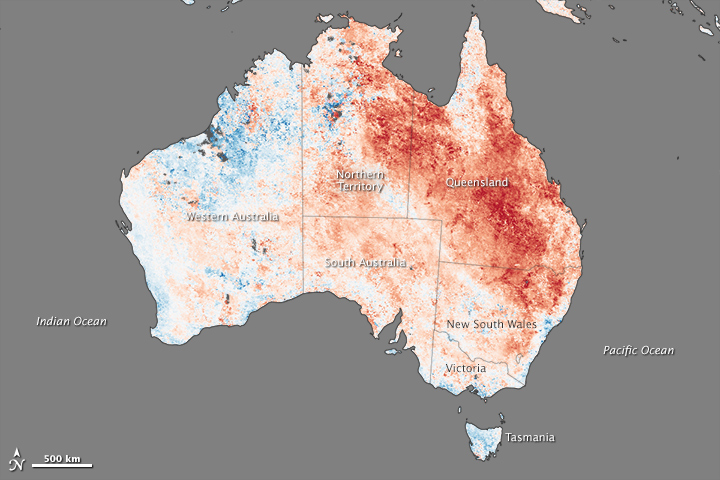
    Heat Wave Stifles Australia

    acquired December 27, 2013 – January 3, 2014
    Color bar for Heat Wave Stifles Australia

    2013 turned out to be Australia’s hottest year on record. Fittingly, the year both started and ended with intense heatwaves. The most recent heatwave peaked between December 27, 2013, and January 4, 2014. It was much shorter than the heatwave that began 2013, though it was more intense. Nearly 9 percent of Australia experienced record-breaking temperatures between January 1–4, 2014.

    The heat baked the earth, raising the land surface temperatures (LSTs) monitored by the Moderate Resolution Imaging Spectroradiometer (MODIS) on NASA’s Terra satellite. Dark red dominates this image, indicating that temperatures were significantly higher than average between December 27 and January 3, especially in Queensland and New South Wales. LSTs reflect how warm the ground would be to the touch, a measurement related to but not the same as more standard air temperatures.

    The final day included in the image, January 3, was the hottest day of the heatwave for most places, with 10.2 percent of Queensland and 14.6 percent of New South Wales setting new heat records. The highest air temperature recorded during the week was in Moomba, Queensland, which reached 49.3 degrees Celsius (120.7 degrees Fahrenheit) on January 2. Temperatures reached 48 degrees Celsius (118 Fahrenheit) or higher at 12 locations throughout Australia during the heatwave.

    1. Reference

    2. Australian Government Bureau of Meteorology (2013, January 6) Special climate statement 47 – an intense heatwave in central and eastern Australia. Accessed January 7, 2014.

    NASA Earth Observatory image by Jesse Allen, using data from the Level 1 and Atmospheres Active Distribution System

  • Steam fog streaming from the Great Lakes

    Steam Fog over the Great Lakes

    acquired January 6, 2014 download large image (5 MB, JPEG, 8000×6000)
    acquired January 6, 2014 download GeoTIFF file (69 MB, TIFF)
    Steam Fog over the Great Lakes

    acquired January 6, 2014 download large image (2 MB, JPEG, 2002×1502)
    acquired January 6, 2014 download GeoTIFF file (6 MB, TIFF)

    A swirling mass of Arctic air moved south into the continental United States in early January 2014. On January 3, the air mass began breaking off from the polar vortex, a semi-permanent low-pressure system with a center around Canada’s Baffin Island. The frigid air was pushed south into the Great Lakes region by the jet stream, bringing abnormally cold temperatures to many parts of Canada and the central and eastern United States.

    When the cold air passed over the relatively warm waters of Lake Michigan and Lake Superior, the contrast in temperatures created a visual spectacle. As cold, dry air moved over the lakes, it mixed with warmer, moister air rising off the lake surfaces, transforming the water vapor into fog—a phenomenon known as steam fog.

    On January 6, 2014, the Moderate Resolution Imaging Spectroradiometer MODIS on NASA’s Terra satellite captured this natural-color image (top) of fog forming over the lakes and streaming southeast with the wind. A false-color image (bottom) produced with data from the same instrument helps illustrate the difference between snow (bright orange), water clouds (white), and mixed clouds (peach). Water clouds are formed entirely by liquid water drops; mixed clouds contain both water droplets and ice crystals.

    To see what the steam fog looked like from the ground, view the video clips included as part of this story in the Huffington Post.

    NASA Earth Observatory images by Jesse Allen and Robert Simmon, using data from LANCE/EOSDIS Rapid Response. Caption by Adam Voiland.

    Instrument: 
  • New state fault maps show higher earthquake risks in Hollywood

    imes.com/local/la-me-0109-hollywood-fault-20140109,0,5699276.story

    latimes.com

    New state fault maps show higher earthquake risks in Hollywood

    Newly released data tracing the location of the active Hollywood fault will lead to additional curbs on development in the rapidly growing area.

    By Rong-Gong Lin II, Rosanna Xia and Doug Smith

    7:02 PM PST, January 8, 2014

    Advertisement

    New state geological maps released Wednesday show several major developments planned in Hollywood are much closer to an active earthquake fault than Los Angeles city officials initially said.

    The maps chart the course of the Hollywood fault, which runs from Atwater Village and Los Feliz, through central Hollywood and west along the Sunset Strip.

    The state accelerated completion of the maps last fall amid controversy over the Los Angeles City Council approving a skyscraper development on or near the fault.

    Interactive map: Do you live or work in the Hollywood fault zone?

    The maps create a zone of generally 500 feet on both sides of the fault, and state law requires any new development within the zone to receive extensive underground seismic testing to determine whether the fault runs under it. The law prohibits building on top of faults.

    The rules, which will take effect when the maps are finalized this summer, will restrict future development in two fast-growing areas: Hollywood north of Hollywood Boulevard and West Hollywood along Sunset Boulevard. Both areas have seen a surge in new development in the last decade, with more projects planned.

    The state law has not been in force on the Hollywood fault because the state geologist had not completed the fault zone. A Times investigation last month found that Los Angeles approved at least 14 projects along the Hollywood and Santa Monica faults without ordering the kind of underground digging needed to determine exactly where the fissures run. Among those projects is a sprawling $200-million complex, known as Blvd6200, now under construction on Hollywood Boulevard.

    Map: The Hollywood fault and developments

    L.A. officials acknowledged in November they have been using outdated fault maps when reviewing projects. They didn’t realize their error until Times reporters pointed it out to them, and they have since begun using newer maps.

    Luke Zamperini, a spokesman for the city Department of Building and Safety, said the agency is in the process of including Wednesday’s map in its automated permitting system. All new projects within the fault zone will require a full fault study, while previously approved projects that have not begun construction will be reviewed on a case-by-case basis, he said.

    The state’s new map shows that three prominent Hollywood developments — the proposed Millennium Hollywood skyscraper project, the Blvd6200 development and a planned apartment complex on Yucca Street — are within the roughly 500-foot fault zone.

    More coverage: L.A.’s Hidden Dangers

    State geologist John Parrish said the state’s fault line goes underneath both Millennium and Blvd6200.

    “We feel very confident about where we drew that line, within maybe a 50-foot accuracy back and forth. But we’re very confident it’s there,” Parrish told reporters at a downtown Los Angeles news conference. “Surface rupture is very dangerous. In fact, it’s calamitous to structures that are built across of the surface trace of an active fault.”

    The only definitive way to determine if the fault is actually underneath the property is an intensive underground investigation, such as digging a trench, Parrish added.

    Los Angeles officials did not order trenching for any of the three projects before the City Council approved those projects. The city later asked the developers of Millennium to dig an underground trench, but that work has not started yet.

    Philip Aarons, one of the founders of Millennium Partners, said in a statement that the state’s map is not a substitute for underground investigation. Aarons said the geological tests performed so far at the site showed no evidence of an active earthquake fault on the property but he has agreed to complete the trenching work.

    The Millennium project would bring 1 million square feet of retail, residential and office space to Hollywood, and 39- and 35-story towers flanking the Capitol Records tower. The new map shows the fault running under the historic tower.

    Reports filed by the developers to the city for all three projects indicated the fault was much farther away than the new state map indicates. The developers of Millennium said the fault was about 0.4 miles away; Blvd6200 0.5 miles away; and the residential complex at 6230 Yucca St., 0.3 miles away.

    David Jordon, owner of the Yucca Street project, emphasized that the state map is still a draft.

    “Safety is of paramount importance to us. There will be further fault investigations on the site. We’re working with the city of Los Angeles to determine what those studies will be,” Jordon said.

    The developers of Blvd6200 did not respond to a request for comment on Wednesday. But in the past, they have said they don’t believe the fault runs under the project and that a geologist on site during construction saw no evidence of the fault.

    The release of the maps was highly anticipated, in part because of their potential impact on new development in the area.

    Leron Gubler, the head of the Hollywood Chamber of Commerce, said he welcomed the state’s release of the map.

    “It has eliminated a lot of the uncertainties in the last six months on where the Hollywood fault zone is,” Gubler said. “This is a positive development for Hollywood because this is now a zone defined.”

    City councilman Mitch O’Farrell, who represents Hollywood, agreed, adding: “This information provides a clear map for development in the heart of Hollywood.”

    California lawmakers banned construction over faults a year after the 1971 Sylmar earthquake, after homes on top of the San Fernando fault were ripped apart when one side of the fault slid past the other. That movement split the foundations of buildings in half, destroying them.

    For two decades after the Sylmar quake, the state zoned numerous faults around California. But starting in the 1990s, budget cuts stalled new fault mapping — including the Hollywood fault. There are about 2,000 miles of faults still to zone.

    Opponents of more Hollywood development said they were pleased the state produced the Hollywood fault zone.

    “We feel completely vindicated by the state map,” said Robert P. Silverstein, attorney for community groups who have sued to block the Millennium project.

    State officials also released a draft map of the Sierra Madre and Duarte fault zones in the foothill cities of Monrovia, Duarte, Azusa and Glendora in eastern Los Angeles County. Schools that are in or partially within the draft fault zones include Charles H. Lee Elementary School in Azusa and Citrus College in Glendora.

    State geology officials will now begin a 90-day public comment period and hold a public hearing. A final map is expected to be published by July 8.

    The next fault to be zoned is the Santa Monica fault and the western end of the Hollywood fault, but Parrish said his department only has enough funds to have one person work on the mapping for the first half of the year, and there are no funds after June 30. It’s unclear whether mapping the Santa Monica fault can be finished within that timeframe, Parrish said.

    Some state lawmakers have urged the governor’s office to commit more funding to complete the zoning of earthquake faults. The governor’s office will release its proposed budget Friday.

    earthquake@latimes.com