Author: Neville

  • Climate change? Try catastrophic climate breakdown. (MONBIOT)

    Climate change? Try catastrophic climate breakdown

    The message from the IPCC report is familiar and shattering: it’s as bad as we thought it was

    Beta
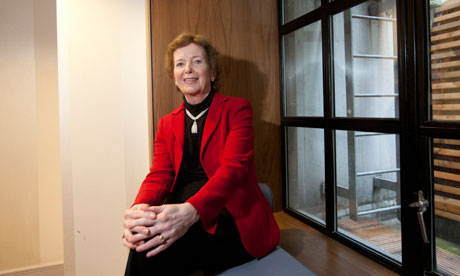
    Mary Robinson

    Former Irish president Mary Robinson emphasized the need to leave fossil fuels untouched. Photograph: Martin Argles for the Guardian

    Already, a thousand blogs and columns insist the Intergovernmental Panel on Climate Change‘s new report is a rabid concoction of scare stories whose purpose is to destroy the global economy. But it is, in reality, highly conservative.

    Reaching agreement among hundreds of authors and reviewers ensures that only the statements which are hardest to dispute are allowed to pass. Even when the scientists have agreed, the report must be tempered in another forge, as politicians question anything they find disagreeable: the new report received 1,855 comments from 32 governments, and the arguments raged through the night before launch.

    In other words, it’s perhaps the biggest and most rigorous process of peer review conducted in any scientific field, at any point in human history.

    There are no radical departures in this report from the previous assessment, published in 2007; just more evidence demonstrating the extent of global temperature rises, the melting of ice sheets and sea ice, the retreat of the glaciers, the rising and acidification of the oceans and the changes in weather patterns. The message is familiar and shattering: “It’s as bad as we thought it was.”

    What the report describes, in its dry, meticulous language, is the collapse of the benign climate in which humans evolved and have prospered, and the loss of the conditions upon which many other lifeforms depend. Climate change and global warming are inadequate terms for what it reveals. The story it tells is of climate breakdown.

    This is a catastrophe we are capable of foreseeing but incapable of imagining. It’s a catastrophe we are singularly ill-equipped to prevent.

    The IPCC’s reports attract denial in all its forms: from a quiet turning away – the response of most people – to shrill disavowal. Despite – or perhaps because of – their rigours, the IPCC’s reports attract a magnificent collection of conspiracy theories: the panel is trying to tax us back to the stone age or establish a Nazi/communist dictatorship in which we are herded into camps and forced to crochet our own bicycles. (And they call the scientists scaremongers …)

    In the Mail, the Telegraph and the dusty basements of the internet, Friday’s report (or a draft leaked a few weeks ago) has been trawled for any uncertainties that could be used to discredit. The panel reports that on every continent except Antarctica, man-made warming is likely to have made a substantial contribution to the surface temperature. So those who feel threatened by the evidence ignore the other continents and concentrate on Antarctica, as proof that climate change caused by fossil fuels can’t be happening.

    They make great play of the IPCC’s acknowledgement that there has been a “reduction in surface warming trend over the period 1998–2012”, but somehow ignore the fact that the past decade is still the warmest in the instrumental record.

    They manage to overlook the panel’s conclusion that this slowing of the trend is likely to have been caused by volcanic eruptions, fluctuations in solar radiation and natural variability in the planetary cycle.

    Were it not for man-made global warming, these factors could have made the world significantly cooler over this period. That there has been a slight increase in temperature shows the power of the human contribution.

    But denial is only part of the problem. More significant is the behaviour of powerful people who claim to accept the evidence. This week the former Irish president Mary Robinson added her voice to a call that some of us have been making for years: the only effective means of preventing climate breakdown is to leave fossil fuels in the ground. Press any minister on this matter in private and, in one way or another, they will concede the point. Yet no government will act on it.

    As if to mark the publication of the new report, the Department for Business, Innovation and Skills has now plastered a giant poster across its ground-floor windows: “UK oil and gas: Energising Britain. £13.5bn is being invested in recovering UK oil and gas this year, more than any other industrial sector.”

    The message couldn’t have been clearer if it had said “up yours”. It is an example of the way in which all governments collaborate in the disaster they publicly bemoan. They sagely agree with the need to do something to avert the catastrophe the panel foresees, while promoting the industries that cause it.

    It doesn’t matter how many windmills or solar panels or nuclear plants you build if you are not simultaneously retiring fossil fuel production. We need a global programme whose purpose is to leave most coal and oil and gas reserves in the ground, while developing new sources of power and reducing the amazing amount of energy we waste.

    But, far from doing so, governments everywhere are still seeking to squeeze every drop out of their own reserves, while trying to secure access to other people’s. As more accessible reservoirs are emptied, energy companies exploit the remotest parts of the planet, bribing and bullying governments to allow them to break open unexploited places: from the deep ocean to the melting Arctic.

    And the governments who let them do it weep sticky black tears over the

  • 15 Things You Should Know About The New IPCC Report On Climate Science

    15 Things You Should Know About The New IPCC Report On Climate Science

    By Ryan Koronowski on September 27, 2013 at 12:49 pm

    Click to enlarge.Click to enlarge.

    The IPCC, or the Intergovernmental Panel on Climate Change, just released its latest scientific report that looks at what the world’s top experts understand about climate change. The review takes years to complete, and will be used for years as a vital resource for climate science.

    During a briefing on the report Friday morning organized by The Climate Group, three of the lead authors offered blunt summaries of their work:

    “Warming is unequivocal.” — Dennis Hartmann, one of the report’s coordinating lead authors, focusing on observations

    “From all of these lines of evidence, we conclude that humans are the dominant cause of changes in the climate system.” — Nathaniel Bindoff, a coordinating lead author, focusing on attribution of climate change

    “The oceans are still taking up heat,” even though warming has recently hit a speed bump at the surface — Jochem Marotzke a coordinating author, focusing on evaluating climate models

    Beyond that, what does the average person need to know about what’s in the report?

      1. It’s happening and we’re doing it: This report concludes that the earth is unequivocally changing, and the evidence is clear that humans have a large role in how it has changed over the last 60 years.
    infographic-debate-is-overCREDIT: (Credit: RAC-France)

      1. 95-100 percent certain: Each of the IPCC’s last five big reports found that climate science has gotten increasingly certain that the planet is warming, and humans are the main cause. Scientists have a 95-100 percent certainty (“extremely likely”) that humans are causing temperatures to rise. Directly from the report: “It is extremely likely that more than half of the observed increase in global average surface temperature from 1951 to 2010 was caused by the anthropogenic increase in greenhouse gas concentrations and other anthropogenic forcings together.” The report in 2001 was 66 percent certain, and the 2007 report was 90 percent certain. Scientific conclusions that cigarettes are deadly and that the universe is about 13.8 billion years old have similar levels of certainty.
      2. Warmest 30 years: The globe has already warmed 0.85°C from 1880 to 2012. 0.6°C of that warming happened since 1950, and “1983–2012 was likely the warmest 30-year period of the last 1400 years.”
      3. Pause? What pause?: The report itself does not mention the word “pause,” but does describe the long term and short term increase in temperature. Since 1880, the nine warmest years have happened since 1998. 1998 was a very warm year partially because a warm ocean caused by El Nino did not take up as much heat as normal, which made the atmosphere warmer. Without 1998′s anomaly, there is no “slowdown,” “plateau,” “pause,” or “speedbump.”
      4. IPCCAR5oceanacidificationgraphAcidifying oceans: The lower the pH, the more acidic something is. The pH levels of the ocean surface dropped by 0.1 since the start of the industrial era, “corresponding to a 26% increase in hydrogen ion concentration.” There’s been that big of an increase with a change of 0.1 because the scale is logarithmic.
      5. Global pollution ceiling: For the first time, the world’s leading climate scientists officially called for an absolute upper limit on greenhouse gas emissions to limit warming. To have a 66 percent chance of limiting warming to 2°C, the world can’t emit more than 1,000 gigatons of carbon dioxide, total. Or 800 gigatons when accounting for methane emissions and land use changes. For context, by 2011, humans had already emitted 531 gigatons of CO2. Known fossil fuel reserves represent 2,795 gigatons, meaning burning more than 10 percent of them pushes the world over 2° of warming.
    Click to enlargeClick to enlarge

    1. Seas rising and warming: Oceans, shallow and deep, are where most of the increases in heat energy goes, “accounting for more than 90% of the energy accumulated between 1971 and 2010.” Sea level has risen 19 centimeters since 1901, and “The rate of sea level rise since the mid-19th century has been larger than the mean rate during the previous two millennia.”
    2. One of the most scrutinized documents on the planet: More than 2,000 scientists worked on this report, which has been reviewed by government, industry, and environmental groups. It is one of the most scrutinized documents on the planet.
    3. Massive amounts of data: The report’s authors analyzed “9,200 peer-reviewed studies, undergirded by a staggering two million gigabytes of numerical data,” according to Jeff Nesbit.
    4. Summary for policymakers: 110 nations joined the review process leading up to the release of the report, which is officially known as the “Fifth IPCC Working Group Report on the Physical Science Basis of Climate Change.” This report is a summary for policymakers, whereas the full report will be over 1,000 pages. The final 5th Assessment will be released in 2014, along with other reports on vulnerability and mitigation.
    5. ‘Yet another wakeup call’: Secretary of State John Kerry said of the report: “This is yet another wakeup call: Those who deny the science or choose excuses over action are playing with fire.” He concluded that, “the response must be all hands on deck. It’s not about one country making a demand of another. It’s the science itself, demanding action from all of us.”
    6. Most comprehensive ever: President Obama’s top science adviser, John Holdren, said the report “represents the most comprehensive and authoritative synthesis of scientific knowledge about global climate change ever generated.”
    7. Senators should pay attention: U.S. Senator Ed Markey, co-chair of the Bicameral Task Force on Climate Change, said “If Senators truly followed the science in this report, we’d have more than 95 votes for action to match the more than 95 percent certainty that we are altering our planet for the worse.”
    8. Deniers can’t pick a response: As Penn State’s Distinguished Professor of Meteorology Michael Mann points out, climate deniers haven’t settled on a specific narrative to attack the report. Some think the report shows a smaller threat and less certainty, some think the report is too mild to mention, while some think that consensus is a bad thing. Yet the report contains more certainty, contains a seriously unmild set of predictions, and after analyzing large streams of data, has a robust consensus on a complex issue.
    9. Blistering pace: To put the report’s findings in perspective, Stanford scientists Noah Diffenbaugh and Chris Field found that the current pace of warming is happening 10 times faster than any time over the
  • The new IPCC climate change report makes deniers overheat

    The new IPCC climate change report makes deniers overheat

    As their erroneous efforts to discredit the ‘Hockey Stick’ curve reveal, sceptics are tying themselves in knots to maintain denial

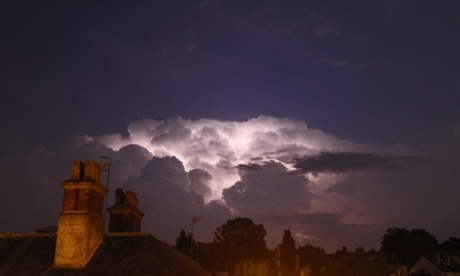
    Storm clouds gathered over Tunbridge Wells in Kent last night, breaking the heatwave across parts of the UK in spectacular style.

    The fifth IPCC report express confidence that climate change is causing various forms of extreme weather. Photograph: Jason Reeve/Demotix/Corbis

    It happens every six years or so: the Intergovernmental Panel on Climate Change (IPCC) publishes its assessment of the current state of scientific understanding regarding human-caused climate change. That assessment is based on contributions from thousands of experts around the world through an exhaustive review of the peer-reviewed scientific literature and a rigorous, several-years-long review process.

    Meanwhile, in the lead-up to publication, fossil-fuel industry front groups and their paid advocates gear up to attack and malign the report, and to mislead and confuse the public about its sobering message. So, in the weeks leading up to the release of the IPCC Fifth Assessment scientific report, professional climate change deniers and their willing abettors and enablers have done their best to distort what the report actually says about the genuine scientific evidence and the reality of the climate change threat.

    This time, however, climate change deniers seem divided in their preferred contrarian narrative. Some would have us believe that the IPCC has downgraded the strength of the evidence and the degree of threat. Career fossil fuel-industry apologist Bjorn Lomborg, in Rupert Murdoch’s the Australian, wrote on 16 September:

    UN’s mild climate change message will be lost in alarmist translation.

    On the other hand, serial climate disinformer Judith Curry, in a commentary for the same outlet five days later, announced:

    Consensus distorts the climate picture.

    So, make up your mind, critics: is it a “mild message” or a “distorted picture”? Consistency, they might well respond, is simply the “hobgoblin of little minds”, after all – but in reality, that’s only if you ignore the foolishness.

    Indeed, claims that members of the IPCC have downgraded their scientific confidence have been plentiful among the usual purveyors of climate change misinformation: Fox News, the editorial pages of the Wall Street Journal and various conservative tabloids in the United States, Canada, Germany and Australia. Fox News even sought to mislead its viewers with a bait-and-switch, focusing attention instead on a deceptive, similarly named report that calls itself the Nongovernmental International Panel on Climate Change (NIPCC), which simply regurgitates standard shopworn denialist myths and erroneous talking points. That non-peer-reviewed report was published by the discredited industry front group known as the Heartland Institute in the lead-up to the publication of the actual IPCC report, presumably to divert attention from the actual scientific evidence.

    In reality, the IPCC has strengthened the degree of certainty that fossil fuel burning and other human activities are responsible for the warming of the globe seen over the past half-century, raising their confidence from “very likely” in the previous report to “extremely likely” in the current one. The IPCC expresses similar levels of certainty that the Earth is experiencing the impacts of that warming in the form of melting ice, rising global sea levels and various forms of extreme weather.

    What about the converse claim, promoted by critics, that the IPCC has exaggerated the evidence?

    Well, if anything, the opposite appears closer to the truth. In many respects, the IPCC has been overly conservative in its assessment of the science. The new report, for example, slightly reduces the lower end of the estimated uncertainty range for a quantity know as the equilibrium climate sensitivity – the amount of warming scientists expect in response to a doubling of carbon dioxide (CO2) concentrations relative to preindustrial levels (concentrations that will be seen mid-century, given business-as-usual emissions).

    The IPCC reports a likely range of 1.5C to 4.5C (roughly 3F to 8F) for this quantity, the lower end having been dropped from 2.0C in the fourth IPCC assessment. The lowering is based on one narrow line of evidence: the slowing of surface warming during the past decade.

    Yet, there are numerous explanations of the slowing of warming (unaccounted for effects of volcanic eruptions and natural variability in the amount of heat buried in the ocean) that do not imply a lower sensitivity of the climate to greenhouse gases. Moreover, other lines of evidence contradict an equilibrium climate sensitivity lower than 2C. It is incompatible, for example, with paleoclimate evidence from the past ice age, or the conditions that prevailed during the time of the dinosaurs. (See this piece I co-authored earlier this year for the Australian Broadcasting Corporation, for a more detailed discussion of the matter.)

    The IPCC’s treatment of global sea-level rise is similarly conservative – arguably, overly so. The report gives an upper limit of roughly 1m (3ft) of sea-level rise by the end of the century under business-as-usual carbon emissions. However, there is credible peer-reviewed scientific work, based on so-called “semi-empirical” approaches that predict nearly twice that amount – that is, nearly 6ft (2m) of global sea-level rise this century. These latter approaches are given short thrift in the new IPCC report; instead, the authors of the relevant chapter favor dynamical modeling approaches that have their own potential shortcomings (underestimating, for example, the potential contribution of ice-sheet melting to sea-level rise this century).

    As some readers may know, the conclusion that modern warming is unique in a long-term context came to prominence with the temperature reconstruction that my co-authors and I published in the late 1990s. The resulting “Hockey Stick” curve, which demonstrates that the modern warming spike is without precedent for at least the past 1,000 years, took on iconic significance when it was prominently displayed in the “summary for policy-makers” of the 2001 Third IPCC Assessment report. Thus, the “Hockey Stick” curve, as I describe in my recent book, The Hockey Stick and the Climate Wars, became a focal point of the attacks by industry-funded climate change deniers.

    So, it might not come as a surprise that one of the most egregious misrepresentations of the IPCC’s latest report involves the Hockey Stick and conclusions about the uniqueness of modern warming.

    An urban legend seems to be circulating around the echo chamber of climate change denial, including contrarian blogs and fringe rightwing news sites. The claim is that the IPCC has “dropped” or “trashed” the Hockey Stick conclusion regarding the unprecedented nature of recent warmth.
    A good rule of thumb is that the more insistent climate change deniers are about any particular talking-point, the greater the likelihood is that the opposite of what they are claiming actually holds. The IPCC has, in fact, actually strengthened its conclusions regarding the exceptional nature of modern warmth in the new report. A highlighted box in the “summary for policy-makers” states the following (emphasis mine):

    In the northern Hemisphere, the period 1983-2012 was likely the warmest 30-year period of the last 1,400 years (medium confidence).

    The original 1999 Hockey Stick study (and the 2001 Third IPCC Assessment report) concluded that recent northern hemisphere average warmth was likely unprecedented for only the past 1,000 years. The 2007 IPCC Fourth Assessment extended that conclusion back further, over the past 1,300 years (and it raised the confidence to “very likely” for the past 400 years). The new, Fifth IPCC Assessment has now extended the conclusion back over the past 1,400 years. By any honest reading, the IPCC has thus now substantially strengthened and extended the original 1999 Hockey Stick conclusions.

    Only in the “up is down, black is white” bizarro world of climate change denial could one pretend that the IPCC has failed to confirm the original Hockey Stick conclusions, let alone contradict them.

    The stronger conclusions in the new IPCC report result from the fact that there is now a veritable hockey league of reconstructions that not only confirm, but extend, the original Hockey Stick conclusions. This recent RealClimate piece summarizes some of the relevant recent work in this area, including a study published by the international PAGES 2k team in the journal Nature Geoscience just months ago. This team of 78 regional experts from more than 60 institutions representing 24 countries, working with the most extensive paleoclimate data set yet, produced the most comprehensive northern hemisphere temperature reconstruction to date. One would be hard-pressed, however, to distinguish their new series from the decade-and-a-half-old Hockey Stick reconstruction of Mann, Bradley and Hughes.

    Conclusions about unprecedented recent warmth apply to the average temperature over the northern hemisphere. Individual regions typically depart substantially from the average. Thus, while most regions were cooler than present during the medieval era, some were as warm, or potentially even warmer, than the late 20th-century average. These regional anomalies result from changes in atmospheric wind patterns associated with phenomena such as El Niño and the so-called North Atlantic Oscillation.

    Colleagues and I, quoting from the abstract of our own article in the journal Science a few years ago (emphasis mine), stated:

    Global temperatures are known to have varied over the past 1,500 years, but the spatial patterns have remained poorly defined. We used a global climate proxy network to reconstruct surface-temperature patterns over this interval. The medieval period [AD 950-1250] is found to display warmth that matches or exceeds that of the past decade in some regions, but which falls well below recent levels globally.

    These conclusions from our own recent work are accurately represented by the associated discussion in the “summary for policy-makers” of the new IPCC report (emphasis mine):

    Continental-scale surface-temperature reconstructions show, with high confidence, multidecadal periods during the Medieval Climate Anomaly (year 950-1250) that were, in some regions, as warm as in the late 20th century. These regional warm periods did not occur as coherently across regions as the warming in the late 20th century (high confidence).

    However, never underestimate the inventiveness of climate change deniers. Where there’s a will, there is, indeed, a way: a meme now circulating throughout the denialosphere is that the IPCC’s conclusions about regional warmth contradict our findings, despite the fact that those conclusions are substantially based on our findings.

    One could be excused for wondering if climate change deniers have lost all sense of irony.

    The most egregious example of this latest contortion of logic found its way into the purportedly “mainstream” Daily Mail, courtesy of columnist David Rose, who admittedly has a bit of a reputation for misrepresenting climate scientists and climate science. Rose wrote in his column on 14 September:

    As recently as October 2012, in an earlier draft of this report, the IPCC was adamant that the world is warmer than at any time for at least 1,300 years. Their new inclusion of the “Medieval Warm Period” – long before the Industrial Revolution and its associated fossil-fuel burning – is a concession that its earlier statement is highly questionable.

    The most charitable interpretation is that Rose simply didn’t actually read or even skim the final draft of the report, despite writing about it at length. For, if he had, he would be aware that the final draft of the report comes to the strongest conclusion yet about the unprecedented nature of recent warmth, extending the original Hockey Stick conclusion farther back than ever before – to the last 1,400 years.

    Moreover, he would be aware that the existence of regional medieval warmth rivaling that of the late 20th century does not contradict that conclusion. Indeed, it is the regional heterogeneity of that warmth, as established in ours and other studies, that leads the IPCC report to conclude that current levels of hemispheric average warmth are unprecedented for at least 1,400 years.

    The lesson here, perhaps, is that no misrepresentation or smear is too egregious for professional climate change deniers. No doubt, we will continue to see misdirection, cherry-picking, half-truths and outright falsehoods from them in the months ahead as the various IPCC working groups report their conclusions.

    Don’t be fooled by the smoke and mirrors and the Rube Goldberg contraptions. The true take-home message of the latest IPCC report is crystal clear: climate change is real and caused by humans, and it continues unabated. We will see far more dangerous and potentially irreversible impacts in the decades ahead if we do not choose to reduce global carbon emissions. There has never been a greater urgency to act than there is now.

    The latest IPCC report is simply an exclamation mark on that already-clear conclusion.

    • This article was originally published by Livescience.com and is

  • House Republicans Clueless On How To Avert Government Shutdown

    I have no understanding of US politics, but this sounds very serious to me. Could be our equivalent of a double dissolution through the blocking of supply. It is hoped they can sort this out.

    House Republicans Clueless On How To Avert Government Shutdown

    Posted: 09/27/2013 7:01 pm EDT

    house republicans government shutdown
    54
    54
    7
    1667
    Get Politics Newsletters:

    WASHINGTON — If Americans aren’t sure whether Congress can head off a shutdown of the government in the next three days, they’re not alone. The Republican-led House of Representatives didn’t know whether it was possible either, as of Friday evening.

    The Senate has passed a bill that keeps federal employees on the job until Nov. 15 — but strips the House GOP’s attempt to defund the Affordable Care Act. It’s now the lower chamber’s turn to deal with the legislation.

    That has presented House Speaker John Boehner (R-Ohio) with one of the toughest quandaries of his reign since the showdown over the country’s debt in 2011.

    A large portion of his conference remains committed to dismantling President Barack Obama’s signature health care law, but on Friday members were having a hard time agreeing on exactly which pill they could use to poison the law that would also stand a chance of getting swallowed by the Senate.

    Part of the problem is that many of the tea party-aligned members see a government shutdown as a better choice than letting Obamacare take root.

    “I don’t want to shut the government down, but I’d prefer to stop this law,” said Richard Hudson (R-N.C.).

    “If there is a price to be paid for this, we will recover from a government shutdown, whether it’s a day, a week or two weeks … something will get resolved, we’ll recover from that as a country,” said Rep. Steve King (R-Iowa). “It’s a temporary inconvenience for a lot of people. But if Obamacare is ever implemented, we will never recover from that as a nation. We can never be a free people again.”

    On the other hand, many GOP lawmakers see throwing a monkey wrench into the gears of government as political suicide.

    “A lot of Americans are going to get hurt in a situation like that. You put people out of work. You inconvenience millions — tens of millions — of other Americans. You raise doubt about your ability to function,” said Rep. Tom Cole (R-Okla.), deputy whip of the House.

    “I don’t think that a government shutdown is ever the right answer. Politically, I think anybody who thinks it’s not high-risk is just not playing with a full deck,” Cole added. “It’s extraordinarily high-risk, and for not much gain.”

    Cole said tea party members in the Senate, such as Sens. Ted Cruz (R-Texas) and Mike Lee (R-Utah), had their chance to defund Obamacare with the original bill the House sent over. But now they’ll have to settle for less.

    “We gave our guys in the Senate an opportunity. We gave them what they asked for, or at least some of them asked for, in the defunding measure, and it looks like they weren’t able to get that done,” he said. “So now maybe we look at something else that’s much more difficult for Democrats to turn down.”

    Cole and nearly all of the House GOP conference do want to send something back to the Senate that whacks Obamacare, and they were busy rifling through their medicine cabinet Friday, hoping to find just the right dose that would force a few Democrats in the Senate to go along. Among the ideas were ending a tax on medical devices, barring the federal government from contributing to congressional health insurance plans, and delaying the law or parts of it for a year.

    The choice is especially fraught. If the House passes a measure that pleases the tea party, Democrats will not go along. If the House passes a token swipe at Obamacare, Cruz and company will not go along.

    Democrats and the president have declared they will not let funding for the government — or the approaching need to raise the country’s borrowing limit — be held hostage to anything. It would be tough to pry even red-state Democrats out of that lockstep.

    “To be absolutely clear, we are going to accept nothing that relates to Obamacare,” Senate Majority Leader Harry Reid (D-Nev.) reaffirmed in a press conference Friday.

    But if the House GOP jab at Obamacare is too lame, it might not pass muster with Cruz and Lee, who have staked out positions demanding the defunding of the health care law.

    “I have said for a long time that I do not intend to vote for any continuing resolution that funds Obamacare,” Cruz told reporters after the Senate passed its bill.

    If any single senator objects to something in a bill, he or she can tie it up for days, as Cruz and Lee did with the measure passed Friday. The only way for a measure to pass before the clock runs out just after midnight on Monday is for senators to unanimously agree to expedite the process.

    Boehner does have one option that would guarantee the government keeps humming, but carries potentially severe consequences for him personally: simply putting the Senate’s bill on the floor. If just 17 Republicans decide not to roll the dice on shutting down the government, the bill would pass with unanimous Democratic support. The drama would be over for the country — for at least the next six weeks — but not for Boehner.

    “I think it would be devastating to the speaker’s support in the conference,” said Hudson, the North Carolina congressman.

    That leaves Boehner trying to thread the legislative needle.

    House Republicans were expected to meet on Saturday to map out a plan.

    “I’ve talked to the speaker and the majority leader, and they’re on different paths of trying to talk to members and see where they are,” Hudson said. “We haven’t

  • U.N. Climate Panel Endorses Ceiling on Global Emissions

    Environment

    U.N. Climate Panel Endorses Ceiling on Global Emissions

    Jonathan Nackstrand/Agence France-Presse — Getty Images

    Ban Ki-moon, the secretary general, addressed the United Nations’ Intergovernmental Panel on Climate Change on Friday.

    By
    Published: September 27, 2013 486 Comments
    • Facebook
    • Twitter
    • Google+
    • Save
    • E-mail
    • Share
    • Print
    • Reprints

    STOCKHOLM — The world’s top climate scientists on Friday formally embraced an upper limit on greenhouse gases for the first time, establishing a target level at which humanity must stop spewing them into the atmosphere or face irreversible climatic changes. They warned that the target is likely to be exceeded in a matter of decades unless steps are taken soon to reduce emissions.

    Related

    Temperature Rising

    Articles in this series focus on the central arguments in the climate debate and examine the evidence for global warming and its consequences.

    Multimedia

    Readers’ Comments

    Unveiling the latest United Nations assessment of climate science, the experts cited a litany of changes that were already under way, warned that they were likely to accelerate and expressed virtual certainty that human activity is the main cause. “Climate change is the greatest challenge of our time,” said Thomas F. Stocker, co-chairman of the Intergovernmental Panel on Climate Change, the United Nations-sponsored group of scientists that produced the report. “In short, it threatens our planet, our only home.”

    The panel, in issuing its most definitive assessment yet of the risks of human-caused warming, hoped to give impetus to international negotiations toward a new climate treaty, which have languished in recent years in a swamp of technical and political disputes. The group made clear that time was not on the planet’s side if emissions continued unchecked.

    “Human influence has been detected in warming of the atmosphere and the ocean, in changes in the global water cycle, in reductions in snow and ice, in global mean sea level rise, and in changes in some climate extremes,” the report said. “It is extremely likely that human influence has been the dominant cause of the observed warming since the mid-20th century.”

    The new report is a 36-page summary for world leaders of a 900-page report that is to be released next week on the physical science of climate change. That will be followed by additional reports in 2014 on the most likely impacts and on possible steps to limit the damage. A draft of the summary leaked last month, and the final version did not change greatly, though it was edited for clarity.

    Going well beyond its four previous analyses of the emissions problem, the panel endorsed a “carbon budget” for humanity — a limit on the amount of the primary greenhouse gas, carbon dioxide, that can be produced by industrial activities and the clearing of forests. No more than one trillion metric tons of carbon could be burned and the resulting gases released into the atmosphere, the panel found, if planetary warming is to be kept below 3.6 degrees Fahrenheit (2 degrees Celsius) above the level of preindustrial times. That temperature is a target above which scientists believe the most dangerous effects of climate change would begin to occur.

    Just over a half-trillion tons have already been burned since the beginning of the Industrial Revolution, and at the rate energy consumption is growing, the trillionth ton will be burned sometime around 2040, according to calculations by Myles R. Allen, a scientist at the University of Oxford and one of the authors of the new report. More than three trillion tons of carbon are still left in the ground as fossil fuels.

    Once the trillion-ton budget is exhausted, companies that wanted to keep burning fossil fuels would have to come up with ways to capture carbon dioxide and store it underground. In the United States, the Obama administration is moving forward with rules that would essentially require such technology, which is likely to be costly, for any future coal-burning power plants; the president’s Republican opponents have accused him of waging a “war on coal.”

    The Intergovernmental Panel on Climate Change is a worldwide committee of hundreds of scientists that issues major reports every five or six years, advising governments on the latest knowledge on climate change.

    The group has now issued five major reports since 1990, each of them finding greater certainty that the world is warming and greater likelihood that human activity is the chief cause. The new report finds a 95 to 100 percent chance that most of the warming of recent decades is human-caused, up from the 90 to 100 percent chance cited in the last report, in 2007.

    But the new document also acknowledges that climate science still contains uncertainties, including the likely magnitude of the warming for a given level of emissions, the rate at which the ocean will rise, and the likelihood that plants and animals will be driven to extinction. The scientists emphasized, however, that those uncertainties cut in both directions and the only way to limit the risk is to limit emissions.

    Climate-skeptic organizations assailed the new report as alarmist even before it was published.

    The Heartland Institute, a Chicago organization, issued a document last week saying that any additional global warming would likely be limited to a few tenths of a degree and that this “would not represent a climate crisis.”

    One issue much cited by the climate doubters is the slowdown in global warming that has occurred over the past 15 years. The report acknowledged that it was not fully understood, but said such pauses had occurred in the past and the natural variability of climate was a likely explanation.

    “People think that global warming means every year is going to be warmer than the year before,” said Gerald A. Meehl, an American scientist who helped write the report. “It’s more like a stair-step kind of thing.”

    Climate scientists not involved in writing the new report said the authors had made a series of cautious choices in their assessment of the scientific evidence. Regarding sea level rise, for instance, they gave the first firm estimates ever contained in an intergovernmental panel report, declaring that if emissions continued at a rapid pace, the rise by the end of the 21st century could be as much as three feet. They threw out a string of published papers suggesting a worst-case rise closer to five feet.

    Similarly, the authors went out of their way to include recent papers suggesting that the earth might be less sensitive to carbon dioxide emissions than previously thought, even though serious questions have been raised about the validity of those estimates.

    The new report lowered the bottom end of the range of potential warming that could be expected to occur over the long term if the carbon dioxide level in the atmosphere were to double, reversing a decision that the panel made in the last report and restoring a scientific consensus that had prevailed from 1979 to 2007. Six years ago, that range was reported as 3.6 to 8.1 degrees Fahrenheit; the new range is 2.7 to 8.1 degrees.

    In Washington, President Obama’s science adviser, John P. Holdren, cited increased scientific confidence “that the kinds of harm already being experienced from climate change will continue to worsen unless and until comprehensive and vigorous action to reduce emissions is undertaken worldwide.”

    Ban Ki-moon, the United Nations secretary general, spoke to delegates at the meeting on Friday by video link, declaring his intention to call a meeting of heads of state in 2014 to push such a treaty forward. The last such meeting, in Copenhagen in 2009, ended in disarray.

  • Worst impacts of climate change still avoidable if we act now

    Press Release

    Worst impacts of climate change still avoidable if we act now

    Canada NewsWire

    VANCOUVER, Sept. 27, 2013

    David Suzuki Foundation calls on Canadians to support climate action in response to latest assessment report from the Intergovernmental Panel on Climate Change

    VANCOUVER, Sept. 27, 2013 /CNW/ – Scientists are more certain than ever that human activity — in particular the burning of fossil fuels and deforestation — is causing climate change, according to the First Installment of the Fifth Assessment Report from the Intergovernmental Panel on Climate Change (IPCC). The report confirms that by contributing to droughts, flooding, severe weather events and ocean acidification, the impacts of global warming are already being felt around the world.

    The David Suzuki Foundation is calling on all Canadians to support action on climate change as the report also shows it is possible to prevent the most serious risks of climate change, but the window of opportunity is closing and the response needs to be more urgent and far-reaching.

    “This year in Canada, we experienced numerous extreme weather events, such as the floods in Calgary and Toronto,” said David Suzuki Foundation science and policy manager Ian Bruce. “This shows how vulnerable our communities are if climate change is allowed to intensify. The IPCC report suggests that if we continue with business as usual in terms of rising carbon emissions, we will become even more vulnerable. But the report says we still have a choice; we can act to reverse the trend in emissions growth.”

    “If you were 95 per cent certain your house was at risk of catching fire, and if there was something you could do to prevent it, you would do it,” Bruce said.

    The latest IPCC scenarios show temperatures could rise from 0.3 Celsius to almost five degrees this century, with the outcome largely dependent on how much action is taken to reduce emissions. The current rising global emission trajectory, mainly from overuse of fossil fuels, is dangerous as this is more likely to cause more dramatic temperature increases (at the upper temperature range) and extreme weather events in the future. The global average temperature has already risen almost one degree Celsius since the start of the 20th century (since 1901).

    “This may not seem like much, but it is,” Bruce said. “Keep in mind that there is only a five degree difference between the Ice Age and our current climate, which can be likened to Goldilocks conditions — just right for human habitation, not too hot and not too cold.”

    “Our parents’ generation didn’t know about the risk of global warming and climate change, but we do,” Bruce said. “It’s unfair to leave this problem to our children and grandchildren to deal with the dire consequences.”

    Background on the IPCC Fifth Assessment Report

    The IPCC produces the most comprehensive scientific reports about climate change globally, based on the greatest consensus of international scientists. The IPCC was awarded the Nobel Peace Prize in 2007. On September 27 (for the summary) and September 30 (for the full report), 2013, the first of four installments of the Fifth Assessment Report by the Intergovernmental Panel on Climate Change are being released from Stockholm. The report collates current understanding of how the world’s natural systems that support human life are changing and will continue to change as a result of the unprecedented amounts of carbon pollution being released into the atmosphere. The previous assessment, the Fourth Assessment Report, was released in 2007 and sparked serious global debate on climate change action. This first installment of the Fifth Report is on the physical science of climate change. Subsequent installments of the Fifth Report will be released over the coming year. They assess the best available research worldwide on climate impacts (second installment) and mitigation strategies (third installment), followed by a synthesis report bringing together the three chapters.

    The summary for policy-makers report was released today and the full report will be released on Monday.

    For IPCC media release and report:
    http://www.ipcc.ch/

    David Suzuki Foundation media backgrounder is available here:
    http://www.davidsuzuki.org/media/news/downloads/DSF_IPCC_WG1_Backgrounder.pdf