Author: Neville

  • The Changing Party Composition of the Senate

    October 03, 2013

    The Changing Party Composition of the Senate

    The two tables below summarise the party composition of the old and new Senate, and also show the change in Senate representation for each state. Results are pending a declaration of the result in Western Australia, the declaration having been delayed by a re-count request.

    Changing Party Composition of the Senate
    Continuing 2013 Election Senate Composition
    Party Senators Until 30 June Post 1 July Current New Change
    Coalition 16 18 17 34 33 -1
    Labor Party 13 18 13 31 26 -5
    Greens 6 3 3 9 9 ..
    Nick Xenophon .. 1 1 1 1 ..
    Democratic Labour Party 1 .. .. 1 1 ..
    Palmer United Party .. .. 3 .. 3 +3
    Family First .. .. 1 .. 1 +1
    Liberal Democratic Party .. .. 1 .. 1 +1
    Motoring Enthusisats Party .. .. 1 .. 1 +1

    The table below summarises the changing composition of Senators from each state and territory.

    Changes in Senate Membership by State/Territory
    NSW Labor Senators Bob Carr and Doug Cameron re-elected, third Senator Ursula Stephens defeated
    Coalition Senators Marise Payne (Liberal), John Williams (National) and Arthur Sinodinos (Liberal) re-elected
    David Leyonhjelm (Liberal Democratic Party) elected
    Net change Liberal Democrats gain one seat from Labor on 1 July 2014
    VIC Labor Senators Gavin Marshall and Jacinta Collins re-elected, third Senator Mehmet Tillem defeated. Tillem was elected by the Parliament of Victoria on 21 August to replace David Feeney who resigned to successfully contest Batman at the House of Representatives election. Tillem has yet to be sworn in, but will take his seat at the first sitting despite his defeat and hold it until 30 June 2014.
    Liberal Senators Mitch Fifield and Scott Ryan re-elected. third Liberal candidate Helen Kroger defeated
    Janet Rice (Green) elected
    Ricky Muir (Australian Motoring Enthusiasts Party) elected
    Net Change Greens gain a seat from Labor and Australian Motoring Enthusiasts gain a seat from the Liberal Party on 1 July 2014.
    QLD Labor Senator Claire Moore re-elected, John Hogg did not contest election, Mark Furner defeated and new Senator Chris Ketter elected
    LNP Senator Ian Macdonald re-elected, Ron Boswell and Sue Boyce did not contest election, while James McGrath and Matthew Canavan are newly elected
    Glenn Lazarus elected for Palmer United Party
    Net Change Palmer United Party gain a seat from Labor on 1 July 2014.
    WA Liberal Senators Michaelia Cash and David Johnston were re-elected, Alan Aggleston did not contest election and Linda Reynolds was elected in his place
    Labor Senator Louise Pratt re-elected, Mark Bishop did not contest election and Joe Bullock was elected in his place
    Green Senator Scott Ludlam defeated
    Zenhya Wang (Palmer United Party) elected
    Net Change Palmer United Party gain a seat from the Greens on 1 July 2014
    SA Labor Senator Penny Wong re-elected, Don Farrell defeated
    Liberal Senators Cory Bernardi and Simon Birmingham re-elected
    Independent Senator Nick Xenophon re-elected
    Green Senator Sarah Hanson-Young re-elected
    Bob Day (Family First) elected
    Net Change Family First gain a Senator from Labor on 1 July 2014
    TAS Labor Senators Catryna Bilyk and Carol Brown re-elected, third Senator Lin Thorp defeated
    Liberal Senators David Bushby and Rickard Colbeck re-elected
    Green Senator Peter Whish-Wilson re-elected
    Jacqui Lambie (Palmer United Party) elected
    Net Change Palmer United Party gain a seat from Labor
    ACT Labor Senator Kate Lundy re-elected
    Liberal Senator Gary Humphries was defeated for party pre-selection and Zed Seselja has been elected as the new Liberal Senator.
    Net Change nil. Territory Senators do not have fixed terms, instead taking their seats at the first sitting of the new Parliament.
    NT Labor Senator Trish Crossin did not contest the election after being replaced as Labor candidate. Nova Peris is the newly elected Labor Senator.
    Country Liberal Senator Nigel Scullion was re-elected
    Net Change nil. Territory Senators do not have fixed terms, instead taking their seats at the first sitting of the new Parliament.

    Posted by on October 03, 2013 at 11:34 AM | Permalink

    Comments

    Post a comment

    Comments are moderated, and will not appear until the author has approved them.

    Comment below or sign in with Typepad Facebook TwitterGoogle+and more…
  • Waves in the bathtub Why sea level rise isn’t level at all

    Waves in the bathtub
    Why sea level rise isn’t level at all
    January 10, 2010
    posted by Dr. Amber Jenkins
    16:00 PST
    Waves in the bathtub


    Josh Willis

    From Dr. Josh Willis, NASA/Jet Propulsion Laboratory oceanographer

    Rubber duck in bath.

    This famous climate scientist I know used to always begin his talks on sea level rise by showing a cartoon of a bathtub. A faucet would fill up the bathtub, representing water coming from melting glaciers and ice sheets, and then a small campfire would add heat, causing the water to expand. It was a nice way of getting people to think about the causes of sea level rise. But you might guess that the real ocean is a bit more complicated than the cartoon lets on. And you’d be right. Even though it’s sometimes convenient to think of the ocean as a great big bathtub, where turning on the tap at one end raises the water level in the whole tub, real sea level rise doesn’t quite happen that way. To understand why, you first have to realize that ‘sea level’ isn’t really level at all.

    There are lots of reasons why the oceans are not level. For example, vast ocean currents like the Gulf Stream in the Atlantic Ocean and the Kuroshio in the Pacific actually reshape the ocean surface, causing it to tilt. As the planet heats up, changes in the prevailing winds (which drive most of these ocean currents) cause changes in the currents, reshaping our ocean and changing local sea level as a result.

    Just as global warming does not raise land temperatures evenly, global ocean warming is not the same everywhere around the globe. Some regions of the oceans are heating up faster than others, and because warm water takes up more space than cold water, those regions experience faster sea level rise.

    Finally, the water locked away in the great ice sheets of Greenland and Antarctica also shapes the ocean surface. As the ice sheets melt and lose water to the oceans, our entire planet feels the effects. The movement of mass from the ice sheets to the oceans very slightly shifts the direction of Earth’s rotation. This, along with changes in the gravitational pull of the ice sheets on the oceans, will reshape sea levels further still.

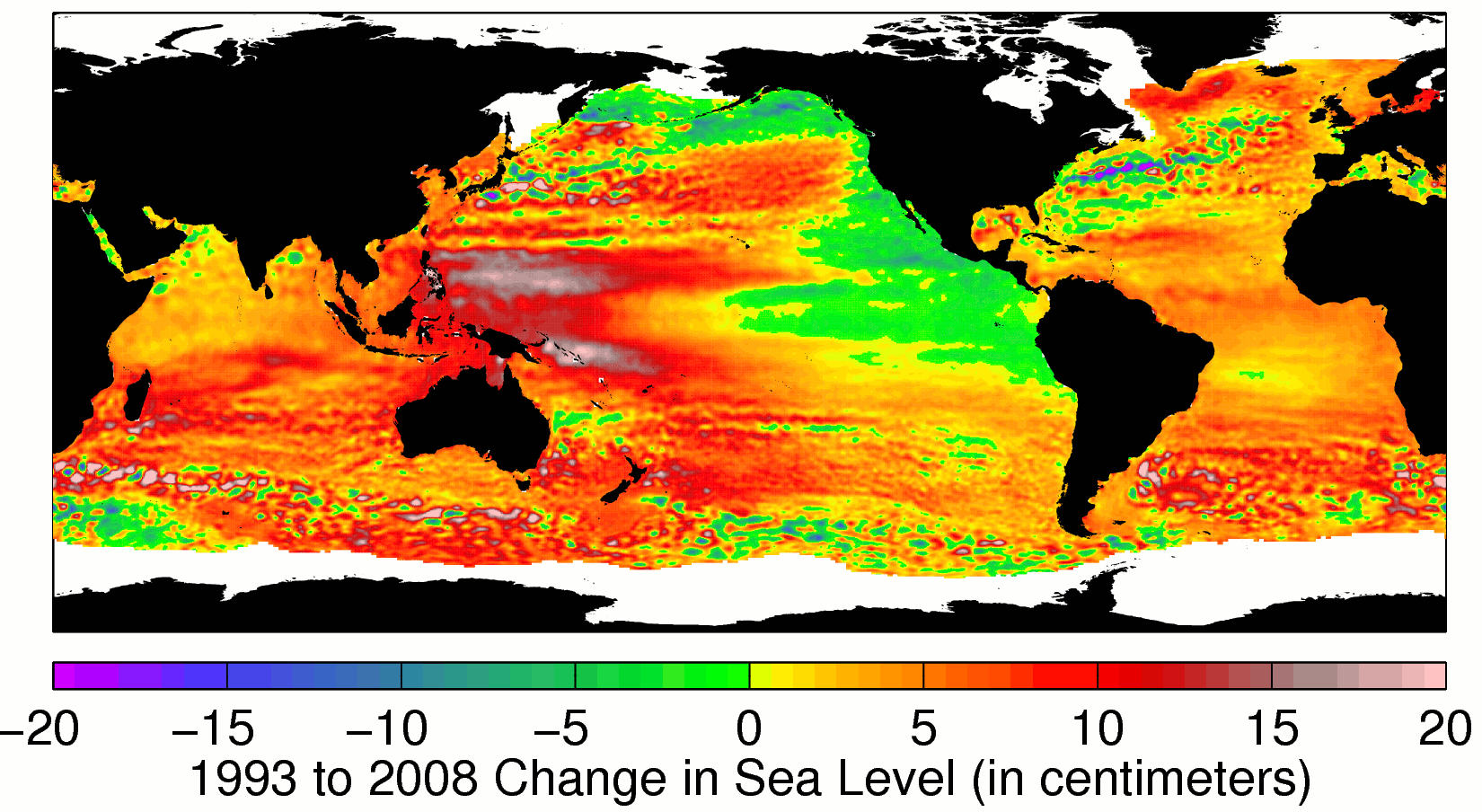
    So sea level rise is complicated, and the bathtub analogy just doesn’t cut it. Given all that, the image below is not that surprising. It shows how sea levels changed between 1993 and 2008 (yellow and red show rising sea levels, blue and green show falling). Since the early 1990s, space satellites have given us a bird’s-eye view of sea level change. They tell us that that sea level, averaged over the whole planet, has gone up by about 4.5 cm (1.8 inches) since 1993 — clear evidence of global warming. (To recap: global warming causes a) ocean water to warm up, expand, and take up more space; and b) glaciers to melt which add more water to the oceans.) But the patterns of sea level change tell a much more complicated story.

    Most of the regional variations seen over this 16-year trend are related to changes in the ocean currents rather than the movement or melting of ice. Australia for example, where 80% of the population lives near the coast, has seen sea levels rise much more quickly than the rest of the planet. Meanwhile, along the California coast, sea level has stayed steady or even fallen a bit.

    The question is whether these regional differences are part of natural climate cycles, or an effect of global warming? The answer is probably both, and scientists around the world are working hard to tell the difference.

    So where does all this leave my friend’s bathtub analogy? High and dry, of course.

    The change in the world’s sea level between 1993 and 2008. Black areas are land; colored are the oceans. Yellow and red regions show rising sea level, while green and blue regions show falling sea level. White regions are missing data during parts of the year. Nearly everywhere, sea level is rising, and the global average is clearly rising fast. But the patterns of sea level change (the regional variations) are complicated. </br></br>Credit: Altimeter data products include data from TOPEX/Poseidon, Jason-1 and Jason-2 and other satellites. Data products come from Ssalto/Duacs, distributed by Aviso, with support from CNES. The change in the world’s sea level between 1993 and 2008. Black areas are land; colored are the oceans. Yellow and red regions show rising sea level, while green and blue regions show falling sea level. White regions are missing data during parts of the year. Nearly everywhere, sea level is rising, and the global average is clearly rising fast. But the patterns of sea level change (the regional variations) are complicated.

    Credit: Altimeter data products include data from TOPEX/Poseidon, Jason-1 and Jason-2 and other satellites. Data products come from Ssalto/Duacs, distributed by Aviso, with support from CNES.

    Editor’s note: If you’re interested in how sea level is changing around the globe check out our Climate Time Machine and Sea Level Viewer.

  • Why do sea levels not rise uniformly around the world?

    While reading the article Hawaii’s Beaches Are in Retreat, and Its Way of Life May Follow on The New York Times’s website, I was surprised to find out that sea levels do not rise around the world at a uniform rate. Assuming that the global warming is true (I think there’s enough credible evidence for it – but I don’t want a debate on the veracity of global warming – therefore, just assume it’s true), what may be the reason for the non-uniformity?

    asked May 15 ’12 at 15:35

    1 Answer

    up vote 5 down vote accepted

    There’s a good article about this at http://climate.nasa.gov/blogs/index.cfm?FuseAction=ShowBlog&NewsID=239. Since it’s a NASA blog I assume it’s reasonably trustworthy. The key points are:

    • ocean currents and the prevailing wind patterns cause water build ups in some areas
    • ocean temperatures vary and higher temperature areas have higher levels because the water density is lower
    • the weight of ice sheets affect the Earth’s axis of rotation and the water distribution

    I must admit I’m not sure about the last of these as it seems to me it would be a very small effect. Finally, another longer term effect I’ve seen mentioned in some discussions is that land rises as it’s freed from the weight of the ice. The north of the UK is still rising, and the south still sinking, after the ice melted at the end of the last ice age.

    answered May 15 ’12 at 15:59
    John Rennie
    54.5k13996
    Wrt your third point, I think the issue is also that some pieces of land rise due to less ice sheets elsewhere. So the apparent sea level rise at those locations is less. – Bernhard May 15 ’12 at 17:00
    @Bernhard sort of. What happened during the last glacial was that the crust under the ice sheets was pushed down by IIRC several hundred meters while crust south of the icesheets rose by a similar amount. With the ice sheets gone the crust is flexing back to its pre-glacial shape. in the extreme case, part of northern Canada is rising almost 2cm/year. In coastal areas mean sea level rises or falls with the movement of the crust. en.wikipedia.org/wiki/Post-glacial_rebound – Dan Neely May 16 ’12 at 17:46
    There’s very small (0.7ms/century) shift in the length of the day due to mass distribution changes. I doubt this is enough to affect the distribution of the ocean meaningfully. – Dan Neely May 16 ’12 at 17:47

  • From Tim Flannery (Climate Council)

    4:09 PM (3 hours ago)

    to me
    Images are not displayed. Display images below – Always display images from info@climatecouncil.org.au
    Dear INGA,Thank you so much for your support!

    In just a few days, over 30,000 of us have banded together to power the new Climate Council. It’s the biggest crowdfunding project ever in Australia (at least that we’ve been able to find). So far we’ve already raised $969,000 together! That’s about half the annual budget we had at the Government-funded Commission.

    Thanks to you, we’ve been able to get straight back to it.

    You’ve probably read about the world’s largest climate science body releasing the IPCC report this week. We spent most of the last week analysing the report, and talking to media across the country about what it means.

    The full report is over 2,000 pages, so here are three quick ways to get up to speed:

    READ: our five minute summary of the latest science.

    SHARE: our infographic to update friends and family.

    TUNE IN: for a personal briefing tomorrow at 6.30pm. As a Founding Friend of the Council, we’d love to give you a chance to talk directly with one of the world’s experts, Climate Councillor Prof. Will Steffen. Join us at 6.30pm AEST tomorrow, Thursday October 3, for a live video discussion on our website. Email with any questions you’d like Prof. Steffen to address.

    Thank you so much for making this all possible. When we put out the call for support last week we had no idea whether the public would respond. In just a few days, so many of you extraordinary people contacted us to chip in donations, or volunteer your help. The Climate Council is powered by you and it’s already making waves around the world – we’ve been contacted by so many scientists overseas who are inspired to help and support us.

    Your support means that we’ll be able to keep providing independent, expert information on climate change. Perhaps most importantly, it brought us together: a community of over 30,000 Australians — and growing by the day — who can keep working together.

    On behalf of the team and all the Councillors, thank you.
    Tim Flannery

    PS – It’s not too late to donate and support the council. At the moment we are up to $969,000. Can you help take us to $1million by sharing this email with your friends and family? Our new, improved donation page is https://secure.climatecouncil.org.au


    You’re receiving this because you signed up for updates from the Climate Council.

    Reply
    Forward
    Click here
  • PUP to be a power in Senate

    PUP to be a power in Senate

    AAP By Lisa Martin – October 2, 2013, 7:13 pm

    Mining magnate Clive Palmer’s political party looks set to hold the balance of power when the new Senate takes shape next July.

    The coalition will have 33 senators but needs six more votes to pass legislation.

    Labor with 26 seats and the Greens with nine – possibly 10 after a recount – are likely to vote together to oppose government plans.

    Both parties oppose repealing the carbon tax, which Prime Minister Tony Abbott has at the top of his legislative priorities.

    The coalition would need to seek support from the eight senators on the crossbench, including five independent/micro party senators.

    They’re independent Nick Xenophon (SA), Democratic Labor Party John Madigan (Vic) and three newcomers: Liberal Democratic Party David Leyonhjelm (NSW), Australian Motoring Enthusiasts Party Ricky Muir (Vic) and Family First’s Bob Day (SA).

    The other newcomers are Palmer United Party (PUP) senators Glenn Lazarus from Queensland, Jacqui Lambie from Tasmania and probably Zhenya Wang from Western Australia.

    However senator-elect Wang is facing a partial vote recount in WA, requested by the man he seems to have ousted on preferences – Australian Greens senator Scott Ludlam.

    Mr Abbott will be able to count on the PUP senators, Mr Day and Senator Madigan since all have publicly opposed the carbon tax.

    But Mr Abbott may have tough negotiations ahead with Senator Xenophon, Senator-elect Muir, and Senator-elect Leyonhjelm.

    Senator Xenophon supports the repeal of the tax but wants it replaced by a model developed by Frontier Economics, which rewards low-emission industries and punishes high-emission polluters.

    The Liberal Democratic Party’s policies state that, should evidence become compelling that global warming is due to human activity, the party would favour market-based options.

    The Australian Motoring Enthusiast Party’s stance is not clear.

    Its environmental policy is to support a balanced approach towards sustainability of the environment and the use of the environment, both for the survival of mankind and for the unimpeded recreational use of the environment.

    However, the party also advocates removing the need for government to waste time on the introduction of “nanny-rules” to protect ourselves from ourselves.

    Mr Abbott’s signature paid parental leave scheme may pass parliament before the changeover next year, if he agrees to the Greens push for a $50,000 payout cap.


  • Australia’s warmest 12-month period on record, again

    Climate change and variability

    Australia’s warmest 12-month period on record, again

    Australia’s warmest September on record

    Australia’s record for warmest 12-month period has been broken for a second consecutive month. This continues a remarkable sequence of warmer-than-average months for Australia since June 2012.

    September 2013 was easily Australia’s warmest September on record. The national average temperature for September was +2.75 °C above the long-term (1961–1990) average, which also sets a record for Australia’s largest positive anomaly for any monthly mean temperature. The previous record of +2.66 °C was set in April 2005.

    The mean temperature for Australia, averaged over the 12 months from October 2012 to September 2013, was 1.25 °C above the long-term average. This was also 0.17 °C warmer than any 12-month period prior to 2013.

    The previous record, set over September 2012 to August 2013, was +1.11 °C above the long-term average, and the record preceding the current warm spell was +1.08 °C, set between February 2005 and January 2006.

    Temperatures for the calendar year to date (January to September) have also been the warmest on record, at 1.31 °C above the long-term average, well above the figure set for January to September 2005 (+1.07 °C). 2005 currently holds the record for Australia’s warmest calendar year.

    The past 18 months have been characterised by widespread heat across Australia. The mean temperature has been above average over the entire continent.

    October 2012 to September 2013 mean temperature deciles for Australia showing 12-month temperatures were the highest on record for 39% of Australia.October 2012 to September 2013 mean temperature deciles for Australia showing 12-month temperatures were the highest on record for 39% of Australia.

    In the past 12-month period a large number of mean temperature records have fallen across Australia including:

    • Australia’s warmest month on record (January)
    • Australia’s warmest September on record
    • Australia’s largest positive monthly anomaly on record (September)
    • Australia’s warmest summer on record (December 2012 to February 2013)
    • Australia’s warmest January to September period on record
    • Australia’s warmest 12-month period on record (broken twice, for the periods ending August and September)
    • Indeed, Australia’s warmest period on record for all periods 1 to 18 months long ending September 2013

    Two significant daily maximum temperature records were also set this year:

    • Australia’s hottest summer day on record (7 January)
    • Australia’s warmest winter day on record (31 August)

    The periods inclusive of September 2013 have also resulted in numerous State and Territory mean temperature records including:

    • Warmest September on record for South Australia, Victoria, New South Wales, Queensland and the Northern Territory
    • Largest positive monthly anomaly on record for South Australia and Queensland (September)
    • The warmest January to September period on record for South Australia, Victoria, New South Wales and the Northern Territory, and also for Melbourne, Sydney and Adelaide
    • The warmest 12-month period on record for South Australia, the Northern Territory, and southern Australia

    In addition to these records, and those set during the heat events of January and autumn, many individual stations have set records for early season heat or September record highs.

    Generally above-average temperatures have persisted with few breaks since September 2012. The period has been characterised by long periods of warmer-than-average days and a distinct lack of cold weather. Nights have also been warmer than average, but less so than daytime temperatures.

    Every calendar month since September 2012 has recorded temperatures at least 0.5 °C above average, with eight of those thirteen months topping 1.0 °C above average including January, April, May, July, August and September of 2013. Widespread record warmth has also been recorded in the oceans around Australia.

    Monthly mean temperature anomalies for September 2012 to September 2013Monthly mean temperature anomalies for September 2012 to September 2013.

    The Remainder of 2013

    The year-to-date temperature anomaly is currently so large that mean temperatures during the remaining three months of 2013 only need to be slightly above average for the year to set a new calendar year record. An anomaly of just +0.24 °C for the remainder of the year (i.e. October to December) will result in 2013 equalling the record held by 2005. Zero anomalies for the last three months of the year will result in 2013 finishing as the second-warmest year on record.

    It also remains possible that the 12-month mean temperature record will be equalled or broken again before the end of the year, for the periods ending October, November and/or December.

    The Bureau’s latest seasonal outlook indicates that both maximum and minimum temperatures are most likely to be above average over most of Australia. The outlook for warmer-than-average temperatures over the remainder of the year is consistent with the Bureau’s knowledge of background temperature trends, and the well-above-average sea surface temperatures that currently surround Australia. Australian temperatures are now on average more than 1 °C warmer than during the 1950s.

    Running means for Australian temperature anomalies for 12-month periods ending September 2013. Vertical grid lines mark 12-month periods commencing January 1920, January 1930, etc.
    Running means for Australian temperature anomalies for 12-month periods ending September 2013. Vertical grid lines mark 12-month periods commencing January 1920, January 1930, etc.