Author: Neville

  • Climate change divestment campaigns go on the offensive

    Environment
    Guardian Environment Blogs

    Southern crossroads badge

    Previous
    Blog home

    Climate change divestment campaigns go on the offensive

    Australia must stop investing in carbon-intensive industries, global climate campaigners announce as they take on the fossil fuel industry

    Share 13
    inShare0
    Email

    Fossil fuel in Australia : Coal Stockpiles At The Newcastle Coal Terminal
    Steam surrounds bucket-wheel reclaimers as they operate at the Newcastle coal terminal in Newcastle, north of Sydney, Australia. Photograph: Ian Waldie/Getty Images

    Bill McKibben, leader of the global climate action group 350.org, had barely left Australia when the Climate Commission released its report The Critical Decade 2013.

    The timely report underlines much that we already know. The climate is changing and the evidence continues to strengthen. The risks we were warned about are now happening. The effects of climate change endangers our “health, property, infrastructure, agriculture and natural ecosystems”. More needs to be done to stabilise the climate. And most importantly, “most of the available fossil fuels cannot be burnt if we are to stabilise the climate this century”.

    McKibben was in Australia at the start of June as part of the Do The Maths tour. The tour came off the back of his Rolling Stone article that reiterated the fact the globe’s carbon budget was almost used up. While in Australia, McKibben appeared on the ABC’s Lateline and Q & A programmes, spoke to the National Press Club, wrote an op-ed for The Guardian, and was featured in The Monthly.

    The message he was spreading: Australia and the world must stop investing in carbon intensive industries:

    Absolutely, and for two reasons. One is it makes no sense to pay for your retirement by investing in companies that guarantee you won’t have a planet worth retiring on. And two, as we’re increasingly finding out, this is a bad bet economically, this industry … Australia’s not alone in causing this problem, but it’s punching above its weight because of its coal mining industry, so hopefully we can figure out how to keep it from expanding in those ways.

    His argument is that sooner or later, investments in fossil fuels will become unburnable, as the 2012 Carbon Tracker Initiative report, Unburnable, explains.

    As I wrote just before McKibben arrived in Australia, the new global climate campaign strategy, led by 350.org, is a divestment campaign based on the historic success of the anti-Apartheid campaign targeted at South Africa. It urges major Australian institutions with large investment portfolios, such as universities, superannuation funds and hedge funds, to sell their stocks in fossil fuel companies. Underscoring this strategy is the ambition to strip away the moral legitimacy of the fossil fuel industry.

    Needless to say, the Australian Coal Association, which represents 24 black-coal miners, is unhappy with this. In April, the ACA released a report into the coal industry, which claimed that “nearly one-fifth of our economy is reliant on mining” and that size of the coal mining industry is around $43 billion. An opinion piece written by coal-funded researchers Sinclair Davidson and Ashton de Silva condemned Bill McKibben and other climate activists:

    Foreigners coming to Australia to campaign against our national economy can do a lot of damage if their claims go unchallenged. So too will “uncivil” disobedience campaigns designed to sabotage local economies and cause property destruction.

    Unfortunately for the Australian Coal Association, the respectable centre for debate in Australia, and elsewhere, is firmly shifting towards the recognition that we are facing a climate emergency. The “emerging consensus” is that fossil fuels, especially coal, oil and gas, are on the wrong side of a historic debate about our economy. A recent Commonwealth Bank “my wealth” article highlights this as well.

    I had the opportunity to speak with McKibben about the Do The Maths tour, and his divestment campaign. I asked him why 350.org had decided to target the fossil fuel industry –  McKibben himself describes the five biggest oil companies making a collective $1tn in profits since 2000 — rather than an easier target.

    “Frankly,” he told me, “that’s where the carbon is. These guys own the carbon reserves. Our target is the carbon, not specific companies.” It just so happens that the majority of carbon reserves are controlled by a handful of companies.

    In the USA, climate activists have been the target of conservative, fossil-fuel funded counter-attacks. The Koch Brothers for example, whose enormous wealth derives from their oil investments, have led the charge. The UK’s Independent paper reported in January that:

    Together, the two brothers have given millions of dollars to non-profit organisations that criticise environmental legislation and support lower taxes for industry.

    The Kochs have also contributed vast sums to promote scepticism towards climate change, more even than the oil industry according to some estimates. Greenpeace, for instance, has calculated that ExxonMobil spent $8.9m on climate-skeptic groups between 2005 and 2008; over the same period the Koch brothers backed such groups to the tune of nearly $25m.

    In Australia, the coal association and the likes of mining magnate Clive Palmer have opposed measures to price carbon. A report in The Australian showed that the ACA  claimed the carbon price would “cost 4000 jobs”, while News Ltd paper The Daily Telegraph wrote that Palmer “urged a rally of climate change sceptics to dig deeper into their pockets and spend more fighting the carbon tax.”

    McKibben had a message for the fossil fuel lobby: “We will go right at them,” he told me. “We will fight them and name them.”

    Divestment is the key to struggle. “Divestment works well,” McKibben said. “It goes on the offence.”

    The Climate Commission report states: “From today until 2050 we can emit no more than 600 billion tonnes of carbon dioxide to have a good chance of staying within the 2°C limit.” To stay below the 2°C limit, most fossil fuels reserves cannot be burned.
    Alex White Posted by
    Alexander White
    Wednesday 24 July 2013 08.00 EST guardian.co.uk

    Jump to comments (0)

    Print this

    Article history
    America’s first climate refugees
    Environment

    Fossil fuels ·
    Climate change ·
    Coal ·
    Energy ·
    Carbon emissions ·
    Activism

    Series

    Guardian Environment Blogs

    More from Southern crossroads on
    Environment

    Fossil fuels ·
    Climate change ·
    Coal ·
    Energy ·
    Carbon emissions ·
    Activism

    Series

    Guardian Environment Blogs

    More blogposts

    Related

    26 Jul 2013

    Coal made up one-third of UK energy generation in 2012, figures show

    24 Jul 2013

    European investment bank to stop financing coal-fired power plants

    20 Jul 2013

    Carbon capture vital

    16 Jul 2013

    42% of UK population unaware of carbon capture and storage – poll

    Previous
    Blog home

  • Global warming and the future of storms

    Global warming and the future of storms

    New research by Kerry Emanuel suggests that hurricanes will become more frequent and more intense

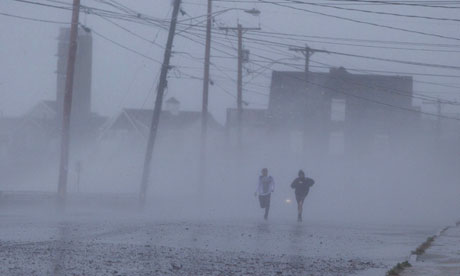
    Hurricane Sandy batters east coast

    Hurricane Sandy battered towns along the United States east coast. Photograph: Scott Eisen/REUTERS

    We know that changes we are making to the Earth’s climate will (and currently are) affecting weather. Some of the impacts are clear to see and easy to quantify. For instance, in some regions, droughts are becoming more severe and longer lasting, while in other locations, the opposite is occurring – more precipitation is falling in heavier downbursts. Two competing issues have to be considered. First, increased temperatures are increasing evaporation rates i.e., drying is occurring. Second, increased temperatures lead to more water vapor in the atmosphere, which results in heavier rain/snow events. In regions that are currently dry, the first issue dominates, whereas in wet regions, the second is more important.

    Despite these competing effects, scientists can detect changes in the drying/wetting patterns around the globe, and these are linked to human emissions.

    For other weather patterns, the evidence is not as clear. For instance for tornadoes, our observations just aren’t good enough to make categorical conclusions. Reliable records in the U.S. started in the early 1950s, but since then, there have been improvements in our sensing instruments, which makes it difficult to assess long-term trends.

    A similar situation exists for hurricanes and cyclones. We are more able to observe and quantify these storms now, so we have to ask whether increases in these storms is caused by global warming, by improved measurements, or by both. Similarly, we have had very destructive storms in the U.S. recently, but is the damage due to more powerful storms or increased infrastructure in storm areas?

    Image of infrared emission from Typhoon Sanba, 2012. Image of infrared emission from Typhoon Sanba, 2012.One useful tool that can help answer these questions are climate models. Climate models are like virtual reality computer programs. You can input today’s conditions (wind speed, temperatures, pressures, etc.) and predict what will happen in the future. Today’s weather forecasts use similar prediction tools. In some respects, “climate” computer programs and “weather” computer programs are different, but there are some clear similarities. “Weather” prediction programs try to give short-term prognostications of local weather a few days into the future. “Climate” predictions attempt to describe long-term trends in large-scale climate patterns years and decades into the future.

    So, how can computer programs help us answer the hurricane/cyclone question? With the help of the program, a scientist can play “what if” scenarios and see how future storms will change. What if greenhouse gases increase? What if ocean temperatures increase? What if wind speeds change? How will these things affect the number and strength of hurricanes?

    Very recently, a publication appeared by perhaps the world’s best-known hurricane scientist, Dr. Kerry Emanuel of MIT. Dr. Emanuel combined global computer simulations with more regional simulations to look into the future at the evolution of storms. What he found was surprising. Because the storms will become stronger and more numerous, within the next century, the power dissipated by future storms will increase by about 50 percent. What was particularly interesting was that his findings show increases in both strong and weaker cyclones.

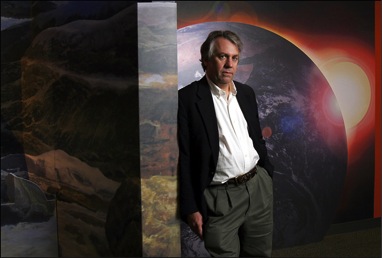
    Dr. Kerry Emanuel, MIT Dr. Kerry Emanuel, MITI asked Dr. Emanuel to summarize the present understanding of hurricanes, and he responded with the following insights:

    • The incidence of high-intensity tropical cyclones (Safir-Simpson categories 3-5) should increase, and the amount of rainfall in these storms should increase, upping the potential for freshwater flooding. These changes will not necessarily occur where tropical cyclones develop and thrive today. “Indeed,” wrote Emanuel, “it is likely that there will be decreasing activity in some places, and increasing activity in others; models do not agree on such regional changes.”

    • Though experts disagree on this point, Emanuel’s work suggests that weak events (tropical storms and Cat 1-2 storms) will become more frequent.

    • “Very little work has been done on the problem of storm size,” wrote Emanuel, “what little research has been done suggests that storm diameters may increase with global temperature. This can have a profound influence on storm surges, which are the biggest killers in tropical cyclone disasters. ”

    Is Dr. Emanuel right? We will have to wait and see. What we do know is he has been right many times in the past, and I am not willing to bet against him. All of this may be academic but it has real human impact. Just ask the people affect by recent storms Katrina, Sandy, Irene, Isaac, Ike, Rita, Wilma, Charley, Ivan, Andrew…you get the point.

  • The oil flowed south, Scots went on the dole … no-one cared

    The oil flowed south, Scots went on the dole … no-one cared

    Iain Macwhirter
    Columnist
    Sunday 28 July 2013

    WHERE’S the anger?

    WHERE’S the anger?

    Custom byline text:
    Iain Macwhirter

    As the economy pulls out of recession into a largely jobless recovery, with wages nearly one-tenth down in real terms on their pre-2008 peak, the strange thing is how little response there has been on the streets. We have been through a longer recession than in the 1930s, and earnings have fallen faster than at any time since the 1870s. Or so economists tell us. Yet, there have been no marches, demos, barricades. Even the Occupy movement, which appeared in city centres two years ago, seems to have vacated the scene.

    The absence of war has posed problems for Scottish Nationalists trying to persuade Scots that they deserve a better deal over oil, welfare benefits, jobs. Scots must be aware that their living standards are being squeezed, and those on benefits are barely surviving. There are hundreds of thousands on housing waiting lists, and many families are living in one-bedroom flats because of the prohibitive cost of buying and renting. But they don’t seem to be drawing the conclusion that oil-rich independence would make them much better off.

    The Yes Campaign is having a desperate time. There is a case to be made that Scots would be better off as a small, independent country like Denmark or Finland, rather than being a provincial backwater of Londonshire. But it’s not getting across. The former SNP candidate, George Kerevan, has even penned an open letter in The Scotsman to Alex Salmond, lamenting his failure to offer a convincing vision. What he is really lamenting is the lack of grievance among Scots about their position in the UK.

    There is cause for Scotland to feel a sense of justified grievance at the loss of oil revenues, which as Professor Gavin McCrone explains in today’s Sunday Herald (following page), were running at up to an astonishing £28 billion a year in the 1980s. Even I had forgotten it was that high. Even tiny Shetland, with 22,000 souls, secured an oil fund of £1bn. The rest of Scotland got nothing – at least not directly.

    Today, much of the Scottish press presents this valuable asset as a burden. “Declining North Sea Oil and gas revenue forecasts could ruin SNP’s economic case for independence”, as the Daily Record put it last week. The oil may be running out, but there is still a lot of it around – £1.5 trillion, according to industry estimates. Denmark and Finland don’t have any oil at all, and they seem to do all right.

    The left in Scotland has it that Margaret Thatcher’s assault on the miners and industry was financed by Scottish oil, and there is something in that. The UK balance of payments depended crucially on the oil wealth as industry collapsed in the last quarter of the 20th century. Much oil revenue went to meet the social cost in unemployment and sickness benefits that came with mass joblessness in the 1980s. Without it, Britain might have been even more bankrupt and the pound would certainly have collapsed in value. Mind you, it collapsed by 25% after 2008 and that is now seen as a good thing.

    But the SNP’s attempt to ignite oil as a Nationalist issue (“It’s Scotland’s Oil”) 30 years ago was an almost complete failure. Throughout the era of peak oil revenues in the 1980s, as hundreds of billions were being sucked out of the North Sea, the Scottish National Party was politically becalmed; blamed somewhat unfairly for forcing the election that brought Mrs Thatcher to power in 1979 (it was surely Jim Callaghan’s fault for not going ahead with the October 1978 election). The crude appeal to self-interest did not appeal to Scottish voters, who like to think that they are motivated by a higher moral purpose.

    And so the oil flowed south and Scotland went on the dole. One-fifth of Scottish industry disappeared in the early 1980s alone, and though new jobs came with the foreign electronics plants of Silicon Glen, they were not like the old jobs. Scotland had been a centre of the industrial revolution in the 19th century, and had been the most advanced technological civilisation after England during the Victorian age. That may sound inflated, but it is a statement of historical fact.

    James Watt’s steam engine, James Young’s distillation of oil, Naysmith’s steam-hammer, Napier’s logarithms, MacAdam’s tarmac, Dunlop’s rubber tyres, Dickson’s motion picture camera, Bell’s telephone and Baird’s TV. Not all of these were developed in Scotland, and industrialists such as Andrew Carnegie and David Buick, the car manufacturer, had to go to America to make their fortunes. But many who remained here created extraordinary industries. Take James Lithgow, who turned a legacy of £1000 into the biggest shipbuilding company in the world in the 1950s.

    We tend to scorn those who celebrate Scotland’s industrial and scientific achievements – but they were real enough. And it wasn’t, of course, Margaret Thatcher alone who destroyed them. Scottish industry had been in decline long before she came to power. What she did was to take on and defeat organised Labour in Scotland – the miners, in particular. Some blame the trades unions for contributing to Scotland’s industrial decline in the 1950s and 1960s by obstructing new and efficient methods of production, and it is true that demarcation disputes were a constant problem in Clydeside.

    But the point is that you will hardly ever hear Scottish voters complaining about this loss of industrial leadership, just as they never complain about the loss of oil revenues. Many Scots, indeed, seem unaware that Scotland has ever been anything other than a threadbare region of the UK that happened to get lucky with oil. That may be as much the fault of the Scottish education system as voter amnesia. But the Scots are probably unique among the regions of Europe in being almost completely lacking a sense of economic grievance.

    I am never quite sure whether to praise or blame Scots for taking their historic defeats so well. There is something rather noble, certainly, in not restoring to the politics of self-interest. Yet there is also something rather sad about a country that does not take itself seriously enough to fight for a better deal.

    Perhaps the current economic “recovery” will alter perceptions. It is almost completely driven by the UK Government’s attempt to boost the housing market – using public money to subsidise the mortgages of people wealthy enough to buy £600,000 houses. Maybe that will ignite some anger. But Scots don’t seem to have much confidence that collective action, political action, is capable of improving things. The habit of dissent seems to have been lost – at least for the time being.

    And no – before you ask – I don’t think people should go out on the streets and cause riots. However, the tradition of protest is a very long and venerable one in Britain, and historians will find it remarkable that this period of economic turbulence has passed with so little trace of public passion. The 1980 recession – much shallower than this one – saw a succession of strikes, demonstrations, campaigns. We saw the growth of alternative comedy, political pop songs from the likes of Billy Bragg and the Proclaimers, radical theatre groups such as 7:84 and Wildcat. Not this time. It’s all quiet on the constitutional front.

    Contextual targeting label:
    Block list

    The absence of war has posed problems for Scottish Nationalists trying to persuade Scots that they deserve a better deal over oil, welfare benefits, jobs. Scots must be aware that their living standards are being squeezed, and those on benefits are barely surviving. There are hundreds of thousands on housing waiting lists, and many families are living in one-bedroom flats because of the prohibitive cost of buying and renting. But they don’t seem to be drawing the conclusion that oil-rich independence would make them much better off.

    The Yes Campaign is having a desperate time. There is a case to be made that Scots would be better off as a small, independent country like Denmark or Finland, rather than being a provincial backwater of Londonshire. But it’s not getting across. The former SNP candidate, George Kerevan, has even penned an open letter in The Scotsman to Alex Salmond, lamenting his failure to offer a convincing vision. What he is really lamenting is the lack of grievance among Scots about their position in the UK.

    There is cause for Scotland to feel a sense of justified grievance at the loss of oil revenues, which as Professor Gavin McCrone explains in today’s Sunday Herald (following page), were running at up to an astonishing £28 billion a year in the 1980s. Even I had forgotten it was that high. Even tiny Shetland, with 22,000 souls, secured an oil fund of £1bn. The rest of Scotland got nothing – at least not directly.

    Today, much of the Scottish press presents this valuable asset as a burden. “Declining North Sea Oil and gas revenue forecasts could ruin SNP’s economic case for independence”, as the Daily Record put it last week. The oil may be running out, but there is still a lot of it around – £1.5 trillion, according to industry estimates. Denmark and Finland don’t have any oil at all, and they seem to do all right.

    The left in Scotland has it that Margaret Thatcher’s assault on the miners and industry was financed by Scottish oil, and there is something in that. The UK balance of payments depended crucially on the oil wealth as industry collapsed in the last quarter of the 20th century. Much oil revenue went to meet the social cost in unemployment and sickness benefits that came with mass joblessness in the 1980s. Without it, Britain might have been even more bankrupt and the pound would certainly have collapsed in value. Mind you, it collapsed by 25% after 2008 and that is now seen as a good thing.

    But the SNP’s attempt to ignite oil as a Nationalist issue (“It’s Scotland’s Oil”) 30 years ago was an almost complete failure. Throughout the era of peak oil revenues in the 1980s, as hundreds of billions were being sucked out of the North Sea, the Scottish National Party was politically becalmed; blamed somewhat unfairly for forcing the election that brought Mrs Thatcher to power in 1979 (it was surely Jim Callaghan’s fault for not going ahead with the October 1978 election). The crude appeal to self-interest did not appeal to Scottish voters, who like to think that they are motivated by a higher moral purpose.

    And so the oil flowed south and Scotland went on the dole. One-fifth of Scottish industry disappeared in the early 1980s alone, and though new jobs came with the foreign electronics plants of Silicon Glen, they were not like the old jobs. Scotland had been a centre of the industrial revolution in the 19th century, and had been the most advanced technological civilisation after England during the Victorian age. That may sound inflated, but it is a statement of historical fact.

    James Watt’s steam engine, James Young’s distillation of oil, Naysmith’s steam-hammer, Napier’s logarithms, MacAdam’s tarmac, Dunlop’s rubber tyres, Dickson’s motion picture camera, Bell’s telephone and Baird’s TV. Not all of these were developed in Scotland, and industrialists such as Andrew Carnegie and David Buick, the car manufacturer, had to go to America to make their fortunes. But many who remained here created extraordinary industries. Take James Lithgow, who turned a legacy of £1000 into the biggest shipbuilding company in the world in the 1950s.

    We tend to scorn those who celebrate Scotland’s industrial and scientific achievements – but they were real enough. And it wasn’t, of course, Margaret Thatcher alone who destroyed them. Scottish industry had been in decline long before she came to power. What she did was to take on and defeat organised Labour in Scotland – the miners, in particular. Some blame the trades unions for contributing to Scotland’s industrial decline in the 1950s and 1960s by obstructing new and efficient methods of production, and it is true that demarcation disputes were a constant problem in Clydeside.

    But the point is that you will hardly ever hear Scottish voters complaining about this loss of industrial leadership, just as they never complain about the loss of oil revenues. Many Scots, indeed, seem unaware that Scotland has ever been anything other than a threadbare region of the UK that happened to get lucky with oil. That may be as much the fault of the Scottish education system as voter amnesia. But the Scots are probably unique among the regions of Europe in being almost completely lacking a sense of economic grievance.

    I am never quite sure whether to praise or blame Scots for taking their historic defeats so well. There is something rather noble, certainly, in not restoring to the politics of self-interest. Yet there is also something rather sad about a country that does not take itself seriously enough to fight for a better deal.

    Perhaps the current economic “recovery” will alter perceptions. It is almost completely driven by the UK Government’s attempt to boost the housing market – using public money to subsidise the mortgages of people wealthy enough to buy £600,000 houses. Maybe that will ignite some anger. But Scots don’t seem to have much confidence that collective action, political action, is capable of improving things. The habit of dissent seems to have been lost – at least for the time being.

    And no – before you ask – I don’t think people should go out on the streets and cause riots. However, the tradition of protest is a very long and venerable one in Britain, and historians will find it remarkable that this period of economic turbulence has passed with so little trace of public passion. The 1980 recession – much shallower than this one – saw a succession of strikes, demonstrations, campaigns. We saw the growth of alternative comedy, political pop songs from the likes of Billy Bragg and the Proclaimers, radical theatre groups such as 7:84 and Wildcat. Not this time. It’s all quiet on the constitutional front.

    inShare0

  • Shortage of Hospital Beds and Prevalence of Lifestyle Diseases Propelling Growth of Hospital Market

    Shortage of Hospital Beds and Prevalence of Lifestyle Diseases Propelling Growth of Hospital Market
    Netscribes, Inc. launches a report on the Hospital Market in India 2013, covering a market with strong growth potential. It is a part of Netscribes’ Healthcare Series.

    New York, NY, July 27, 2013 –(PR.com)– Global market intelligence firm Netscribes Inc. has released its latest report on the ‘Hospital Market in India 2013’, which describes the Indian hospital market as one with the strongest growth potential in the healthcare sector.

    The Indian hospital market faces a critical crunch in the number of hospital beds in comparison to the demand. Persistent growth in population necessitates the growth in both public and private hospital facilities to cater to population of varied economic standards residing in the country.

    The country has witnessed a growing demand for quality healthcare service. This is not only because of changing nature of Indian patient population but also due to the booming medical tourism that India is currently witnessing. As a result, the sector is attracting a good amount of foreign investments in the hospital market in India. The Indian government is also undertaking numerous initiatives including tax incentives and budget allocations that would aid in investment inflow and betterment of the market.

    Indian entrepreneurs are bringing in innovation in the hospital business by revolutionizing the approach towards healthcare delivery. Initiatives are being taken to penetrate smaller cities and towns where the private sector was hesitant to penetrate even a few years back. Primary and secondary care is being offered through specialty clinics or smaller hospitals specializing in few key areas to reduce their cost of operation while still looking to increase revenue by carrying out a number of selected procedures. On the other hand, mobile hospitals and telemedicine is being popularized so that they can reach the patient population in rural and urban slum areas and deliver immediate healthcare services.

    The competitive landscape of the Indian hospital market is primarily segmented into two spheres: public and private. The public hospitals operating in the country provide service at a subsidized rate that enables the under-privileged to have access to reliable treatment. However, in the private segment hospital business in India is dominated by 11 key players that operate on a chain basis, either regionally or nationally. On the other hand, the leading hospitals in the country operate in the standalone format. With the penetration level of private players in the market increasing, healthcare delivery is becoming intensively competitive among the private players, which in turn is resulting in constant development in terms of service offered by them.

    Contact Information
    Netscribes.Inc
    Gaurav Kumar
    +91 33 4027 6214
    Contact
    www.netscribes.com
    Click here to view the list of recent Press Releases from Netscribes, Inc.
  • It’s scary to think that oceans are rising

    Deborah McDermott

    dmcdermott@seacoastonline.com
    July 28, 2013 2:00 AM

    Editor’s note: This is the first in a series of stories on sea level rise in the Seacoast. In future weeks, adaptation measures by individual municipalities will be highlighted.

    Superstorm Sandy was a bellwether for coastal New England, say regional and state coastal environmentalists and scientists. The devastation it wreaked is proof of the need for communities to be proactive in looking at their own vulnerabilities — whether or not people see climate change as the cause.

    “Sea level rise is happening, whether you want to believe it or not,” said Ted Diers of the N.H. Department of Environmental Services, and he ticks off the reasons:

    — The Greenland ice cap is melting

    — Geologically, the land in New England has stopped shifting

    — The ocean is warming, which expands ocean water that “has to go somewhere.”

    “Whether you think climate change is the cause doesn’t really matter, in my mind,” said Diers, administrator of the DES Watershed Management Bureau. “The fact is, these crazy storms are going to be increasing and this is something we should be thinking about now.”

    JT Lockman of the consulting firm Catalysis Adaptation Partners in Portland, Maine, draws an analogy.

    “If you’re robbed, you would immediately spend money to fix the damage, and get better locks,” he said. “You could take the position that until someone can explain to you why you were robbed you aren’t going to spend any money. But I think most people would agree it’s important to do something now.”

    From Seabrook, inland up the coastal river systems and into York County, Maine, the effects of the rising oceans will over time have economic, social, infrastructure and geological impacts.

    In the past five or so years, precise modeling maps have become possible due to the introduction of the Light Detection and Ranging, or LIDAR, laser measuring system. Projections based on this modeling indicate that in the Seacoast, the ocean will rise between 3 and 6 feet by 2100.

    Derek Sowers, project manager of the Piscataqua Region Estuaries Partnership, said storms are going to become more frequent and more powerful in the near future and long term.

    Based on modeling by the University of New Hampshire, he said, a 150-year storm will become a 25-year storm in coastal New Hampshire by the mid-21st century if current carbon emission levels remain constant.

    The economic costs are significant. According to a 2013 study by risk modeling consultants AIR Worldwide, the insured value of properties in the coastal counties of New Hampshire is $64 billion.

    In 2006, Maine state economist Charles Colgan and University of Southern Maine environmental financial expert Sam Merrill conducted a study on the economic impact of increasingly severe storms on seven communities in York County. At the time, they pegged the costs of wages at at-risk businesses at more than $40 million.

    “This isn’t just a little environmental issue we can ignore,” Sowers said. “There’s a true economic and public safety cost. Can we ignore that at our own peril, or recognize scientific realities and plan for the future?”

    Regional cooperation

    The New Hampshire Seacoast has long had a sea level rise champion in the Coastal Adaptation Workgroup, or CAW, a consortium of local, state, federal and nonprofit agencies based in this area. CAW has been meeting monthly since 2009 to share information on the work each has been doing and to coordinate forums and workshops for area municipalities.

    “We want to convey what we’re doing to our communities in a consistent way so we’re not sending out mixed messages about the importance of this issue,” said Sowers, a member of CAW.

    Cameron Wake, associate professor of climatology at UNH and on the staff of the UNH Institute for the Study of Earth, Oceans and Space, is another member. Wake has been working with LIDAR mapping programs to provide detailed modeling of storm surge and sea level rise on most communities in the New Hampshire Seacoast. This information is in turn disseminated to local municipalities to help them in their adaptation planning.

    “They have become a central tool as part of a much broader discussion on the regional level,” he said. “The maps get officials to understand the scope of the challenge and to begin planning.”

    Meanwhile, said Diers at NHDES, the New England states are also planning regionally. “We coordinate well across the states and with the federal government, too, especially NOAA (the National Oceanic and Atmospheric Administration), which is keenly interested in this issue,” he said.

    LIDAR data is driving this effort, as well, he said. “It’s really revolutionized the way that we look at sea level rise and storm surges. We can be very precise. We don’t want communities to over protect,” he said, “but we also want them to be realistic.”

    Public policy challenges

    The governments of New Hampshire and Maine have up until now played largely an advisory role in sea level rise issues. People like Diers or employees at the Maine Coastal Program provide planning help to a variety of stakeholders from environmental organizations to municipalities.

    It’s a role, said Diers, that’s not likely to change much in the future. Grant funding comes almost entirely from the federal government and, in these economic times, he thinks it’s unlikely that state government will step up funding in a significant way.

    “We give money to emergencies. Unfortunately, there’s no such thing as a planning emergency,” he said. “That said, there’s a lot to do and we will do everything with what we have to help.”

    The New Hampshire Legislature recently passed a bill that would form a sea level rise commission to study the issue and make policy recommendations to the Legislature.

    State Sen. David Watters, D-Dover, sponsored the legislation, which was co-sponsored by state Sens. Nancy Stiles, R-Hampton, and Martha Fuller Clark, D-Portsmouth.

    “The fact is, there may be dire financial consequences” from storm surge and sea level rise,” Watters said. “Shouldn’t we plan wisely now?”

    Federal funding is available for planning, particularly through NOAA, but it’s not sufficient to meet the fiscal challenge facing most coastal communities, said USM’s Sam Merrill.

    “There are federal funds available for some things, and I think we’ll see them continue to take a role,” he said. But the grants tend to be small and are likely over time to become smaller, he said.

    When it comes to federal disaster relief, funding is not expected to continue at current levels.

    “It’s impossible for the federal government to come in and pay for everyone,” said Sowers.

    Federal flood insurance is going to become insolvent at some point, he said, as more powerful storms damage buildings and infrastructure.

    “Federal flood insurance programs aren’t supposed to lose money,” Lockman said. “Just like any insurance, the premiums are supposed to be greater than the outlay. But that’s changing. The usual way of doing things isn’t sustainable.”

    That leaves it up to municipalities to bear the brunt of the cost of adaptation measures.

    “The fact is, federal and state coffers are broke,” Merrill said. “Municipal government has to say, ‘We have to take this into our own hands.’”

    Sowers agrees.

    “The message I take away is that if communities understand the challenges they face, the ball is in their court to look after themselves,” he said.

    But Diers is quick to say the world is not ending tomorrow.

    “You plan now, and you set aside a little every year,” he said. “When we’re talking about a 100-year time frame, the whole idea is to talk about it now. If you’re planning to put in the same culvert you put in 30 years ago, you might want to rethink that. It’s that kind of thing.”

    The fact is, said Diers and others, municipalities don’t have much of a choice. But UNH’s Wake said he understands there’s a psychological barrier to deal with, as well.

    “It’s a big shift, there’s no doubt about it,” he said. “If you really accept this is happening, it’s scary. Because if you accept it, you have to start thinking about what you’re going to do — to protect yourself, your family and the community.”

    HOME

    Reader Reaction

    Comments (0)
    Login or signup
    You must be logged in to comment
    0/2500 characters
    Markers:
    Tags:

    Sort By: Most RecentPopular NowMost LikesOldest First
    No items at this time…
    social networking by

    We reserve the right to remove any content at any time from this Community, including without limitation if it violates the Community Rules. We ask that you report content that you in good faith believe violates the above rules by clicking the Flag link next to the offending comment or fill out this form. New comments are only accepted for two weeks from the date of publication.

    Print this ArticlePrint this Article
    Email this ArticleEmail this Article
    Sign Up for Text AlertsSign Up for Text Alerts
    Ads by Google

    Advertisement
  • Speaker: Rising sea levels unstoppable

    Speaker: Rising sea levels unstoppable

    Dramatic changes coming as sea rises and shoreline moves inland, oceanographer says

    •  2

    Related

    Speaker: Rising sea levels unstoppable photo
    It is time to think about the large-scale financial and societal impacts of climate change, John Englander, an oceanographer, global ocean explorer and author, told an audience on Friday.

    By William Kelly

    Daily News Staff Writer

    Humanity has arrived at a geological intersection, and residents who live along the low-lying, densely populated coast of southeast Florida have a front row seat.

    Dramatic changes will unfold in the next few decades as the sea continues to rise and the shoreline moves inland. It is time to think about the large-scale financial and societal impacts, John Englander, an oceanographer, global ocean explorer and author, told an audience on Friday.

    “The world is changing,” he said. “It is stunning, how quickly it is changing.”

    Englander, who penned the book High Tide on Main Street: Rising Sea Level and the Coming Coastal Crisis, was the keynote speaker at a symposium on rising sea levels. More than 200 people attended the event at Oxbridge Academy.

    Englander’s remarks were followed by discussions among panelists who also took questions from the audience. The panelists including educators, government leaders, Realtors, water and natural resource managers, and others. Based on the discussions, the most pressing issues confronting South Florida include flooding; the threat to coastal development, beaches and tourism; property values; and the saltwater contamination of the fresh-water supply.

    Jim Sackett, retired anchor from WPTV NewsChannel 5, moderated.

    Fluctuations in ocean levels are not a new phenomenon for the earth. During the last peak ice age 20,000 years ago — the blink of an eye in geological time — the sea level was 390 feet below where it is today, Englander said. For the last 6,000 years, it has remained essentially constant. But now it is rising (about 8 inches over the last century) and will continue to do so for at least 1,000 years, Englander said.

    This marks the first time that human civilization has collided with climate change and rising seas, he said.

    The arctic has been frozen for three million years. Now the ice there is disappearing by as much as 7 percent a year, he said. As recently as 1970, scientists would not have thought that to be possible.

    “Some September in the next 20 years, the arctic will be completely devoid of ice, and the period of time when it is ice-free will gradually expand each year for decades,” he said.

    The arctic ice is important to the climate because it reflects 90 percent of the sun’s light, rather than absorbing it. Once that region turns to dark ocean, it will reflect only 6 percent of the light, he said. “The planet will absorb more heat. There’s nothing we can do to stop it right now.”

    Most people don’t understand the science, he said. Most of Englander’s audiences believe that the melting polar ice cap contributes to sea level rise, Englander said. The melting of the arctic ice is significant because it is proof that the planet is warming. But it doesn’t add to sea level rise.

    Unlike the ice sheets on Greenland and Antarctica, the arctic ice is not on land. It is frozen ocean, with 10 percent above the surface. The ice displaces the water, so when it melts away it won’t change the level of the seas.

    If all the ice on Greenland were to melt, that would raise the sea level by 24 feet, he said. That could happen in about 3,000 years, he said (Antarctica has seven times more ice than Greenland).

    Ninety percent of the world’s glaciers are receding, and all will eventually disappear. The collective impact of that is 2 to 3 feet of sea level rise.

    Humans can’t reverse the changes in climate and sea level, though it may eventually be slowed. Meanwhile, there is no point in getting depressed about it, he said.

    “We are an amazingly adaptive species,” he said. “It is probably our greatest strength. It may be emotionally challenging, but we’re resilient. We find ways to do that.”

    *

    See Thursday’s edition for a report on the panel discussion at the symposium.

    – See more at: http://www.palmbeachdailynews.com/news/news/speakerrisingsea-levelsunstoppable/nY53n/#sthash.kvY16W04.dpuf