Author: Neville

  • 82 die in Europe’s worst floods for decades

    82 die in Europe’s worst floods for decades

    By ANTHONY FRANCE, COLIN ADAMSON and HUMFREY HUNTER, Evening Standard

    Homes are submerged in
    Vienna, Austria

    Torrential rains across central Europe have led to the worst flooding in decades, claiming the lives of 82 people.

    At least 58 died in the Black Sea area at the weekend, where thousands of Russian tourists were caught out by floodwaters that swept cars and tents out to sea.

    Thousands of British tourists are being forced to cancel holidays amid the chaos. One of the worst-hit cities is Prague, where more than 50,000 people, including foreign visitors, were being evacuated today as the most devastating floods for more than a century threaten to engulf the Czech capital.

    Soldiers and hundreds of volunteers worked into the early hours building sandbag barriers. But as torrential rain continued to fall overnight much of the city looked likely to be under water by this evening and a state of emergency was declared.

    Parts of Mala Strana, the mediaeval area of the city centre, were almost certain to be flood-damaged as the deluge forced dams on the river Vltava to open their gates. Prague has not seen the river as high since 1890 with estimates putting the water flow at 20 times the average for the time of year.

    In Croatia, according to the country’s tourist board, 25,000 people – up to 8,000 of them British – have cancelled trips and those already on holiday have shortened their stay. Fearing for the future, Croatian tourism chiefs are now heading to the UK to get expert advice on how to offer the best holiday facilities when it rains.

    Croat tourism expert Ruzica Mikacic said: “This has been terrible for our country’s economy. We have had 8,000 British campers cancel and there are probably many more who decided not to come. Some actually made it here, did not like the weather and decided to head off back home or somewhere where it didn’t matter that it was raining.”

    A Welsh women’s under-21 hockey team was today stranded in hotel in Ceske Budejovice, two hours south of Prague, by a moat of water with the players unable to get to the airport to fly home. The 27 players and supporters are helping local residents fill sandbags to protect the hotel from the rising water after an international tournament was cancelled after just one game on Sunday.

    In Austria, Salzburg has been declared a disaster zone and Vienna is under threat. The Danube has been closed to all shipping as the river has swollen to a near 100-year high. Three people have been killed in towns near Salzburg. In the city itself 1,000 buildings were partially or totally submerged, and the sightseeing-boat Amadeus sank. Emergencyservices in Upper Austria, where over three-quarters of the region is affected by flooding, said 8,000 workers and volunteers were ready to help evacuate residents.

    Experts fear the Danube will rise by as much as 30 feet, threatening several villages. In Germany an eight-year-old girl was among four people who died because of the floods. Six districts in Bavaria and others in Saxony have been declared a state of emergency and the highway-between Munich and Salzburg through the Alps was closed. In Switzerland, torrential rains caused a series of small landslides.

    Worldwide, a mudslide ploughed through a mountain village in China’s Yunnan province, killing seven people. In the Philippines, at least 11 people died and more than 400 were evacuated as heavy rains and a waterspout triggered mudslides, damaged houses and washed out roads. At least 14 people have drowned in flash floods in Iran today. In Nepal, meanwhile, relief agencies say floods and landslides following torrential monsoon rains have killed at least 422 people, while scores more are missing and thousands have been left homeless.

    For a change, much of southern England was bathed in warm sunshine today. For the next few days London and the South-East can expect sunshine and temperatures as high as 27C. “For once it looks like we are the lucky ones weatherwise,” said a Met Office spokesman.
    Read more: http://www.dailymail.co.uk/news/article-133199/82-die-Europes-worst-floods-decades.html#ixzz2ViS7WWKg
    Follow us: @MailOnline on Twitter | DailyMail on Facebook

  • ACT hotter than hot for growth Date

    ACT hotter than hot for growth

    Date
    June 9, 2013
    • 9 reading now
    • (8)
    A housing report shows the ACT is performing remarkably when it comes to residential development and population growth.A housing report shows the ACT is performing remarkably when it comes to residential development and population growth. Photo: Graham Tidy
    A HOUSING report shows the ACT is punching above its weight when it comes to residential development and population growth.

    The Housing Industry Association Population and Residential Building Hotspots report indicates the region rates the third highest number of ”hot spots” of states and territories in a weighted comparison.

    Hot spots are areas where the annual population growth rate is above the national average and the value of residential building work is more than a benchmark set on a jurisdiction.

    NSW, Victoria and Western Australia had to record values in excess of $100 million, Queensland and South Australia $50 million, the ACT and the Northern Territory $20 million and Tasmania $10 million.

    Advertisement

    In 2011-12 the ACT recorded 12 hot spots, down from 14 in the previous 12 months.

    Victoria recorded 17, Queensland 13, Western Australia seven, South Australia three, Tasmania two and Northern Territory two.

    HIA ACT/Southern NSW acting executive director Adrian Langford said the ACT had a strong track record for development compared with the rest of the country.

    But he said the next financial year would probably return less positive results for the sector, particularly due to the lack of confidence since the announcement of the federal election.

    The HIA has welcomed the ACT government’s initiatives in the recent budget to stimulate the building industry.

    From September the First Home Owner Grant will rise from $7000 to $12,500 and will only be applicable for buyers of new homes or those they will ”substantially renovate”.

    According to the report issued during the week, the booming north filled the top six positions on the ACT’s list. These suburbs were Crace, Bonner, Forde, Harrison, Casey and Franklin.

    But the established areas of Belconnen, Macgregor, Civic, Kingston-Barton, Bruce and Braddon also recorded more than $20 million worth of building approvals and grew populations by more than 1.6 per cent.

    Kambah rated as the suburb with the highest value of approvals for alterations and additions in the ACT, recording $6.1 million worth of approved work during the 2011-12 financial year.

    This was followed by Ainslie ($5.4 million) and then O’Connor ($4.9 million).

    The report also showed that the ACT was the only jurisdiction other than the Northern Territory to record the bulk of its population growth (6907) from a natural increase of 3439.

    ”The ACT has seen something of a baby boom over most of the past decade, where most years during this period has seen an increased number of persons added to the population due to natural increase,” the report said.

    In 2011-12 net overseas immigration accounted for 2772 people and interstate immigration for 695 people.

    The ACT also had two areas make the nation’s top 20 hot spot list – Bonner was first on the list and Belconnen eighth.

    Bonner recorded more than $170 million of residential building approvals and a population growth rate of 99.7 per cent and Belconnen had $122 million in approvals and an annual population growth rate of 12.3 per cent.

    Read more: http://www.canberratimes.com.au/act-news/act-hotter-than-hot-for-growth-20130608-2nx7w.html#ixzz2ViNJECFp

  • Runoff: Measuring the North’s glacier wastage

    Runoff: Measuring the North’s glacier wastage

    Print
    Font Size:
    Default font size
    Larger font size
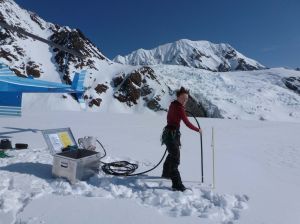
    Melting glaciers Photos by Regine Hock

    Melting glaciers

    Grad student Joanna Young drills a hole into the Susitna Glacier for a weather station and a melt stake to be installed in April.

    Posted: Saturday, June 8, 2013 11:45 pm

    Runoff: Measuring the North’s glacier wastage Molly Rettig newsminer.com | 0 comments

    Every summer, Alaska’s glaciers melt and send vast quantities of water gushing through silty gray rivers, past towns and villages and finally into the sea. Some glaciers calve directly into the ocean, instantly losing car-sized chunks of ice and wowing boats full of tourists.

    The world’s melting glaciers are boosting ocean levels 0.71 millimeters per year, accounting for roughly one-third of total sea level rise, according to a recent study.

    “That’s the equivalent of draining the Great Lakes once a month each year,” says Regine Hock. She and colleague Anthony Arendt, both glaciologists at the University of Alaska Fairbanks Geophysical Institute, just contributed to an article in Science on the role of glaciers in sea level rise.

    Alaska and Canada comprise nearly half of that — purging 100 gigatons of mass annually from frozen storage into the ocean.

    The mass loss, which scientists call wastage, is so massive that it changes the Earth’s gravity field and alters ocean currents around Alaska. So heavy is it that parts of the Earth can bounce up several centimeters in response.

    The scientists worked with an international team to calculate the ice loss of glaciers around the world from 2003 to 2009 using satellite data and ground measurements.

    “When many people think about sea level rise, they only think about the big ice sheets in Greenland and Antarctica. They don’t think these smaller ones can contribute anything,” says Hock.

    The other two-thirds of total sea level rise come from equal parts melting ice sheets and the warming and expansion of oceans. Overall, oceans have risen 2.5 millimeters per year since 2003.

    “In 10 years, that’s an inch. That’s quite a lot,” says Hock.

    It trickles in from the state’s favorite glaciers — Gulkana in the Alaska Range, Exit in Seward, Portage on the Kenai Peninsula, Mendenhall in Juneau, Columbia on Prince William Sound and all throughout the Wrangell mountains.

    Where does it go?

    “Most of the meltwater ends up in streams and eventually makes its way to the oceans,” Hock says.

    This affects not just the ocean but the overall hydrology of the Earth. Communities in the Andes, for example, rely on glacial runoff for water in the summer dry season. The more ice that is lost, the smaller their water source

    Glacier water is cold and fresh, which affects the temperature and chemistry of rivers and oceans — and can impact fisheries and ecosystems.

    “Salmon and other species are really sensitive to stream composition. If the temperature changes just a few degrees, that might affect whether salmon can spawn,” Arendt says.

    Glacier mass changes have traditionally been estimated by field measurements of individual glaciers.

    “It’s really old school,” Arendt says.

    Scientists dig a snow pit in the winter and measure the snow accumulation, calculate its density, and then convert it to water equivalent. This tells them the annual growth of the glacier.

    To calculate melting, they drill a stake into the ice at the beginning of summer and measure the height sticking above the surface. An end-of-summer measurement reveals how much was lost. This depth is converted to water equivalent and extrapolated to the whole basin.

    The melt has greatly outpaced the snowfall, according to these observations.

    But because of logistics, there are only a handful of such field sites over Alaska’s vast ice-covered region.

    To capture broader changes, the new study combined conventional field measurements with satellite data.

    One tool was measuring the gravitational force exerted by glaciers.

    From Newton, we know that greater mass means larger gravitational force. When a satellite crosses a large mass (like an ice sheet) it speeds up a little because of the greater force. Over areas with less mass, the satellite slows down. By tracking satellite positions over time, you can estimate changes in the ice sheet.

    They learned the volume loss by measuring the distance between a satellite and the glacier.

    “You bounce a laser off the surface and it tells you the height. You come back at a later time and map that height again,” says Arendt. What does this mean for the world — and Alaska?

    Some coastlines will be hit harder than others, depending on which glacier regions melt the most.

    Sea levels will actually drop in Alaska, as the weight of glaciers is lifted and the earth rises relative to the water.

    “As the glaciers disappear, and you take off that load, it allows the earth’s crust to rebound in response,” Hock says.

    Smaller glaciers, like those in the Brooks Range, will disappear faster than bigger, high-elevation glaciers like those on St. Elias. As glaciers shrink, so could tourism.

    Understanding glacier wastage can help predict flooding in river communities and plan energy projects.

    “With hydropower coming online, these companies need to know how much water will be transported into these watersheds and how that will change in the future,” Hock says.

    Since the late 1970s, the University of Alaska Fairbanks’ Geophysical Institute has provided this column in cooperation with the UAF research community.

  • Wind Power Blowing Strong In Cold Climates

    Wind Power Blowing Strong In Cold Climates

    Posted: 08 Jun 2013 05:54 AM PDT

    The deployment of wind turbines in cold climates has been taking place rapidly in cold climates.

    Wind farm in the snow (Netherlands).Dutch wind farm.
    Image via T.W. van Urk/Shutterstock.

    This deployment is so significant that 40–50 GW of wind power capacity (wind turbines, basically) is forecast to be constructed by 2017. That would be an increase of 72% compared to 2012, and cost approximately €75 billion.

    Wind speeds tend to be higher during the winter in the United States. For example, in Birmingham, wind speeds are highest during the winter months of December, February, and March, while wind speeds are lowest in the hot summer months of June, July, and August.

    The density of cold air also helps to increase wind power production, according to Technical Research Centre of Finland (VTT).

    “This is a huge opportunity,” says Research Scientist Tomas Wallenius from VTT Technical Research Centre of Finland. “There has been a lot of talk about the potential of offshore wind power, but the market for cold climate wind energy is more than ten times greater. We already have the tools to harness the potential of cold climate wind energy cost-effectively, while offshore wind energy is still at the research and development stage.”

    Winter weather can have a negative impact on wind turbines (ice and snow accumulation for example), but fortunately, this has been studied and addressed (to some extent). Icing, for example, causes production losses of 3–10% per year. Anti-icing systems address this by pulsating the blades and heating them.

    VTT has conducted the first study into the feasibility of deploying wind turbines in cold regions across the globe. Some of the cold climates include Scandinavia, Canada, Central Europe, United States, and China.

    Wind Power Blowing Strong In Cold Climates was originally posted on: PlanetSave. To read more from Planetsave, join thousands of others and subscribe to our free RSS feed, follow us on Facebook (also free), follow us on Twitter, or just visit our homepage.

  • Corporation moots methane plants to power streetlights

    Corporation moots methane plants to power streetlights

    Deepa H. Ramakrishnan

    Share  ·   Comment   ·   print   ·   T+  T+  ·   T-
    Over the last 14 years, Deepa’s beats have changed every now and then. Currently, she covers infrastructure, the TNPCB and fishermen’s issues in Chennai…. »

    Plan comes in the aftermath of residents opposing localised compost yards, fearing stench

    With Chennai Corporation’s plan to set up compost yards near residential localities and in parks facing stiff resistance from residents, the civic body proposes to install small bio-methanation plants that will power lights.

    “The idea is to get residents to see how the garbage from their homes lights up streetlights in the area. This will encourage them to segregate garbage at home. We will also utilise waste from local hotels,” said an official in Chennai Corporation.

    As a pilot project, two plants would be installed at the Villivakkam slaughterhouse and the garbage transfer station for Royapuram zone.

    “These will be set up in about three months,” he added.

    The bio-methanation plants will be fuelled with vegetable and food waste and will emit methane. The gas will be captured and used to generate power. The by-product, slurry, can be used as manure.

    The plan comes in the aftermath of residents opposing localised compost yards, fearing the possibility that they may generate a stench. “In one instance, a portion of land had been earmarked in a park for a compost pit but residents were adamantly against it and even locked up the place,” the official added.

    A recent survey among city residents by The Energy and Resources Institute (TERI) found that at least 49 per cent of those interviewed were unwilling to segregate waste.

    Only 33 per cent indicated willingness to segregate their solid waste into biodegradable and non-biodegradable components. Twenty three per cent of the respondents perceived adverse impact on health due to improper solid waste management.

    Many residents cite the lack of space as the reason for not segregating garbage. For instance, Kannan, a resident of T. Nagar, said that he did not have the space to keep two bins.

    Many residents also continue to see the handling of the garbage as the duty of the Corporation.


  • Labor’s woolly plan for a referendum on local government at the September 14 federal election has hidden fangs

    Labor’s woolly plan for a referendum on local government at the September 14 federal election has hidden fangs

    Your Friends’ Activity

    NEW! Discover news with your friends. Give it a try.
    To get going, simply connect with your favourite social network:

    Facebook
    • twitter
    • linkedin
    • google

    This feature allows you to discover news with your friends on Our Network.

    This means stories that are read and watched will be shared with your friends, and they’ll share things with you too.

    To try out Discover news with friends simply login with your favourite social network. You can login with Facebook, Twitter, Linkedin or Google+

    Give it a try! You can turn it off at any time.

    Question Time

    Speaker of the House Anna Burke during Question Time in the House of Representatives at Parliament House in Canberra. Picture: Gary Ramage Source: The Daily Telegraph

    LOCAL government might not sound like a sexy topic (probably because it isn’t) but the federal government’s plan to seek constitutional reform via a referendum at this year’s election is a disgrace, both for the change sought and the process being followed to achieve it.

    Voters right across the country should be concerned about plans to give the Commonwealth more power over how local governments spend their money, not to mention enshrining local government in our Constitution.

    After all, how many more examples do we need of centrally controlled government schemes being either inefficiently run or downright dangerous?

    Don’t get me wrong, I’m no fan of local government administrations. Most “politicians” who serve at the local government level are thoroughly unimpressive to say the least.

    But at the moment they are entirely limited by the powers state governments bestow on them.

    Constitutional recognition of local government potentially breaks that control while giving the Commonwealth yet another arm of local service delivery that it can stick its nose into.

    From the Homepage

    I’m filthy over Origin ban

    Paul Gallen PAUL Gallen: SO many questions have been thrown my way in the wake of Wednesday night’s State of Origin match.

    The real faces of 457 Visas

    The real faces of 457 Visas THEY do the jobs most Australians either don’t want or can’t do.

    ‘Women for Gillard’ funding push

    Clarabella BurleyEXCLUSIVE: JULIA Gillard is to launch a new Women For Gillard campaign based on the United States’ successful fundraising movement Women for Obama.

    Search goes on as more bodies found

    Search goes on as more bodies found THE bodies of 13 asylum seekers have now been sighted by rescuers in the grim search for survivors after an asylum seeker boat tragedy.

    Churches denounce anti-vaccine cult

    Jane LeonforteEVERY genuine religion in Australia wants parents to vaccinate their kids, from Islam and Judaism to Seventh Day Adventists and Jehovah’s Witnesses.

    Kids who just want love

    Kids who just want love CEBBY’S full-time carer died when he was eight. Like many other kids in the Northern Territory he just wants and needs to be cared for.

    Gym junkies muscle in on power drugs

    Peptide UseSPECIAL INVESTIGATION: FITNESS fanatics, teenagers and bikie gangs are driving a massive rise in the use of illegal peptides and hormones.

    Michelle and ex still a ‘great team’

    Michelle Bridges and Bill Moore THEY may not have succeeded in love, yet in business the relationship between Michelle Bridges and her ex-husband Bill Moore is as happy as ever.

    Such a referendum was tried and failed twice before: in 1974 and in 1988.

    But at least on those two occasions the government played fair when proposing change, funding both the yes and the no cases.

    This time there is a $20 million (taxpayer) funded allotment for the yes case, with not one red penny going towards the no case.

    That is a style of democracy more common in Russia than in Australia.

    As outrageous as the approach from the Labor government has been on this issue, the opposition has been little better in the way that it has approached the matter.

    It signed off in agreement on the referendum “yes” case before it had even seen the wording of the question, and before bothering to ask its party room what it thought about the issue (many MPs have a problem with it, incidentally).

    The wording for the referendum question is not that which was thought up by the expert panel which looked into constitutional recognition of local government, nor is it the wording the Joint Select Committee settled on either.

    In fact constitutional lawyers who usually disagree on most things are in unison in their opposition to this referendum question, suggesting that such change to the Constitution, if passed, will have a range of adverse unintended consequences.

    The answer is simple: vote NO on September 14.

    WHAT A BURKE

    THE current Speaker of the House of Representatives, Anna Burke, doesn’t seem to understand what the whole point of Question Time is. Let’s just think about it for a moment: to answer questions perhaps? Consider what she told the opposition this week in parliament when it complained that ministers weren’t answering questions: “Question time is not about the answers you are looking for; it is about ministers being relevant to the question.”

    No wonder your average voter is so disillusioned with the politics of spin.

    TERROR-FYING

    SO a convicted jihadist terrorist was held in low security detention in the Adelaide Hills for several months before finally being moved to a more appropriate facility.

    The opposition took great delight this week in pointing out that the facility was fenced off by nothing more than a “pool fence”. I’m no fan of the way that the opposition likes to beat up the issue of boat arrivals, but that surely is a pretty extraordinary situation, even if the terrorist never ventured out for a little wine tasting while he was there.

    On one hand the poor security appraisal gives rednecks and racists the opportunity to (rather unfairly) tar all asylum seekers with the jihadist brush. On the other hand it was an alarmingly casual approach to how to handle a known terrorist.

    SWAN BUSHED

    EDUCATION reforms are laudable to say the least, so bravo to Labor for pursuing the much debated Gonski education package.

    But perhaps the Deputy Prime Minister needs to sign himself up for a class focused on basic expression, assuming his home state of Queensland decides to sign up to the reforms.

    In parliament on Wednesday Wayne Swan not so eloquently said: “We want to ensure that every child gets a good education and none is left behind.”

    It reminded me of something that other great wordsmith, former US President George W Bush, once said: “Rarely is the question asked: is our children learning.”