Author: Neville

  • With CO2 Cuts Tough, U.S. and China Pledge a Push on Another Greenhouse Gas

    With CO2 Cuts Tough, U.S. and China Pledge a Push on Another Greenhouse Gas

    By ANDREW C. REVKIN
    The presidents on Saturday. China and the United States agreed to discuss ways to reduce emissions of hydroflourocarbons, known as HFCs.Christopher Gregory/The New York TimesThe presidents on Saturday. China and the United States agreed to discuss ways to reduce emissions of hydroflourocarbons, known as HFCs.

    As some environmental analysts had hopedPresident Obama and President Xi Jinping of China found room to maneuver on global warming in their California desert retreat. They sidestepped the super wicked issues impeding restrictions of the greenhouse gas of greatest concern, carbon dioxide, and staff released a joint statement on plans to cut releases of hydrofluorocarbons, or HFCs, a potent group of heat-trapping gases.

    Below you can read the joint statement, followed by a link to a 2010 Times article showing how this action by the two nations is related not to the troubled 1992 United Nations climate treaty, but instead is an outgrowth of the 1987 Montreal Protocol, an accord originally aimed at controlling synthetic chemicals that were harming the atmosphere’s protective ozone layer:

    United States and China Agree to Work Together on Phase Down of HFCs

    Today, President Obama and President Xi agreed on an important new step to confront global climate change. For the first time, the United States and China will work together and with other countries to use the expertise and institutions of the Montreal Protocol to phase down the consumption and production of hydrofluorocarbons (HFCs), among other forms of multilateral cooperation. A global phase down of HFCs could potentially reduce some 90 gigatons of CO2 equivalent by 2050, equal to roughly two years worth of current global greenhouse gas emissions.

    The agreement between the United States and China reads as follows:

    Regarding HFCs, the United States and China agreed to work together and with other countries through multilateral approaches that include using the expertise and institutions of the Montreal Protocol to phase down the production and consumption of HFCs, while continuing to include HFCs within the scope of UNFCCC and its Kyoto Protocol provisions for accounting and reporting of emissions.

    HFCs are potent greenhouse gases used in refrigerators, air conditioners, and industrial applications. While they do not deplete the ozone layer, many are highly potent greenhouse gases. Their use is growing rapidly as replacements for ozone-depleting substances that are being phased out under the Montreal Protocol on Substances that Deplete the Ozone Layer. Left unabated, HFC emissions growth could grow to nearly 20 percent of carbon dioxide emissions by 2050, a serious climate mitigation concern.

    The Montreal Protocol was established in 1987 to facilitate a global approach to combat depletion of the stratospheric ozone layer. Every country in the world is a party to the Protocol, and it has successfully phased out or is in the process of phasing out several key classes of chemicals, including chlorofluorocarbons (CFCs), hydrochlorofluorocarbons (HCFCs), and halons. The transitions out of CFCs and HCFCs provide major ozone layer protection benefits, but the unintended consequence is the rapid current and projected future growth of climate-damaging HFCs.

    For the past four years, the United States, Canada, and Mexico have proposed an amendment to the Montreal Protocol to phase down the production and consumption of HFCs. The amendment would gradually reduce consumption and production and control byproduct emissions of HFCs in all countries, and require reporting in these areas. The amendment includes a financial assistance component for countries that can already access the Protocol’s Multilateral Fund, and leaves unchanged the reporting and accounting provisions of the UN Framework Convention on Climate Change and Kyoto Protocol on HFC emissions.

    Here’s the 2010 article with more on this climate strategy: “A Novel Tactic in Climate Fight Gains Some Traction.”

  • Climate talk by Dr.John James

    John James
    5:15 AM (5 hours ago)


    Dear Friends

    Here is the link to a resounding talk I gave at the Carrington in Katoomba in May 2013. I describe what is inevitable in global warming, what we cannot now avoid, and what we could do to maintain our happiness, our humanity and our love.

    Please pass this video on the EVERYONE who you think should listen to it. This is the truth. This is our future, and we can survive it!!

    http://www.youtube.com/watch?v=UFhNyWHv0qQ&feature=youtu.be

  • The American Party

    Climatologist

    GET UPDATES FROM Dr. James Hansen

    45

    The American Party

    Posted: 05/30/2013 9:00 am
    178
    56
    31
    224
    Get Green Alerts:

    My remarks when receiving the Ridenhour Courage Award were written in Union Station on my way to the event. But my concluding comment — that we are near a point when the American people should contemplate a centrist third party — was not an idle spur-of-the-moment reflection.

    I was in government 40 years, long enough to understand how aging organizations can evolve into self-licking ice cream cones1, organizations whose main purpose becomes self-perpetuation rather than accomplishment of their supposed objectives. The public can see this tendency in our politicians, our Congress, and our major political parties.

    Our government has failed to address climate, energy, and economic challenges. These challenges, addressed together, actually can be a great opportunity. Our democracy and economic system still have great potential for innovation and rapid adoption of improved technologies, if the government provides the right conditions and gets out of the way.

    The Solution is Not Rocket Science

    Conservatives and liberals alike can recognize the merit of honest pricing of fossil fuels. Fossil fuels today receive subsidies and do not pay their costs to society. Human health costs of pollution from fossil fuel burning and fossil fuel mining are borne by the public. Climate disruption costs are borne by the victims and all taxpayers.

    This market distortion makes our economy less efficient and less competitive. Fixing this problem is not rocket science. The solution can be simple and transparent.

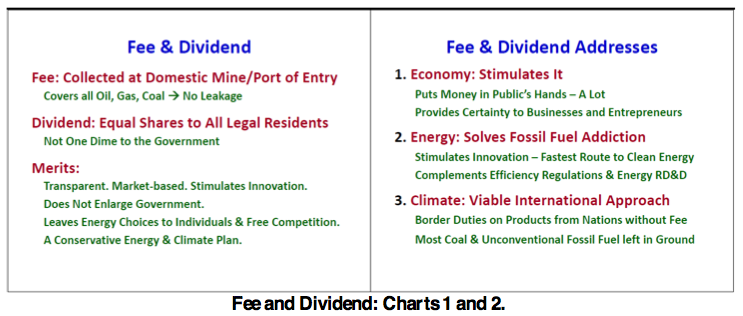
    I have described a fossil fuel “fee-and-dividend” approach, summarized on Charts 1 and 2. 100% of a continually rising carbon fee, collected from fossil fuel companies at the domestic mine or port-of-entry, is distributed uniformly to all legal residents (electronically to bank account or debit card). 60% of people receive more in the dividend than they pay in increased prices, but to get or stay on the positive side of the ledger they must pay attention to their fossil fuel use. Millions of jobs are created as we move toward clean energy. Economic modeling shows that our fossil fuel use would decrease 30% after 10 years. A rising carbon fee provides a viable international approach to reduce global emissions, the basic requirement being a bilateral agreement between the U.S. and China. A border duty on products from nations without an equivalent carbon fee or tax would provide a strong incentive for other nations to join.

    Reactions to this proposal are revealing. When I spoke to a group of international labor leaders, one of them declared “that’s libertarian!”. Yet I have found that most people understand that millions of jobs would be created by a system that moves us in a clear way to an honest price on all energies, far more jobs than provided by continued public subsidies of fossil fuels and specific favored “green” energies.
    2013-05-30-Screenshot20130530at8.48.38AM.pngAfter I spoke to a group of conservative politicians, one of them said “that’s income redistribution!” Well, yes, overall fee-and-dividend is progressive, and some ambitious low income people who pay special attention to their carbon footprint will be able to save money for other purposes. Wealthy people who own multiple houses or fly around the world a lot, will pay more in added costs than they receive in the dividend. However, the added cost to them is small compared with change of income tax rates — and lower income tax rates would be much more likely when the economy improves as the system moves toward honest pricing of fossil fuels.

    One other experience may be worth relating. I was invited by one Jim DiPeso, policy director of Republicans for Environmental Protection, to give a keynote talk at their meeting. DiPeso had written an article praising my fossil fuel fee-and-dividend proposal as embodying conservative principles. Soon I was disinvited. Rumor has it that DiPeso was last seen being escorted to a boat on the shores of Lake Michigan and being fitted with large concrete shoes.

    What Choices Do People Have?

    The extreme reactions (libertarian! income redistribution!) do not represent the feelings of most Americans I have spoken with. Most people readily appreciate fee-and-dividend and honest pricing of fossil fuels, once it is explained. They understand that it would help modernize our infrastructure, improve our economic competitiveness, and raise living standards. DiPeso noted that it could be made clear in an elevator talk. The public needs to know, but unfortunately, we do not have a President giving fireside chats on such fundamental matters, despite their importance for the economy, energy independence, national security, and climate stabilization.

    The public is rational about such matters, in my opinion. But what present choices do they have?

    Some Republicans are so well-oiled and coal-fired that they assert that human-made climate change is a “hoax” perpetrated by scientists seeking research funding (allowing them to work 80 hours a week for a modest wage, after investing 7-10 years in obtaining their higher education). Realistic Republicans, seeing the power of extremists, hesitate to speak.

    Well-oiled coal-fired Democrats exist too, but their main problem is addiction to spending our money. Even when they advocate fee-and-dividend, they propose to use much of the fee to “pay down the national debt” (read: “make the government bigger”) and to fund their pet energy technologies.

    Energy Research, Development and Demonstration (RD&D)

    Government has a proper role in energy technology — it should support RD&D (research, development and demonstration). This topic is crucial to climate stabilization and closely related to the present topic — our currently dysfunctional two-party system — so I briefly digress.

    Climate stabilization requires phasing out fossil fuel CO2 emissions, which in return requires a large source of carbon-free electricity. Hydropower is limited in amount. That leaves nuclear power and “renewables” (wind, sun, geothermal, etc.) as principal alternatives to fossil fuels, at least with current technologies.

    Unfortunately, proponents of nuclear power or renewables, in promoting their preference, usually attack the other. This helps the fossil fuel industry, but is detrimental to our children’s future. Given the urgency of phasing out CO2 emissions, we need both nuclear and renewables. In the long run, one may win out over the other, but this is no time for mutual destruction.

    Solar power and wind power have moved smartly through RD&D in recent years and are beginning to provide significant amounts of electricity, the biggest success story being Germany. In the decade 2001-2011 Germany increased the non-hydroelectric renewable energy portion of its electricity from 4% to 19%, with fossil fuels decreasing from 63% to 61% (hydroelectric decreased from 4% to 3% and nuclear power decreased from 29% to 18%). Germany’s renewable energy is continuing to increase (but the fact that Germany is building new lignite power plants is disconcerting as regards their expectations for fossil fuel phase-out).

    Nuclear power has demonstrated a capacity for rapid expansion, e.g., in the decade 1977-1987, France increased nuclear power production 15-fold, the nuclear portion of electricity increasing from 8% to 70%. That was 2nd-generation technology, light-water reactors that use only about 1% of the energy in the nuclear fuel, leaving nuclear waste with a lifetime of millennia. Reactors planned today (mostly 3rd generation, light-water technology) include improvements (such as convective cooling that can operate without external power, thus avoiding the basic problem faced by the Fukushima reactors), but they still leave most of the fuel as long-lived “waste.”

    Expansion of nuclear power thus depends on introduction of 4th generation technology, “fast” reactors, which allow neutrons to move fast enough to utilize more than 99% of the nuclear fuel. These reactors also can “burn” nuclear waste as well as excess nuclear weapons material. Argonne National Laboratory extensively tested a prototype, the Integral Fast Reactor (IFR), designed with a fuel cycle that minimized the possibility of plutonium acquisition by terrorists or a rogue state. Using this technology there is sufficient fuel in nuclear waste and excess weapons material to provide our electrical energy needs for centuries without uranium mining.

    Given the awareness of climate change that existed in the 1990s, it was a shock when President William Clinton, in 1993 in his first State of the Union address declared: “We are eliminating programs that are no longer needed, such as nuclear power research and development.” Although this pleased a vocal anti-nuclear minority, it deprived the nation of the ability to examine and compare all potential alternatives to fossil fuel electricity and reduced our potential to provide international leadership in peaceful uses of nuclear power.

    This 1993 decision, to at least some extent, has caused a 20-year delay in development and refinement of advanced nuclear power technology in the United States. Just as with solar technology, there is great potential for technology development that reduces costs of nuclear power, especially via standardized modular construction. Bill Gates, who points out that nuclear power is already safer than all other major energy sources, is using a part of his personal wealth to develop a specific 4th generation reactor, but for the sake of optimizing results and minimizing future electricity costs it is desirable to have more broad-based RD&D.

    Past failure to carry out this RD&D has created a situation in which gas is the likely energy source for continued and expanded electricity generation. In turn, this means that political leaders in many countries will be practically forced to approve hydraulic fracturing (“fracking”) for gas on a large scale, unless sufficient effective alternatives are available.

    Gas will truly be a transition fuel between coal and clean energies only if better, inexpensive, clean alternatives for electricity generation are developed. Otherwise such fuel-switching could backfire, because usable gas resources are enormous It would be helpful if advocates for nuclear power and renewables would be mutually supportive. Let competition and the public decide what energy sources they prefer on the long run. That decision can be made best as experience allows the full potential of all alternatives to tested. A rising fee on carbon can then be successful, leading to phase-out of fossil fuel emissions.

    The American Party

    The public recognizes and is fed up with the failure of both political parties to work for the common good. So is it time to abandon them for a third party? Perhaps not quite.

    Some conservative thought leaders recognize the merits of a carbon fee, a non-tax, 100% of collected funds distributed to the public on per capita basis. I have mentioned a Wall Street Journal article endorsing this approach by George Shultz and Gary Becker, Shultz having been Secretary of State under Reagan and Becker being a Nobel prize winning economist. It seems worthwhile to work hard to gain support for this approach, with expectation that conservative support would be conditional on liberals not using any of the funds to expand government.

    However, it may turn out that no matter how we try, such a rational approach cannot gain sufficient support within any reasonable period. The rumor about DiPeso’s concrete shoes is only half facetious. Among potential supporters there seems to be a palpable fear of ostracism if they were to endorse a moderate conservative approach such as fee-and-dividend.

    And yet moderation is just what most Americans seem to want.

    In such case, the fastest way to progress may be a 3rd party, a centrist party. It is very possible that the United States is ready for a centrist American Party. In 1992 Ross Perot garnered almost 20% of the votes for President. At times he had led in the polls, but he damaged his credibility in several ways, including his assertion that he had once seen Martians on his front yard.

    Compared with 1992, a much larger fraction of the people is fed up with the failures of both major parties. If, following the mid-term elections of 2014, there is not a strong indication of bipartisan progress, it may be time to consider the possibility of launching a major centrist 3rd party effort, not only for the Presidency but for Congress as well.

    Citizens Climate Lobby

    Implausible dreaming, you scoff. Not so fast. For example, consider Citizens Climate Lobby. If you don’t know about them read today’s article in the New York Times. These are honest, hard- working people trying to educate politicians and the public about the need for a revenue-neutral carbon fee via op-eds, letters-to-the-editor, meetings with editorial boards, meetings with congressional staffers, and meetings with congress people.

    Citizens Climate Lobby is made up largely of volunteers, with continual training of new recruits. They have doubled in size each year for the past several years and are active in most states. They are positive, dedicated and respectful, creating a good impression with congress people.

    What is the chance that they can compete against the well-heeled fossil fuel lobby? Hard to say. But if they fail to move our present government by 2015, and by then have doubled in size a few more times, they just may be a democratic force to be reckoned with. They seek to persuade and are unfailingly respectful and polite, but determined. So, if in a few years the two major parties remain uncompromising and unsupportive of a carbon fee, it would not surprise me if Citizens Climate Lobby became a major force for a centrist third party.

    Everybody is welcome to join Citizens Climate Lobby — a link to an introductory call is at http://www.tfaforms.com/275537. Their summer conference in Washington this year is 23-25 June; registration is at http://citizensclimatelobby.org/2013-international-conference

    1A self-licking ice cream cone is a self-perpetuating system with no purpose other than to sustain itself. The phrase was used first in 1992 in On Self-Licking Ice Cream Cones, a paper by Pete Worden about NASA’s bureaucracy.

    Cross-posted from Dr. Hansen’s website.

    FOLLOW GREEN
    135k

    My remarks when receiving the Ridenhour Courage Award were written in Union Station on my way to the event. But my concluding comment — that we are near a point when the American people should contem…
    My remarks when receiving the Ridenhour Courage Award were written in Union Station on my way to the event. But my concluding comment — that we are near a point when the American people should contem…

    • Comments
    • 224
    • Pending Comments
    • 0
    • View FAQ

    Previewing Your Comment.

    This comment has not yet been posted

    You have exceeded your word limit by    words. Please click the “Edit” button and shorten your comment.

    You can post to us this information Contact us

    Post CommentPreview Comment

    To reply to a Comment: Click “Reply” at the bottom of the comment; after being approved your comment will appear directly underneath the comment you replied to.

    Post Comment Preview Comment

    To reply to a Comment: Click “Reply” at the bottom of the comment; after being approved your comment will appear directly underneath the comment you replied to.

    Share your Comment:

    Post to Facebook.
    Post to Blogger.
    Post to Twitter.
    Post to WordPress.
    Post to TypePad.
    Post to Tumblr.
    Post to Yahoo!
    Blogger login:
    Blogger password:
    Select blog:  refresh list
    Remember me:
    WordPress host:
    WordPress login:
    WordPress password:
    Remember me:
    TypePad host:
    TypePad login:
    TypePad password:
    Select blog:  refresh list
    Remember me:
    Tumblr login:
    Tumblr password:
    Remember me:
    Community Notice:  We’ve made some changes to our badge program, including the addition
    of our newest badge: Community Curator.
    View All
    Favorites
    Recency  |
    Popularity
    Page: 1 2 3 4 5  Next ›  Last »  (5 total)
    photo

    HUFFPOST SUPER USER

    Michael Mann

    Nuclear Educator
    05:06 PM on 06/06/2013

    The topic is making the right choices for a better future. The best choice for supplying energy humanity needs with the least impact on the environment is nuclear energy; first with current technology and later with advanced reactors like the LFTR . Childish word games are off topic.

    Michael_Mann: The topic is making the right choices for a better

    History  | Permalink  | Share it

    This comment has been down-ranked into oblivion. View comment
    You have not right to carry out this operation or Error this operation.

    spinner Loading comments…

    This comment has been removed due to violations of our [Guidelines]
    photo

    HUFFPOST SUPER USER

    Atoms4Peace1

    Applying the atom peacefully since 1978
    03:38 PM on 06/07/2013

    Fess up professor, you work for the coal industry. They pay you to post.

    Atoms4Peace1: Fess up professor, you work for the coal industry. They

    History  | Permalink  | Share it

    This comment has been down-ranked into oblivion. View comment
    You have not right to carry out this operation or Error this operation.

    spinner Loading comments…

    This comment has been down-ranked into oblivion. View comment
    You have not right to carry out this operation or Error this operation.

    spinner Loading comments…

    photo

    HUFFPOST SUPER USER

    Michael Mann

    Nuclear Educator
    08:01 PM on 06/03/2013

    Dr. James Edward Hansen, Department of Earth and Environmental Sciences at Columbia University. Hansen is best known for his research in the field of climatology, his testimony on climate change to congressional committees in 1988 that helped raise broad awareness of global warming, and his advocacy of action to avoid dangerous climate change. From 1981 to 2013, he was the head of the NASA Goddard Institute for Space Studies in New York City, a part of the Goddard Space Flight Center in Greenbelt, Maryland. He might know a few things…maybe we should listen to what he has to say…

    Michael_Mann: Dr. James Edward Hansen, Department of Earth and Environmental Sciences

    History  | Permalink  | Share it

    This comment has been down-ranked into oblivion. View comment
    You have not right to carry out this operation or Error this operation.

    spinner Loading comments…

    professor

    Correkt the Spelling and Pick on the Moniker
    03:18 PM on 06/03/2013

    You can tell this guy is living in a dream world.

    First he trumpets nuclear power with out the slightest mention of Fukushima.

    Then he champions a 3rd party, like that even means anything at all.

    Just because he invented global warming doesn’t make him the Apotheosis of All Humanity.

    He got lucky once and ever since has been riding his own coattails.

    How bout somebody lives in the real world?

    professor: You can tell this guy is living in a dream

    History  | Permalink  | Share it

    photo

    HUFFPOST SUPER USER

    Atoms4Peace1

    Applying the atom peacefully since 1978
    03:39 PM on 06/07/2013

    why mention Fukushima at all? A 50-year Gen 1 technology that was overwhelmed by a 1/1000 year tsunami that killed 25,000 is irrelevant to this conversation.

    You dont live in the real world. Because if you did, you would know the real world is powered by nuclear. In some places more than others. Yet nuclear goes on.

    I bet where you live you derive electricity from nuclear.

    But you are in denial.

    Atoms4Peace1: why mention Fukushima at all? A 50-year Gen 1 technology

    History  | Permalink  | Share it

    This comment has been down-ranked into oblivion. View comment
    You have not right to carry out this operation or Error this operation.

    spinner Loading comments…

    This comment has been down-ranked into oblivion. View comment
    You have not right to carry out this operation or Error this operation.

    spinner Loading comments…

    professor

    Correkt the Spelling and Pick on the Moniker
    03:13 PM on 06/03/2013

    I don’t know who got to this guy. Apparently, he doesn’t know about Fukushima. Which is still emitting radiation hand over fist. Like a typical academic, he lives in a bubble of pure theory. He cannot imagine real nuclear power plants, run by unaccountable, irresponsible, schlemiels, built by corrupt, corner-cutting phonies, engineered by pompous know-it-alls who have no idea whatsoever the future will bring (more radioactivity in our morning porridge seems painfully inexorable, but somehow they can’t, in their immovable self-congratulation, foresee it) leaking to high heaven, and then exploding.

    Or else he’s just co-opted like the rest of them.

    professor: I don’t know who got to this guy. Apparently, he

    History  | Permalink  | Share it

    HUFFPOST SUPER USER

    PEinEE

    06:23 PM on 06/03/2013

    More junk science

    Actually real science peer reviewed and published in reputable journal from Unscear just told us ‘The Fukushima Nuclear Disaster Will Kill No One – As I Told You” Google

    PEinEE: More junk science Actually real science peer reviewed and published

    History  | Permalink  | Share it

    photo

    HUFFPOST SUPER USER

    Michael Mann

    Nuclear Educator
    08:06 PM on 06/03/2013

    The UN just released the definitive report on the impact of Fukushima. “A breakdown of data, based on age, gender and proximity to the nuclear plant, does show a higher cancer risk for those located in the most contaminated parts. Outside these parts – even in locations inside Fukushima Prefecture – no observable increases in cancer incidence are expected.” Experts also stated that the psychosocial impact of the nuclear disaster may have a long-term consequence on the health and well-being of the population, and this should be addressed as part of the overall response along with the environmental impact to prevent future incidents of this nature.

    http://www.un.org/apps/news/story.asp?NewsID=44248#.Ua0sIUBtjTk

    Michael_Mann: The UN just released the definitive report on the impact

    History  | Permalink  | Share it

    This comment has been down-ranked into oblivion. View comment
    You have not right to carry out this operation or Error this operation.

    spinner Loading comments…

    This comment has been down-ranked into oblivion. View comment
    You have not right to carry out this operation or Error this operation.

    spinner Loading comments…

    photo

    HUFFPOST SUPER USER

    Atoms4Peace1

    Applying the atom peacefully since 1978
    04:53 PM on 06/05/2013

    Obviously you have your facts mixed up. I downloaded the Japan Radiation Network on my smart phone and 0.5 microSv/hr is not “hand over fist”. Get a grip.

    To you everyone is as schlemiel. Have you looked in the mirror? There is one there too.

    Atoms4Peace1: Obviously you have your facts mixed up. I downloaded the

    History  | Permalink  | Share it

    This comment has been down-ranked into oblivion. View comment
    You have not right to carry out this operation or Error this operation.

    spinner Loading comments…

    spinner Loading comments…

    This comment has been down-ranked into oblivion. View comment
    You have not right to carry out this operation or Error this operation.

    spinner Loading comments…

    01:53 PM on 06/02/2013

    Subsidies for green energy so they dont go bankrupt – smart investment
    Tax deductions for cash operating expenses – “Tax Subsidy” –
    George Orwell – 1984.

    Joe_Dallas: Subsidies for green energy so they dont go bankrupt –

    History  | Permalink  | Share it

    photo

    HUFFPOST SUPER USER

    Atoms4Peace1

    Applying the atom peacefully since 1978
    03:42 PM on 06/07/2013

    What was the same of that company that went bankrupt after getting a subsidy? Solaria? Solartopia?

    http://www.forbes.com/fdc/welcome_mjx.shtml

    #accountability.

    Atoms4Peace1: What was the same of that company that went bankrupt

    History  | Permalink  | Share it

    This comment has been down-ranked into oblivion. View comment
    You have not right to carry out this operation or Error this operation.

    spinner Loading comments…

    photo

    HUFFPOST SUPER USER

    Atoms4Peace1

    Applying the atom peacefully since 1978
    Atoms4Peace1: http://www.forbes.com/sites/chuckjones/2013/04/09/solar-companies-continue-to-go-bankrupt/

    History  | Permalink  | Share it

    This comment has been down-ranked into oblivion. View comment
    You have not right to carry out this operation or Error this operation.

    spinner Loading comments…

    This comment has been down-ranked into oblivion. View comment
    You have not right to carry out this operation or Error this operation.

    spinner Loading comments…

    01:50 PM on 06/02/2013

    AS Hansen stated in the article – Economic modeling shows that our fossil fuel use would decrease 30% after 10 years.
    We can only hope the economic modeling is better than the climate modeling.

    Joe_Dallas: AS Hansen stated in the article – Economic modeling shows

    History  | Permalink  | Share it

    photo

    HUFFPOST SUPER USER

    Atoms4Peace1

    Applying the atom peacefully since 1978
    03:44 PM on 06/07/2013

    It would decrease if production and demand decreased. Since in 10 years another 2 billion will be added to the planet, its hard to fathom current economic modelling without consideration for population growth and the growth of high performance computing which places burdens on demand.

    Atoms4Peace1: It would decrease if production and demand decreased. Since in

    History  | Permalink  | Share it

    This comment has been down-ranked into oblivion. View comment
    You have not right to carry out this operation or Error this operation.

    spinner Loading comments…

    photo

    mbkeefer

    Elder Amateur Scientist
    04:13 PM on 06/07/2013

    If the economic modeling is anywhere near as good as the climate modeling has been, it will be amazing.

    mbkeefer: If the economic modeling is anywhere near as good as

    History  | Permalink  | Share it

    This comment has been down-ranked into oblivion. View comment
    You have not right to carry out this operation or Error this operation.

    spinner Loading comments…

    This comment has been down-ranked into oblivion. View comment
    You have not right to carry out this operation or Error this operation.

    spinner Loading comments…

    This user has chosen to opt out of the Badges program

    photo

    12:14 PM on 06/02/2013

    How is it that the 1% so readily and so repeatedly is able to garner so much support from the right-leaning members of the 99%? This is the question, wherein lies the solution to forging the political will to change America and move to a sustainable national way of life. Anyone have the answer(s)?

    Rik_Seyman: How is it that the 1% so readily and so

    History  | Permalink  | Share it

    ubrew12

    that crazy uncle from Amarcord
    04:19 PM on 06/02/2013

    Its the history of fascism. Italy, 1870-1930. Politicians incur deficit spending by trying to please all sides. Taxes are cut on the rich, spending continues for the poor. Debt is passed onto successors. Cans are kicked down the road, bitter pills aren’t swallowed. The economy falls into malaise, the population becomes restive. ‘The rich are too rich.’ ‘The poor are too lazy.’ But the rich have political power, so the second meme is what gets pushed. New politicians try to distract the population by identifying ‘enemies of the state’: foreign and domestic. Its helpful to conduct a foreign war against a hapless and blameless Third World country (Ethiopia). Red anarchists are ‘everywhere’, plotting the overthrow of all we hold dear. Fortunately, a breed of supermen is foisted on the public. They are ram-rod straight in posture. They have medals on their breasts. They fought and defeated the enemy overseas, perhaps they can do the same at home. Just a temporary ‘adjustment’ in civil liberties, and everything will be alright…

    When people are scared and living hand-to-mouth, supermen look awfully attractive. Mussolini got elected furious about the debt. Mussolini doubled the debt. So it goes, until it all collapses and a generation goes by while reforms are instituted that should have been there all along.

    ubrew12: Its the history of fascism. Italy, 1870-1930. Politicians incur deficit

    History  | Permalink  | Share it

    This comment has been down-ranked into oblivion. View comment
    You have not right to carry out this operation or Error this operation.

    spinner Loading comments…

    photo

    HUFFPOST SUPER USER

    Atoms4Peace1

    Applying the atom peacefully since 1978
    03:45 PM on 06/07/2013

    I dont think nuclear energy is partisan to the right. There are supporters and detractors across party lines. Its about what is best for the growing world population.

    Atoms4Peace1: I dont think nuclear energy is partisan to the right.

    History  | Permalink  | Share it

    This user has chosen to opt out of the Badges program

    photo

    Rik_Seyman: Any thoughts about this story?http://www.huffingtonpost.com/2013/06/08/san-onofre-nuclear-plant-closing_n_3408386.html?ir=Green&ref=topbar

    History  | Permalink  | Share it

    This comment has been down-ranked into oblivion. View comment
    You have not right to carry out this operation or Error this operation.

    spinner Loading comments…

    This comment has been down-ranked into oblivion. View comment
    You have not right to carry out this operation or Error this operation.

    spinner Loading comments…

    This comment has been down-ranked into oblivion. View comment
    You have not right to carry out this operation or Error this operation.

    spinner Loading comments…

    02:26 AM on 06/02/2013

    In order for this to succeed we have to have honest politicians and that is hard to come by.

    Barbara_Wilson_Stevens: In order for this to succeed we have to have

    History  | Permalink  | Share it

    photo

    HUFFPOST SUPER USER

    Atoms4Peace1

    Applying the atom peacefully since 1978
    03:46 PM on 06/07/2013

    agreed. Start with Harry Reid. He pushed back an adequate nuclear waste disposition policy that took billions and thirty years. The hubris of politicians.

    Atoms4Peace1: agreed. Start with Harry Reid. He pushed back an adequate

    History  | Permalink  | Share it

    This comment has been down-ranked into oblivion. View comment
    You have not right to carry out this operation or Error this operation.

    spinner Loading comments…

    This comment has been down-ranked into oblivion. View comment
    You have not right to carry out this operation or Error this operation.

    spinner Loading comments…

    10:36 PM on 06/01/2013

    there are too many different groups with individual issues. That’s why they fail to have an impact. Until all groups work together, no group will make a difference.

    Pat_Benjamin: there are too many different groups with individual issues. That’s

    History  | Permalink  | Share it

    This comment has been down-ranked into oblivion. View comment
    You have not right to carry out this operation or Error this operation.

    spinner Loading comments…

    11:02 AM on 06/01/2013

    Hansen has clearly not progressed from the hypothetical tax and dividend to writing the required legislation and modelling its impacts.

    He describes an hypothetically “progressive” tax measure, that is a measure that collects a greater share of wealthy persons’/households’ disposable income and a lesser share of poorer households’ disposable income.

    But householdsd with the top 25% of incomes net 12-18 times more after-tax-+-govt-support income than households in the bottom 25%. But the households that own three cars and fly around the world only consume about three time as much energy as the poorest households–50% of whom don’t own any cars now.

    So any energy tax is highly regressive–shifts tax burden from the rich to he poor–before we account for Hansen’s prescribed government-administered programmes that need to be set up to manage the process of distributing the cash back to citizens/households. To make this tax programme “progressive”, you would have to rebate more than $3, on average, to the poorest 25% of households for every $1 in carbon tax they pay, assuming a $0 rebate, on average, for the wealthiest 25%.

    And then how much further regulation is required to ensure that the poor don’t use their carbon tax profit to buy their first fossil fuel-guzzling car? Does government have to also intervene to control how households spend their rebates?

    Aldyen: Hansen has clearly not progressed from the hypothetical tax and

    History  | Permalink  | Share it

    ubrew12

    that crazy uncle from Amarcord
    04:16 PM on 06/01/2013

    “any energy tax is highly regressive” It’s a tax on fossil energy at the source. That’s all it is. It just happens to be slightly progressive because rich people have a larger fossil footprint. It’s purpose is NOT to redistribute wealth. Easier ways exist, like estate taxes, taxes on wealth, progressive income taxes, also a tax on stock trading.

    “how much further regulation is required to ensure that the poor don’t use their carbon tax profit to buy their first fossil fuel-guzzling car?” This sentence suggests you don’t understand this tax/dividend scheme. The poor are free to buy whatever car they want. They are also free to smoke cigarettes. But it’ll cost them.

    ubrew12: “any energy tax is highly regressive” It’s a tax on

    History  | Permalink  | Share it

    This comment has been down-ranked into oblivion. View comment
    You have not right to carry out this operation or Error this operation.

    spinner Loading comments…

    This comment has been down-ranked into oblivion. View comment
    You have not right to carry out this operation or Error this operation.

    spinner Loading comments…

    09:50 AM on 06/01/2013

    It could be the simplest solution in the world, but when it comes to making a buck, almost everyone will try to cash in. Greed has a way of trumping common sense and morality.

    Vgman: It could be the simplest solution in the world, but

    History  | Permalink  | Share it

    This comment has been down-ranked into oblivion. View comment
    You have not right to carry out this operation or Error this operation.

    spinner Loading comments…

    photo

    HUFFPOST SUPER USER

    skintero

    05:13 AM on 06/01/2013

    Another tax is not what we need.

    skintero: Another tax is not what we need.

    History  | Permalink  | Share it

    05:35 AM on 06/01/2013

    It’s the simplest and least painful way to solve a major problem. What else would you suggest? (Doing nothing is not a viable option.)

    j_l_mcdonald: It’s the simplest and least painful way to solve a

    History  | Permalink  | Share it

    This comment has been down-ranked into oblivion. View comment
    You have not right to carry out this operation or Error this operation.

    spinner Loading comments…

    ubrew12

    that crazy uncle from Amarcord
    04:18 PM on 06/01/2013

    No, what we need is higher property insurance rates, higher weather-related cleanup costs, and higher costs of rebuilding ports and low-lying populated areas away from rising sea levels (/sarcasm).

    ubrew12: No, what we need is higher property insurance rates, higher

    History  | Permalink  | Share it

    This comment has been down-ranked into oblivion. View comment
    You have not right to carry out this operation or Error this operation.

    spinner Loading comments…

    spinner Loading comments…

    This comment has been down-ranked into oblivion. View comment
    You have not right to carry out this operation or Error this operation.

    spinner Loading comments…

    HUFFPOST SUPER USER

    bthompson18

    08:18 PM on 05/31/2013

    Then the Government would put a 100% tax on it.

    bthompson18: Then the Government would put a 100% tax on it.

    History  | Permalink  | Share it

    This comment has been down-ranked into oblivion. View comment
    You have not right to carry out this operation or Error this operation.

    spinner Loading comments…

    This user has chosen to opt out of the Badges program

    photo

    11:52 AM on 05/31/2013

    Someone help me out… How does “pay down the national debt” equate to “make the government bigger?”

    AuntSally: Someone help me out… How does “pay down the national

    History  | Permalink  | Share it

    photo

    HUFFPOST SUPER USER

    skintero

    skintero: It doesn’t http://economix.blogs.nytimes.com/2012/01/06/under-obama-a-record-decline-in-government-jobs/

    History  | Permalink  | Share it

    This comment has been down-ranked into oblivion. View comment
    You have not right to carry out this operation or Error this operation.

    spinner Loading comments…

    This comment has been down-ranked into oblivion. View comment
    You have not right to carry out this operation or Error this operation.

    spinner Loading comments…


    Page: 1 2 3 4 5  Next ›  Last »  (5 total)

    spinner Loading comments…

  • Climate change is happening but we can meet the challenge

    Climate change is happening but we can meet the challenge

    As carbon emissions rise inexorably, it’s easy to feel powerless as catastrophe looms. But activism is a chance to take control

    Keystone XL pipeline protests

    Demonstrators in San Francisco rally against the Keystone XL oil pipeline. Photograph: Stephen Lam/Reuters

    “The level of carbon dioxide in the atmosphere just hit 400ppm,” I told Alex, my 23-year-old son, as we were catching up on news.

    “So that’s it, huh?” he asked.

    I couldn’t think what to say. Alex had just returned from college, a new graduate, ready to start his life as an adult. Like many members of his age group, Alex knows that 350ppm is the threshold for safe levels of carbon in the atmosphere. Pass that level and, climate scientists tell us, things get dicey: soils dry out, damaging food production. There is more frequent and more intense flooding, coastlines get inundated, species go extinct. Farming, which relies on predictable weather patterns, is disrupted, and dry land farming areas turn to desert. Forests die from new infestations and drought, and become more prone to monster fires.

    Young people like Alex are coming of age in a world that’s changing much faster than was predicted just a few years ago. Already, scenes of wildfires, floods, drought, and storms border on apocalyptic. And so far, temperatures have risen less than one degree centigrade.

    So what does a young person do when confronted with a global climate crisis? What does anyone do?

    Based on a roundtable discussion with young leaders and informal conversations with others of all ages, I’ve come to believe that these three steps are essential:

    First, let this reality sink in. This is not the future we thought we would have. Young people, especially, have the right to be disappointed, angry, and fearful. It will take courage to face this new normal, especially when so many others remain disconnected from what’s happening. By being mindful of your own emotions, you can experience fear or grief without being overwhelmed by those feelings. And by remaining alert to the way the climate crisis may show up in your life, you can be better prepared and more resilient.

    There’s controversy among some environmental leaders about whether to downplay the dangers for fear of frightening people or fostering nihilism. But if we are counting on the unique human genius for creative solutions, we need to be honest about the task at hand, and the consequences of inaction.

    Second, take a stand. We may be too late to stop the climate from shifting, but we can likely stop the most catastrophic effects of climate change. People of all ages are stepping up to block extraction, transportation, and burning of fossil fuels and to challenge the clout of the fossil fuel lobby. Some are doing it to protect their community’s water or air or their own health; others are motivated by concern for climate stability and the lives of generations to come. Here are some examples:

    • President Obama has the power to stop the Keystone XL Pipeline, which would expedite further extraction of tar sands, an extraordinarily destructive form of energy. Around the United States, people are pressing the president to reject the pipeline and make good on his promise to take on the climate challenge.

    • Fracking for natural gas has been sold as a climate-friendly alternative to coal and oil. It is not. Leakage of methane during extraction and shipment makes it as damaging to the climate as other fossil fuels, and it threatens precious groundwater supplies. Communities around the United States are joining up to block fracking.

    • In the Pacific Northwest, young people, Native American tribes, and others are mobilizing to stop the rail transport of huge quantities of Wyoming Powder River Basin coal to Northwest seaports for export to Asia.

    • Students and alumni are calling on colleges and universities to divest holdings in oil companies. While this might not immediately reduce the mammoth profits of these global corporations, it does help erode the legitimacy of this industry and therefore their claim on public subsidies and special benefits (like the right to use our atmosphere as a dumping ground).

    Third, consider ways to replace the consumer-oriented, energy-intensive ways of life that are unaffordable both for many of our families and for the planet. Young people are especially are turning to finding satisfaction in what they contribute, the depth of friendships, and in personal development – rather than in “having stuff”. Building relationships founded in trust and reciprocity increases quality of life and resilience today, and builds the foundation for the life-centered – rather than consumption-centered – world that can thrive within the constraints of a small planet.

    The news about the climate is daunting, but we don’t have to wait for skeptics or politicians to get it. We can act right now by getting real about what’s happening, taking a stand to stop further damage to our climate, and working together to build a world that treasures the precious diversity of life on this planet – including human life today and in the future.

  • Save oceans – save environment June 08, 2013

    Save oceans – save environment

    June 08, 2013

    ZARINA PATEL

    E-mailPrintPDF

    World Oceans Day is celebrated each year on 8th June to highlight the importance of oceans and to raise global awareness of the existing threats to oceans. The day is the official UN-designated international day of ocean celebration. The two-year theme for 2013 and 2014 is “together we have the power to protect the ocean”.



    OCEANS ARE IMPORTANT FOR ALL LIVING BEINGS “With every drop of water you drink, every breath you take, you are connected to the sea. No matter where on Earth you live” – Sylvia Earle

    Oceans provide us precious minerals, food and enormous highway for business. Oceans cover three quarters (70%) of our planet Earth and holds 97% of planet’s water. Surface of Earth contains (5) five oceans, including the Arctic, Atlantic, Indian, Pacific and Southern. The main oceans further subdivided into smaller regions called seas, gulfs, or bays. The world ocean has an area of about 361 million sq km (139,400,000 sq mi), an average depth of about 3,730 m (12,230 ft), and a total volume of about 1,347,000,000 cu km (322,280,000 cu mi). Each cubic mile of seawater weighs approximately 4.7 billion tons and holds 166 million tons of dissolved solids.

    Salinity is a main feature of oceans. Six elements (chlorine, sodium, magnesium, sulfur, calcium, and potassium) represent over 90% of the total salts dissolved in the oceans. On the deep ocean floor, manganese nodules, formed by the precipitation of manganese oxides and other metallic salts around a nucleus of rock or shell, represent a potentially rich and extensive resource. The ocean floor might hold more than the 110 million tones of rare earths elements. Countries such as Kuwait, and Israel, desalinate ocean water to produce freshwater.

    Oceans provide food resources for more than one billion people around the world. As much as 10% of human protein (rich in essential fatty acids) intake comes from the oceans. Pharmacists have been using coral reef plants, blue green algae and animals for making medicines of arthritis, Alzheimer’s, heart diseases and cancers.

    Oceans are full of natural treasures. Oysters are valuable sources of pearls. The oceans’ “shallow continental shelves” are a great source of sand and gravel. A study reveals that the great amount of deuterium present in the ocean water makes it a perfect source of energy that can be used in the development of the nuclear fusion reactors. Oceans provide recreational activities for people around the world. Fishing, scuba diving, boating, swimming, and water skiing are favourite pass time for water lovers.

    THE OCEANS AFFECT GLOBAL CLIMATE AND WEATHER The atmosphere and oceans influenced each other. Earth’s atmosphere mainly depends on oceans and ocean life. Oceans regulate weather and improve global temperature. They serve as global temperature stabilisers and help to buffer man caused carbon dioxide emission. Nearly half the CO2 produced by human activities in the last 200 years has dissolved into the ocean.

    Most of the sunlight absorbed by earth is absorbed at the top of the tropical ocean. The atmosphere does not absorb much sunlight. It is too transparent. Sunlight passes through the air and warms the surface of the ocean. Most of the ocean is a deep navy blue. It absorbs 98% of the solar radiation when the sun is high in the sky. Ocean plants such as mangroves, sea grass bed etc generate half of the world’s oxygen. According to UN oceans are lungs of our planet Earth.

    The action of winds blowing over the ocean surface creates waves and the great current systems of the oceans. When winds are strong enough to produce spray and whitecaps, tiny droplets of ocean water are thrown up into the atmosphere where some evaporate, leaving microscopic grains of salt sustained by the turbulence of the air. These tiny particles may become nuclei for the condensation of water vapour to form fogs and clouds.

    When water evaporates, heat removed from the oceans and stored in the atmosphere by the molecules of water vapour. When condensation occurs, this stored heat freed to the atmosphere to develop the mechanical energy of its motion. The atmosphere obtains nearly half of its energy for circulation from the condensation of evaporated ocean water.

    MAJOR THREATS TO OCEANS Human activities have imposed alarming danger to oceans life especially cetacean species (whales, dolphins and porpoises). Cetacean species are oceanic mammals found in both freshwater and marine environment. According to WWF for nature report, Nineteen species of cetaceans had so far been reported found in Pakistan, also home to the blue whale, known to be the world’s largest animal, as well as the finless porpoise, one of the smallest marine cetacean species. There are about 1,300 whales are living in River Indus. Of the 18 cetacean species found in Pakistan, three are baleen whales while the remaining are toothed whales and dolphins.

    These species are facing tremendous threats such as whaling, pollution, extinction of food resources, loss of habitat, climate change, toxic substances, plastic materials presence, net entanglement, and ship strikes and over fishing.

    In Pakistan, unregulated use of gillnets in profit-making fishing and a vast boost in fishing boats are major threats to the cetacean species. the precious cetaceans entangled in fishing nets each year. The fishing fleet increased from 2,133 and 4,355 (in 1986) to 6,636 and 10,689 in Sindh and Balochistan, respectively, in 2011. The United Nations resolution on gillnets has restricted its length to 2.5km. However, in Pakistan the average size of a gillnet is from 10km to 12km while exceptionally large size gillnets (up to 24km) are also in use.

    Overfishing is one big threat and directly changing aquatic ecosystems. Statistics reveal that global main marine fish stocks are in danger, increasingly pressured by overfishing and environmental degradation. Several important commercial fish populations have declined to the point where their survival is threatened. Unless the current situation improves, stocks of all species currently fished for food predicted to collapse by 2048.

    The latest data from the international scientific committee, which monitors tuna in the Pacific, showed blue fin tuna stocks were a small fraction of what they had been and were in danger of disappearing. According to a Food and Agriculture Organisation (FAO) estimate, over 70% of the world’s fish species either fully exploited or depleted. The dramatic increase of destructive fishing techniques world-wide destroys marine mammals and entire ecosystems. FAO reports that illegal, unreported and unregulated fishing world-wide appears to be increasing as fisher men seek to avoid stricter rules in many places in response to shrinking catches and declining fish stocks.

    The oceans are facing threats from global warming. Global warming have negative impacts on sea levels, coastlines, ocean acidification, ocean currents, seawater, sea surface temperature, tides and the sea floor. Human activities emit heat-trapping carbon dioxide causing rise of the average ocean temperature. Human-based carbon emissions as the primary culprit for average acidity increases of 30 percent in the world’s surface waters since the Industrial Revolution.

    Marine population is facing terrible time due to global warming. Algae produces food for other marine life through photosynthesis is vanishing due to ocean warming. The acidification of the oceans due to climate change impairs the ability of coral reefs and shelled organisms to form skeletons and shells. Research has shown that krill reproduce in significantly smaller numbers when ocean temperatures rise. This can have a disastrous effect by disrupting the life cycle of krill eaters, such as penguins and seals. According to the World Wildlife Fund, a small increase of two degrees Celsius would destroy almost all existing coral reefs. Additionally, ocean circulation changes due to warming would have disastrous impact on marine fisheries.

    Warmed ocean surface is leading to increased temperature. When water heats up, it expands. This expansion results in shoreline erosion, and powerful storms and hurricanes/cyclones. These stronger storms can increase damage to human structures when they make landfall. They can also harm marine ecosystems like coral reefs and kelp forests. An increase in storm frequency means more destruction for small habitats. Global warming has caused the global ocean temperatures to increase by an average of a third of a degree Celsius (about a half a degree Fahrenheit), and this change has fuelled the increase in hurricane intensity.

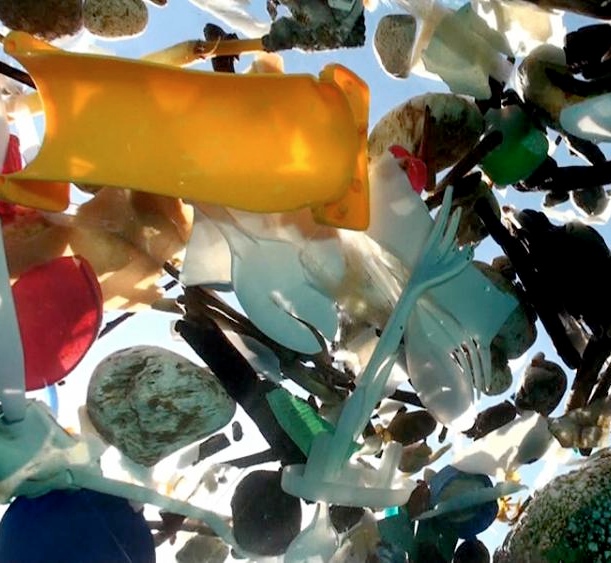
    Presence of pesticides, herbicides, chemical fertilisers, detergents, oil, sewage, plastics, and other solids are polluting our oceans. Solid waste like bags, foams, plastic materials are fatal for marine mammals, fish, and birds that mistake these materials for food.

    Scientists are discovering that pharmaceuticals ingested by humans but not fully processed by our bodies are eventually ending up in the fish we eat. According to a research, Pakistan has a coastline that stretches over 1050km, (990km measured as a straight line) along the Arabian Sea. The coast of Pakistan consists of sandy beaches that interrupted by rocky protruding points. The Indus delta located at the head of the Arabian Sea has found changing its characteristics due to damming upstream, which has reduced river borne sediments.

    Pakistani mangroves are located mainly along the delta of the Indus River eco region. Major mangrove forests are on the coastline of Sindh and Balochistan. The mangroves are bush like trees, which grow in shallow waters often on small islands, which regularly get swamped by changes.

    The mangroves provide a diverse habitat for a complex and inter-reliant community of invertebrates, fish, birds, and reptiles. News report revealed that despite their importance to this region the mangrove forests are constantly under attack from untreated chemicals and industry bi-products, which discarded directly into the sea. Near urban areas, mangroves are cleared for developmental activities. Reduced water flow in the River Indus after the construction of dams and barrages upstream is also causing damage to the mangrove forest and its surrounding ecosystem.

    The increased presence of loud or continual sounds from ships, sonar devices, oilrigs, and even from natural sources like earthquakes are disrupting the voyage, communication, hunting, and reproduction patterns of many marine animals, particularly aquatic mammals like whales and dolphins. The highest levels of noise appear in the northern parts of the Atlantic and Pacific Oceans and along popular shipping passages like the Suez Canal.

    Healthy, clean and unpolluted oceans ensure safe environment for present and future generation. Together we can protect oceans and our environment.

    Copyright Business Recorder, 2013

  • Warming, Rising Acidity and Pollution: Top Threats to the Ocean

    Warming, Rising Acidity and Pollution: Top Threats to the Ocean

    Ruddy turnstones sit on an abandoned pier on the coast of Hawaii. Photo by LCDR Eric T. Johnson, NOAA Corps

    Ocean plants produce some 50% of the planet’s oxygen. Seawater absorbs a quarter of the carbon dioxide we pump into the atmosphere. Ocean currents distribute heat around the globe, regulating weather patterns and climate. And, for those who take pleasure in life’s simple rewards, a seaweed extract keeps your peanut butter and ice cream at the right consistency!

    Nonetheless, those of us who can’t see the ocean from our window still feel a disconnect—because the ocean feels far away, it’s easy to forget the critical role the ocean plays in human life and to think that problems concerning the ocean will only harm those people that fish or make their living directly from the sea. But this isn’t true: the sea is far more important than that.

    Every year, scientists learn more about the top threats to the ocean and what we can do to counter them. So for tomorrow’s World Oceans Day, here’s a run-down of what we’ve learned just in the past 12 months.

    A partially-bleached coral. The coral animals have abandoned the white, bleached section in response to warmer water. Photo by Klaus Stiefel

    Getting heated

    This year, we got the news that the apparent “slow down” in global warming may just be the ocean shouldering the load by absorbing more heat than usual. But this is no cause to celebrate: the extra heat may be out of sight, but it shouldn’t be out of mind. Ocean surface temperatures have been rising incrementally since the early 20th century, and the past three decades have been warmer than we’ve ever observed before. In fact, waters off the U.S. East Coast were hotter in 2012 than the past 150 years. This increase is already affecting wildlife. For example, fish are shifting their ranges globally to stay in the cooler water they prefer, altering ecosystems and fisheries’ harvests.

    Coral reefs are highly susceptible to warming: warm water (and other environmental changes) drives away the symbiotic algae that live inside coral animals and provide them food. This process, called bleaching, can kill corals outright by causing them to starve to death, or make it more likely that they will succumb to disease. A study out this year found that even if we reduce our emissions and stop warming the planet beyond 2°C, the number considered to be safe for most ecosystems, around 70% of corals will degrade and die by 2030.

    Although coral reefs can be quite resilient and can survive unimaginable disturbances, we need to get moving on reducing carbon dioxide emissions and creating protected areas where other stressors such as environmental pollutants are reduced.

    More than a hit of acid

    The ocean doesn’t just absorb heat from the atmosphere: it also absorbs carbon dioxide directly, which breaks down into carbonic acid and makes seawater more acidic. Since preindustrial times, the ocean has become 30% more acidic and scientists are just starting to unravel the diverse responses ecosystems and organisms have to acidification.

    And it really is a variety: some organisms (the “winners”) may not be harmed by acidification at all. Sea urchin larvae, for instance, develop just fine, despite having calcium carbonate skeletons that are susceptible to dissolving. Sponges that drill into shells and corals show an ability to drill faster in acidic seawater, but to the detriment of the organisms they’re boring into.

    Nonetheless, there will be plenty of losers. This year saw the first physical evidence of acidification in the wild: the shells of swimming snails called pteropods showed signs of dissolution in Antarctica. Researchers previously found that oyster larvae fail under acidic conditions, potentially explaining recent oyster hatchery collapses and smaller oysters. Acidification may also harm other fisheries.

    Plastic trash floats in the waters off the Smithsonian’s Carrie Bow Cay field station in Belize. Photo by Laurie Penland

    Plastic, plastic, everywhere 

    Americans produced 31 million tons of plastic trash in 2010, and only eight percent of that was recycled. Where does the remaining plastic go? A lot of it ends up in the ocean.

    Since last World Oceans Day, trash has reached the deep-sea and the remote Southern Ocean, two of the most pristine areas on Earth. Most of the plastic trash in the ocean is small—a few centimeters or less—and can easily be consumed by animals, with damaging consequences. Some animals get hit on two fronts: when already dangerous plastic degrades in their stomachs it leaches toxic chemicals into their systems. Laysan albatross chicks are fed the bits of plastic by their parents in lieu of their typical diet and one-third of fish in the English Channel have nibbled on plastic.

    Where have all the fish gone?

    A perennial problem for the ocean, overfishing has only gotten worse with the advent of highly advanced gear. Despite fishing fleets going farther and deeper, the fishing gains are not keeping up with the increased effort.

    Our brains can’t keep up either: even as we catch fewer fish, we acclimate to the new normal, adjust to the shifting baseline, and forget the boon that used to be, despite the fact that our memories are long enough to realize that most of the world’s fisheries (especially the small ones that aren’t regulated) are in decline.

    Thankfully, those responsible for managing our fisheries are aware of what’s at stake. New knowledge about fish populations and their role in ecosystems can lead to recovery. A report from March 2013 shows that two-thirds of U.S. fish species that are closely managed due to their earlier declines are now considered rebuilt, or on their way.

     Learn more about the ocean from the Smithsonian’s Ocean Portal. This post was co-authored by Emily Frost and Hannah Waters.

    ***

    Sign up for our free email newsletter and receive the best stories from Smithsonian.com each week.

    Read more: http://blogs.smithsonianmag.com/science/2013/06/warming-rising-acidity-and-pollution-top-threats-to-the-ocean/#ixzz2VbY32AZg
    Follow us: @SmithsonianMag on Twitter