Author: Neville

  • Comeback kid: Rudd’s charm assault

    “Rudd on the Blue Mountains with ALP Candidate Susan Templeman. The voter turnround in 4 days is absolutely amazing”

    Comeback kid: Rudd’s charm assault

    Date
    June 30, 2013 – 12:01AM
    • 142 reading now
    • (141)
    Kevin Rudd on the election trail in the town of Springwood in the lower Blue Mountains with local member Susan Templeman.Kevin Rudd on the election trail in the town of Springwood in the lower Blue Mountains with local member Susan Templeman. Photo: James Alcock

    Kevin Rudd appears capable of neutralising Opposition Leader Tony Abbott’s relentless attack on the government’s mishandling of asylum seeker boat arrivals.

    Polling in key Labor seats that had turned their backs on the ALP under Julia Gillard reveals a surprise turnaround in confidence in Mr Rudd to find a solution on boats.

    Most of my friends are younger folk.

    As refugee policy became the first flashpoint between the rebadged Labor government and the Coalition, a Fairfax-ReachTEL poll of four Labor electorates in Sydney and Melbourne found voters believe Mr Rudd is just as well equipped as Mr Abbott to slow maritime arrivals.

    A survey of voters in Blaxland and McMahon in western Sydney, and Chisholm and Maribyrnong in outer Melbourne, found a 50:50 split on who was the best leader for the task.

    Advertisement

    The result will be of serious concern to Liberal strategists who had made deep inroads into once-safe Labor seats by focusing on Labor’s handling of the issue under Ms Gillard – and Mr Rudd before her.

    Confidence in Mr Rudd is more surprising considering 74 per cent of the voters in those seats blame Labor for the morass.

    In Blaxland, held by Home Affairs Minister Jason Clare, 52 per cent of the 625 people polled by phone on Thursday said Mr Rudd was best able to handle the issue.

    In Treasurer Chris Bowen’s seat of McMahon, Mr Abbott led by a whisker on the issue, with 50.5 per cent of people backing him. In Bill Shorten’s seat of Maribyrnong, 55 per cent backed Mr Rudd.

    Election rally speeches delivered in Melbourne on Saturday by former prime minister John Howard and Mr Abbott indicated the Coalition would step up the attack on Labor over boats.

    Boat arrivals have caused concern among migrants, many of whom see themselves as having come in ”through the front door”. Mr Rudd and Foreign Minister Bob Carr have signalled a ”harder edge” on processing of refugee applications.

    Mr Howard branded Mr Rudd the ”great policy chameleon of Australian politics”, pointing to the Prime Minister’s various promises to tow back boats in 2007 and warnings to his colleagues not to lurch to the right and the left on the issue.

    Ads by Google

    Marine & Earth Sciences

    www.marineandearth.com

    Onshore and Offshore Geophysical Seismic Refraction

    Read more: http://www.smh.com.au/opinion/political-news/comeback-kid-rudds-charm-assault-20130629-2p4f6.html#ixzz2XeKx7KT8

  • World’s first hybrid wind/current generator could generate double the power

    World’s first hybrid wind/current generator could generate double the power

    SKWID wind and current generator

    © MODEC

    Combining a three-bladed Darrieus turbine on top, a Savonius turbine underneath, and a generator in between, the SKWID power generation concept is claimed to be the world’s first hybrid system “capable of maximizing the harvesting of ocean energy from wind and current”.

    The SKWID, from the Japanese company Mitsui Ocean Development & Engineering Company (MODEC), is designed to capitalize on the energy potential available both in the winds above the ocean, and in the currents flowing beneath the waves. The device uses an omnidirectional Darrieus wind turbine sitting 47 meters above the sea on one end of a vertical shaft, with a different type of omnidirectional turbine design, a 15 meter diameter Savonius, spinning at the other end under the surface.


    © MODEC

    The Darrieus wind turbine efficiently harnesses the ocean wind: The omnidirectional Darrieus turbine rotates regardless of the wind direction. Due to the location of the generator, the system has excellent stability with a low center of gravity, as well as excellent maintainability with easy access. The Darrieus’ rectangular swept area catches twice as much wind when compared to the circular swept area of typical onshore wind turbines of the same diameter and is therefore capable of delivering twice as much power from a single installation – far more power from the same wind farm areaThe Savonius current turbine harnesses the current: The split-cylinder-shaped buckets of the Savonius current turbine can harness any weak current and will rotate in one direction regardless of current direction. This turbine is insensitive to marine growth on the buckets and is harmless to the marine ecosystem, as it rotates slowly at the speed of the current. – MODEC

    The floating unit is said to be stable and self-righting, thanks to a gimbal-like support structure that isolates the generator unit from the motion of the waves, as well as the underwater turbine acting as a ballast or keel. According to CBS News, a prototype SKWID unit will be deployed off the coast of Japan this fall.

    Tags: Technology | Wave Power | Wind Power

  • Churches want all sides to make climate change an election issue

    Churches want all sides to make climate change an election issue

    MUSLIM, Uniting, Catholic and Hindu religious leaders are to write to the Federal Government and Opposition, urging quick climate change action to help avert a devastating 4C rise in global temperatures.

    The religious leaders say they are as one on human-induced climate change and have called for bipartisan support for carbon pricing, the fast-tracking of renewable energy and the winding back of coal exports.

    Carbon pricing is opposed by Opposition Leader Tony Abbott but supported by Labor.

    The letter follows a prediction from scientists at a conference in Tasmania this week that sea level rises will likely be double the .5m forecast by the Intergovernmental Panel on Climate Change for the end of this century.

    HEATING UP: Religious leaders have issued a dire warning that temperatures are on the rise.
    HEATING UP: Religious leaders have issued a dire warning that temperatures are on the rise. Source: News Limited

    Professor Tim Naish, director of the Antarctic Research Centre at Victoria University of Wellington, said the window was closing quickly on mitigation options in terms of a world response.

    “Rises could be higher than what the upper bounds of IPCC would suggest,” Prof Naish said. “We have got to prepare for a world with extreme climate. Wetter areas will be wetter and warmer places will get warmer.”

    CO2 levels have passed 400 ppm for the first time in 3 million years.

    Weather bureau chief Rob Vertessy said humankind was changing the earth at a rapid pace and in a way that had never happened before.

    “Change on the planet largely stems from population growth, growing consumption and that is going to accelerate all kinds of environmental processes,” Dr Vertessy said.

    “We are going to lose a lot more natural capital and the climate and earth will change with it.”

    Prominent religious leaders to sign the letter include the Grand Mufti Dr Ibrahim Abu Mohammad; the Chair of Catholic Earthcare Australia, Archbishop Philip Wilson; the President of the Uniting Church Assembly, Rev Professor Andrew Dutney; and the Chair of the Hindu Council of Australia, Professor Nihal Agar.

    The letter, which has gone viral on social media a week before its formal launch, says: “Influential bodies are now warning us about an unthinkable 4C rise in temperatures if greenhouse gas emissions continue to increase. Recent experiences of extreme weather events, both here and overseas, are a mild foretaste of what this will mean.”

    Uniting Church NSW-ACT Moderator, the Reverend Dr Brian Brown said: “We urge all Australians to give this moral issue the attention it demands. If we don’t, our children and grandchildren will face devastating consequences because of our failure to act now.”

    In the 2011 Census, more than 67 per cent of Australians identified themselves with the religions from which the signatories are drawn.

  • Major Changes Needed for Coral Reef Survival

    Major Changes Needed for Coral Reef Survival

    June 28, 2013 — To prevent coral reefs around the world from dying off, deep cuts in carbon dioxide emissions are required, says a new study from Carnegie’s Katharine Ricke and Ken Caldeira. They find that all existing coral reefs will be engulfed in inhospitable ocean chemistry conditions by the end of the century if civilization continues along its current emissions trajectory.


    Share This:

    Their work will be published July 3 by Environmental Research Letters.

    Coral reefs are havens for marine biodiversity and underpin the economies of many coastal communities. But they are very sensitive to changes in ocean chemistry resulting from greenhouse gas emissions, as well as to coastal pollution, warming waters, overdevelopment, and overfishing.

    Ricke and Caldeira, along with colleagues from Institut Pierre Simon Laplace and Stanford University, focused on the acidification of open ocean water surrounding coral reefs and how it affects a reef’s ability to survive.

    Coral reefs use a mineral called aragonite to make their skeletons. It is a naturally occurring form of calcium carbonate, CaCO3. When carbon dioxide, CO2, from the atmosphere is absorbed by the ocean, it forms carbonic acid (the same thing that makes soda fizz), making the ocean more acidic and decreasing the ocean’s pH. This increase in acidity makes it more difficult for many marine organisms to grow their shells and skeletons, and threatens coral reefs the world over.

    Using results from simulations conducted using an ensemble of sophisticated models, Ricke, Caldeira, and their co-authors calculated ocean chemical conditions that would occur under different future scenarios and determined whether these chemical conditions could sustain coral reef growth.

    Ricke said: “Our results show that if we continue on our current emissions path, by the end of the century there will be no water left in the ocean with the chemical properties that have supported coral reef growth in the past. We can’t say with 100% certainty that all shallow-water coral reefs will die, but it is a pretty good bet.”

    Deep cuts in emissions are necessary in order to save even a fraction of existing reefs, according to the team’s results. Chemical conditions that can support coral reef growth can be sustained only with very aggressive cuts in carbon dioxide emissions.

    “To save coral reefs, we need to transform our energy system into one that does not use the atmosphere and oceans as waste dumps for carbon dioxide pollution. The decisions we make in the next years and decades are likely to determine whether or not coral reefs survive the rest of this century,” Caldeira said.

    Share this story on Facebook, Twitter, and Google:
  • EU plans to make it mandatory for ship owners to measure carbon emissions

    EU plans to make it mandatory for ship owners to measure carbon emissions

    Carbon reporting for ships using EU ports will become legally binding if approved by the European parliament

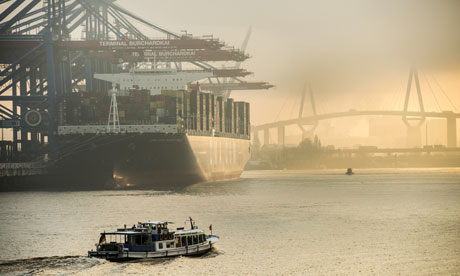
    Container ship docks at Hamburg harbour

    The EU believes that carbon emissions monitoring system will bring environmental and economic gains for the shipping industry. Photograph: Patrick Lux/Getty Images

    Owners of large ships using EU ports will have to measure and report annual carbon emissions from January 2018 under new European commission proposals published on Friday.

    The plans stop short of including shipping emissions in the EU carbon market, but the commission says they can still have an impact and are part of its work towards global emissions agreements.

    “The EU monitoring system will bring environmental and economic gains for the shipping sector by increasing transparency about emissions and creating an incentive for ship-owners to cut them,” Connie Hedegaard, EU commissioner for climate action, said in a statement.

    The proposals are subject to months of debate and will need approval from EU member states and the European parliament before they can become law.

    They would create an EU-wide legal framework for collecting and publishing verified annual data on CO2 emissions from all large ships (defined as more than 5,000 gross tons) that use EU ports, irrespective of where the ships are registered.

    Owners – such as Denmark’s AP Moller-Maersk A/S, the group behind the world’s biggest container shipping operator – will also be required to provide other information, such as data to determine the ships’ energy efficiency.

    The commission said the EU-wide monitoring system should cut emissions from the journeys covered by up to 2% and could also help to reduce costs to owners.

    Debate on how to handle shipping emissions, which the commission estimates account for 3% of global and 4% of EU greenhouse gas emissions, has rumbled on for years with little progress.

    Without action, shipping emissions are expected to more than double by 2050 as transport demand increases.

    Preliminary discussions between EU member states and the shipping industry addressed the option of including emissions in the emissions trading scheme.

    But there is little chance of that happening in the short term, given the international outcry and threats of a trade war that followed an earlier decision to expand the carbon trading scheme to include all flights to and from EU airports.

    As a result, the EU agreed to freeze the charge on intercontinental flights for a year to give the UN International Civil Aviation Organisation (ICAO) a chance to come up with an alternative.

    Talks are already under way at the International Maritime Organisation on a global deal for shipping emissions. The EC says its measures on both shipping and airlines are only being introduced pending a worldwide agreement and the EU shipping rules would be modified if necessary to conform to any global standards, if agreed.