Author: Neville

  • Keep our coal in the ground

    Keep our coal in the ground

    If coal extraction developments are to go ahead in Queensland, we are dooming ourselves to a world no one wants to see

    Queensland coal
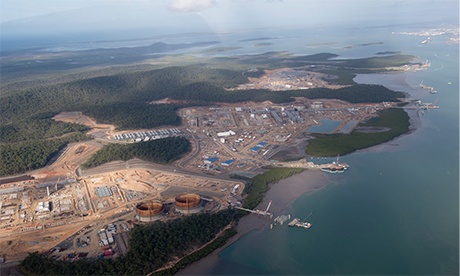
    Coal waiting to be loaded onto ships at the Gladstone harbour. Photograph: Simon Copland 

    I’m instantly stuck by the contrast. On one side, the landscape is beautiful. A river winds its way towards the ocean, until it hits a few islands sitting on the coast. Mangroves cling to the water edge. Beyond the initial line of trees, the landscape is bare – dark brown and red soils radiating in the sun.

    The other side is very different. Amongst the beauty, humans have wreaked havoc. We can see factories, gas plants and piles of coal getting ready to be shipped out. On the ocean I can count around 20 ships, sitting, waiting to be loaded up with their cargo. The harbour is being dredged so more ships can enter its waters.

    I have traveled with US climate activist Bill McKibben and Greens senator Larissa Waters to the town of Gladstone to visit the frontline of Australia’s coal expansion. We took a charter plane to fly over the developments, and I interviewed McKibben and Waters as part of the trip. McKibben said that he was struck by what he saw: “I thought it was remarkable to see one of the relatively few spots in the world where the great carbon conveyor belt has its beginning.”
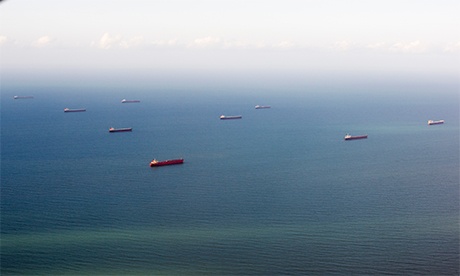
    Coal ships waiting off the coast of Gladstone
    Coal ships waiting off the coast of Gladstone. Photograph: Simon Copland 

    The Gladstone and Fitzroy Delta port area already comprises of two ports, with three more proposed/under construction (a fourth was recently dumped by Xstrata). The port area already handles approximately 50 million tonnes of coal each year. The new developments could increase that number by approximately 28.3 million tonnes. McKibben says that is simply too much for the climate to bear:

    “There’s just six or seven places around the world that have such great concentrations of carbon. This part of Australia, the tar sands of Canada, the Powder River basin of the US. Unless we can keep that carbon in the ground there is very little chance of arresting climate change.”

    The last year in climate science has been nothing short of terrifying. In Australia, we saw our “angry summer“. Records were smashed and floods and fires ravaged the country. But what has been worse has been the reports coming out from some of our more conservative institutions; ones like The World Bank and the International Energy Agency, saying that we are heading for a world of four degrees warming or more. Far too much for a safe climate.

    The maths – as highlighted by McKibben – has become clear. The science shows that we can only emit globally 565 gigatons more of CO2 to stay at or below two degrees of global warming – a target agreed by pretty much every government in the world. The known carbon reserves in Australia make up 30% of that number.

    Thinking about those numbers as I flew over Gladstone, one thing became obvious. Even though we have implemented a carbon price, Australia is not doing enough to halt climate change. Our leaders, and our fossil fuel companies, are addicted to coal, and in doing so are playing an oversized role in warming our planet. Waters agrees. She told me that we can’t let most of the proposed developments go ahead:

    “If the world is to stay below two degrees we only have a certain budget left, a carbon budget if you like. And if all of the proposed, enormous coal mines that are planned for the Galilee basin – if they were to go ahead, that one basin would comprise 6% of the world’s burnable carbon to stay below two degrees warming. That is a sheer amount that simply must stay in the ground.”

    Waters argued that despite agreeing to the target, the Australian government is not doing enough:

    “Under the current environment minister, and in fact all previous environment ministers, no coal mine has ever been rejected in Queensland and to my knowledge in Australia. Under our current environmental laws there has never been a refusal of a fossil fuel project in our history. And that’s saying an awful lot.”

    This is the reality we now must face up to. Global warming is here. If developments like Gladstone and the Galilee Basin go ahead, we are dooming ourselves to a world of four degrees of warming – a world no one wants to see.

    If we are serious about leaving a safe world for our future generations there is only one course of action – leave our coal in the ground.

  • Chief of Army David Morrison tells troops to respect women or ‘get out’

    This is long overdue.


    Chief of Army David Morrison tells troops to respect women or ‘get out’

    ABCUpdated June 14, 2013, 1:47 pm

    Army chief David Morrison has issued a stern warning to personnel after it was revealed that dozens of members were involved in the distribution of hundreds of explicit emails denigrating women.

    and the Director of Public Prosecutions is considering a brief of evidence against them from the New South Wales Police.

    In a message to members of the army recorded on Wednesday and uploaded to YouTube, Chief of Army General David Morrison said there is “no place” in the army for members who “exploit and demean” their colleagues.

    “[The] conduct, if proven, has not only brought the army into disrepute, but has let down every one of you and all of those whose past service has won the respect of our nation,” he said.

    “Evidence collected to date has identified a group within our ranks who have allegedly produced highly inappropriate material demeaning women, and distributed it across the internet and Defence’s email networks.

    “If this is true, then the actions of these members are in direct contravention of every value the Australian Army stands for.”

    General Morrison says there has been a systemic problem, and urged personnel to uphold defence force values.

    “I will be ruthless in ridding the army of people who cannot live up to its value, and I need everyone of you to support me in achieving this,” he said.

    “If we are a great national institution – if we care about the legacy left to us by those who have served before us, if we care about the legacy we leave to those who, in turn, will protect and secure Australia – then it is up to us to make a difference. If you’re not up to it, find something else to do with your life. There is no place for you amongst this band of brothers and sisters.”

    He also issued a warning to army personnel who bullied or humiliated their colleagues.

    “Those who think that it is okay to behave in a way that demeans or exploits their colleagues have no place in this army,” he said.

    “If that does not suit you, then get out. The same goes for those who think that toughness is built on humiliating others.

    “If you become aware of any individual degrading another, then show moral courage and take a stand against it.”

    Fairfax Media is reporting that a ring of soldiers calling themselves the Jedi Council swapped footage of their sexual encounters online without the women’s knowledge.

    General Morrison says the allegation is a “fair description” of what he had been told.

    “There are other offences to do with inappropriate use of defence computing systems and there are references in the many emails we have seen to possibly the use of illicit drugs and they are all matter for investigation,” he said in an interview this morning.

    The Defence investigation is continuing and is expected to last months.

  • Aboriginal Legal Service (NSW/ACT) Aboriginal deaths in custody

    NEVILLE

    We won! With just over two weeks to go before the CNS phone line preventing Aboriginal deaths in police custody was due to cease operating, the Federal Attorney-General Mark Dreyfus has agreed to funding for a two-year period.

    We want to thank all of YOU – 33,864 online petitioners who fought hard with us to get the CNS funded.

    Thanks to you, we’re now able to continue our vital Custody Notification Service that has prevented Aboriginal deaths in police custody in NSW and ACT since its inception in 2000.

    For the last six weeks we’ve run an aggressive campaign to Save the CNS and bring Government attention to this life-saving service. Your signatures, and your heartfelt comments about why the CNS is essential obviously made a huge difference — with the Federal Government allocating $100,000 immediately to the CNS. They have also agreed to us using another $900,000 of their Federal Budget allocation between 2013 to 2015.

    This means the CNS has secured funding for a further two years. A huge victory. Of course we will continue to seek ongoing funding for this essential life-saving service – our fight is not really over – but we’re glad for the breathing room.

    We’d love for you to help us keep fighting for sustainable funding and keep up to date with the Aboriginal Legal Service. So join our Facebook page, follow us on Twitter here, and you can visit our website at: www.alsnswact.org.au

    We have been overwhelmed by your support, and hope you can join us into the future to ensure the CNS remains for as long as there are vulnerable Aboriginal people in police custody.

    Thank you.

    Phil Naden

    CEO

    Aboriginal Legal Service (NSW/ACT)

    We wish to acknowledge the many significant people and organisations who publicly and privately expressed their support for our campaign to continue funding for the CNS including the NSW Police, NSW Coroner, NSW Law Society, Australian Red Cross, NSW Council of Civil Liberties, Coalition of Peak Aboriginal Organisations (CAPO) including NSW Aboriginal Land Council (NSWALC), Link Up NSW, NSW Aboriginal Education Consultative Group, NSW Aboriginal Health and Medical Research Council, and NSW Aboriginal Child, Family and Community Care State Secretariat, the previous Social Justice Commissioner Tom Calma, the NSW Greens, and the NSW Ombudsman wrote to the NSW Government late last year in support of the CNS.

    People are starting petitions every day on Change.org.
    NEVILLE, what will you change?
                                                   

              START A PETITION
  • Two-thirds of energy sector will have to be left undeveloped, Bonn conference told

    Two-thirds of energy sector will have to be left undeveloped, Bonn conference told

    If world is to limit global warming we cannot burn all our fossil fuels, says International Energy Agency economist Fatih Birol

    International Energy Agency chief economist  Fatih Birol: “Globally, the direction we are on is not the right one. If it continues, the increase would be as high as 5.3 degrees – and that would have devastating effects on all of us.” Photograph: David SleatorInternational Energy Agency chief economist Fatih Birol: “Globally, the direction we are on is not the right one. If it continues, the increase would be as high as 5.3 degrees – and that would have devastating effects on all of us.” Photograph: David Sleator

    Wed, Jun 12, 2013, 01:00

    First published: Wed, Jun 12, 2013, 01:00

    About two-thirds of all proven reserves of oil, gas and coal will have to be left undeveloped if the world is to achieve the goal of limiting global warming at two degrees Celsius, according to the chief economist at the International Energy Agency.

    Addressing participants in the latest round of UN climate talks in Bonn, Fatih Birol said this should be an “eye-opener” for pension funds with significant investments in the energy sector – particularly in coal – as well as for ratings agencies.

    He predicted coal would be hardest hit in the “unburnable carbon” scenario, followed by oil and gas. “We cannot afford to burn all the fossil fuels we have. If we did that, it [average global surface temperature] would go higher than four degrees.
    ‘Devastating effect’
    “Globally, the direction we are on is not the right one. If it continues, the increase would be as high as 5.3 degrees – and that would have devastating effects on all of us.”

    Instead of ignoring it, energy companies had a “crucial” role in confronting the challenge of climate change. “We think the energy sector cannot afford to be isolated – not just for moral reasons, but also for the business perspective.”

    Dr Birol delivered his address a day after the energy agency published its latest special report, Redrawing the Energy-Climate Map, which called on governments to take action between now and 2020 to ensure the two-degree target could be achieved.

    Looking at positive developments, he cited China’s closure of 70 of its worst-performing coal-fired power stations and said other countries should follow suit – an open invitation to the Government to switch Moneypoint in Co Clare to gas.

    Dr Birol said US greenhouse gas emissions had fallen back to the mid-1990s level, largely due to cheaper gas replacing coal for electricity generation.

    “This is huge . . . revolutionary,” he said, attributing the change to widespread fracking of shale gas.

    Dr Birol was speaking as one of the key strands of the UN talks fell apart due to Russian obstruction.

  • When Will the Next Megathrust Hit the West Coast of North America?

    When Will the Next Megathrust Hit the West Coast of North America?

    June 12, 2013 — Understanding the size and frequency of large earthquakes along the Pacific coast of North America is of great importance, not just to scientists, but also to government planners and the general public. The only way to predict the frequency and intensity of the ground motion expected from large and giant “megathrust ” earthquakes along Canada’s west coast is to analyze the geologic record.


    Share This:

    A new study published today in the Canadian Journal of Earth Sciences presents an exceptionally well-dated first record of earthquake history along the south coast of BC. Using a new high-resolution age model, a team of scientists meticulously identified and dated the disturbed sedimentary layers in a 40-metre marine sediment core raised from Effingham Inlet. The disturbances appear to have been caused by large and megathrust earthquakes that have occurred over the past 11,000 years.

    One of the co-authors of the study, Dr. Audrey Dallimore, Associate Professor at Royal Roads University explains: “Some BC coastal fjords preserve annually layered organic sediments going back all the way to deglacial times. In Effingham Inlet, on the west coast of Vancouver Island, these sediments reveal disturbances we interpret were caused by earthquakes. With our very detailed age model that includes 68 radiocarbon dates and the Mazama Ash deposit (a volcanic eruption that took place 6800 yrs ago); we have identified 22 earthquake shaking events over the last 11,000 years, giving an estimate of a recurrence interval for large and megathrust earthquakes of about 500 years. However, it appears that the time between major shaking events can stretch up to about a 1,000 years.

    “The last megathrust earthquake originating from the Cascadia subduction zone occurred in 1700 AD. Therefore, we are now in the risk zone of another earthquake. Even though it could be tomorrow or perhaps even centuries before it occurs, paleoseismic studies such as this one can help us understand the nature and frequency of rupture along the Cascadia Subduction Zone, and help Canadian coastal communities to improve their hazard assessments and emergency preparedness plans.”

    “This exceptionally well-dated paleoseismic study by Enkin et al., involved a multi-disciplinary team of Canadian university and federal government scientists, and a core from the 2002 international drill program Marges Ouest Nord Américaines (MONA) campaign,” says Dr. Olav Lian, an associate editor of the Canadian Journal of Earth Sciences, professor at the University of the Fraser Valley and Director of the university’s Luminescence Dating Laboratory. “It gives us our first glimpse back in geologic time, of the recurrence interval of large and megathrust earthquakes impacting the vulnerable BC outer coastline. It also supports paleoseismic data found in offshore marine sediment cores along the US portion of the Cascadia Subduction Zone, recently released in an important United States Geological Survey (USGS) paleoseismic study by a team of researchers led by Dr. Chris Goldfinger of Oregon State University.

    In addition to analyzing the Effingham Inlet record for earthquake events, this study site has also revealed much information about climate and ocean changes throughout the Holocene to the present. These findings also clearly illustrate the importance of analyzing the geologic record to help today’s planners and policy makers, and ultimately to increase the resiliency of Canadian communities. ”

    Share this story on Facebook, Twitter, and Google:
  • Carbon Dioxide Absorption in Antarctic Seas

    Carbon Dioxide Absorption in Antarctic Seas

    June 12, 2013 — The seas around Antarctica can, at times, resemble a garden. Large-scale experiments where scientists spray iron into the waters, literally fertilizing phytoplankton, have created huge human-made algal blooms. Such geoengineering experiments produce diatoms, which pull carbon dioxide out of the air. Experts argue that this practice can help offset Earth’s rising carbon dioxide levels. However, the experiments are controversial and, according to a new study at the Georgia Institute of Technology, perhaps not as effective as expected.


    Share This:

    Georgia Tech research published online Monday in Nature Communications indicates that diatoms stuff more iron into their silica shells than they actually need. As a result, there’s not enough iron to go around, and the added iron may stimulate less productivity than expected. The study also says that the removal of iron through incorporation into diatom silica may be a profound factor controlling the Southern Ocean’s bioavailable pool of iron, adversely affecting the ecosystem.

    “Just like someone walking through a buffet line who takes the last two pieces of cake, even though they know they’ll only eat one, they’re hogging the food,” said Ellery Ingall, a professor in Georgia Tech’s College of Sciences. “Everyone else in line gets nothing; the person’s decision affects these other people.”

    Ingall says, similarly, these “hogging” diatoms negatively affect the number of carbon-trapping plankton produced. They also outcompete other organisms for the iron.

    “It appears the diatoms aren’t using all of the iron for photosynthesis,” he said. “They’re incorporating iron in their shells for another purpose, keeping it from others and affecting the plankton ecosystem.”

    Researchers have known for years that diatoms can remove iron from oceans and carbon from the atmosphere, but little is known about how iron is cycled and removed from the Antarctic region.

    Ingall and a former Georgia Tech graduate student, Julia Diaz, spent nearly six weeks in Antarctica’s Ross Sea from 2008 to 2009, trying to learn more. They collected samples in the frigid waters and used them to create what is believed to be the first spectroscopic, compositional characterization of iron in marine biogenic silica. Ingall conducted an X-ray analysis of the phytoplankton at the U.S. Department of Energy’s Argonne National Laboratory.

    A major source of bioavailable iron in Antarctica is from melting snow and dust deposition. Ingall found that iron addition via these sources barely keeps pace with subtraction by diatoms.

    “Uptake of iron by diatoms is significant compared to what Mother Nature is able to naturally add to the ocean,” he said. “This uptake could shift microbial communities toward organisms with relatively lower iron requirements.”

    According to Ingall, removal of iron by diatom-dominated phytoplankton communities may dampen the intended outcome of enhanced carbon uptake through iron fertilization by reducing the productivity of other phytoplankton, which take up carbon dioxide more efficiently.

    This research was funded by the National Science Foundation (EDI-0849494, PLY-0836144, and EDI-1060884). The findings and conclusions are those of the authors and do not necessarily represent the official views of the NSF.

    Share this story on Facebook, Twitter, and Google: