Author: Neville

  • Earth to warm 3.8C as nations fail on climate goals: report

    Earth to warm 3.8C as nations fail on climate goals: report

    Source: Wed, 12 Jun 2013 05:00 PM

    Author: Michael Szabo, Reuters Point Carbon
    cli-cli cli-pol
    Enlarge image
    North and South Tarawa are seen from the air in the central Pacific Island nation of Kiribati. Kiribati consists of a chain of 33 atolls and islands that stand just metres above sea level, spread over a huge expanse of otherwise empty ocean. With surrounding sea levels rising, Kiribati President Anote Tong has predicted his country will likely become uninhabitable in 30-60 years because of inundation and contamination of its freshwater supplies. May 23, 2013. REUTERS/David Gray
    TweetRecommendGoogle +LinkedInBookmarkEmailPrint

    Jump down to related content

    BONN, June 12 (Reuters Point Carbon) – The world’s biggest emitting nations are struggling to meet existing pledges to cut emissions of greenhouse gases by the end of the decade, researchers warned Wednesday, adding that global temperatures would likely rise by 3.8C this century as a result.

    Climate Action Tracker (CAT), a coalition of European climate policy consultants, said governments are unlikely to deliver on legal and voluntary carbon reduction targets, goals which most scientists say are already too weak to stop the earth warming more than deemed safe levels of 2C.

    “Assuming current emissions trends, implemented and presently planned policies there is a 40 percent chance of warming exceeding 4C by 2100 and a 10 percent chance of it exceeding 5C in the same period, with a likely warming projected at 3.8C by 2100,” the researchers said in a report published on the sidelines of U.N. climate talks in Germany.

    “With these emission trends, a warming of 3-4 degrees warming at 2100 won’t stop there. Warming is likely to continue upwards well into the 22nd century,” added Bill Hare of Climate Analytics, one of the groups that contributed to the work.

    Negotiators from over 100 nations are meeting in Bonn this week to try to draft a new global climate pact to be signed in 2015 and come into effect in 2020.

    The talks are taking place amid warnings from scientists that the world’s population could suffer wide-spread drought and flooding as a result of rising emissions of greenhouse gases, which trap the sun’s heat in the atmosphere.

    In May, U.S. researchers said the amount of carbon dioxide in the air reached 400 parts per million for the first time, while on Monday the International Energy Agency estimated emissions hit a record last year, despite economic slowdown in most developed nations.

    PARADOX

    A key part of the U.N. talks are on how different nations can deepen existing goals to cut emissions by the end of the decade, although no major emitting nation has tabled fresh pledges in the past three years.

    “It’s a great paradox that policy seems to be unwinding almost as fast as temperature projections are increasing,” Hare added.

    Last week the world’s two biggest emitting nations – China and the United States – promised to accelerate a phase out of production and consumption of potent greenhouse gases called hydrofluorocarbons, but the researchers said the move may only curb temperature rises by 0.1 to 0.5 degrees.

    A shift from coal- to gas-based power in the U.S., thanks to the nation’s newly-tapped vast shale gas reserves, may also be undermining its current goal to cut emissions by 17 percent below 2005 levels before 2020, said Niklas Hohne, a director at Ecofys, another contributor to the report.

    According some estimates, the fugitive emissions from shale gas, for example methane released through its production, almost entirely offsets the climate benefits of switching fuels, he added.

    “While shale gas may have a little positive impact on U.S. (emissions), it’s highly doubtful that it will have a positive impact on the climate in the long-term,” Hohne said.

  • Under pressure: Arctic trends sparking extreme weather at large

    Under pressure: Arctic trends sparking extreme weather at large

    Posted by frontierscientists

    Posted: June 12, 2013 – 6:21 am

    The Polar jet stream is pictured in this screencap of NASA video "Aerial Superhighway". This image portrays a zonal jet stream, with winds moving swiftly west-to-east. The fastest winds are colored red; slower winds are blue. : Courtesy NASA (National Aeronautics and Space Administration) Goddard Space Flight CenterThe Polar jet stream is pictured in this screencap of NASA video “Aerial Superhighway”. This image portrays a zonal jet stream, with winds moving swiftly west-to-east. The fastest winds are colored red; slower winds are blue. : Courtesy NASA (National Aeronautics and Space Administration) Goddard Space Flight Center

    Laura Nielsen for Frontier Scientists

    In September 2012, at the end of last summer, the Arctic sea ice extent reached a record low since satellite measurements began. And, according to the National Snow and Ice Data Center, summer sea ice extent in the Arctic has declined roughly 40 percent in the last three decades.

    Sea Ice Retreat in the Beaufort Sea, north of Alaska. The MODIS instrument on NASA’s Terra satellite collected these images on May 13, 2012 (top), and June 16, 2012 (bottom). The rapid melt was part of a larger phenomenon of increasing sea ice melt.: Courtesy NASA (National Aeronautics and Space Administration) Earth ObservatorySea Ice Retreat in the Beaufort Sea, north of Alaska. The MODIS instrument on NASA’s Terra satellite collected these images on May 13, 2012 (top), and June 16, 2012 (bottom). The rapid melt was part of a larger phenomenon of increasing sea ice melt.: Courtesy NASA (National Aeronautics and Space Administration) Earth Observatory

    The Arctic is warming faster than other parts of the planet. This enhanced warming is called Arctic Amplification. It may seem like a far-away problem to many people, yet a study led by National Oceanic Atmospheric Administration scientist James Overland, Ph.D., and published in the American Geophysical Union’s Geophysical Research Letters shows that it is a much nearer concern. Amplified Arctic warming is contributing to more frequent and more extreme weather events in North America and Europe, making the Arctic an increasingly important player in shaping regional climate in the coming century.

    Climate change and Arctic warming alter the nature of the jet stream, weakening those powerful winds and changing their flow. An altered jet stream can amplify extreme weather events and change the origin, persistence, and severity of regional weather. Let’s look at why.

    The troposphere is the layer of our atmosphere which lies closest to earth. Bands of powerful winds called jet streams occur in the troposhpere where areas of high and low pressure meet. When the temperature difference between the pressure fronts is particularly pronounced, the resulting winds are fiercer, and jet stream winds can exceed 100 miles per hour. The jet stream in the Northern Hemisphere is known as the Polar jet stream.

    Those pressure systems are often dominated in the north by two different forces. One is known as the Aleutian Low, which is an area of low pressure centered near Alaska’s Aleutian Islands. It dominates during the winter months, and tends to generate winter storms. Then, during the summer, that low system is pushed north toward the pole by a high pressure system called the North Pacific High which is influenced more by the warmer southerly temperatures. Both systems are semi-permanent and changeable. Where the fronts meet, cold polar air interacts with the warmer air originating in the tropics and pushing north through the mid-latitudes. It is that interaction which influences weather trends in much of the Northern Hemisphere, particularly in North America and Europe.

    Images illustrating the Arctic Oscillation in its positive and negative phases.: Courtesy NOAA (National Oceanic and Atmospheric Administration) & NCDC (National Climatic Data Center)Images illustrating the Arctic Oscillation in its positive and negative phases.: Courtesy NOAA (National Oceanic and Atmospheric Administration) & NCDC (National Climatic Data Center)

    When the standard low pressure system dominates in the Arctic and a high pressure system pushes northward from the mid-latitudes, the pressure pattern is described as a positive Arctic Oscillation, during which the Polar jet stream behaves in a predictable way. Winds blow swiftly from the west to the east, pushed out of a linear path only slightly by colder low-pressure troughs sliding south and warmer high-pressure air ridges pushing north. The fast, slightly wavy, west-to-east jet stream is called a zonal jet stream flow.

    In contrast, a meridional flow describes a jet stream wind that meanders far from its path, blowing much more north-to-south. Its path is more radical because low-pressure troughs and high-pressure ridges penetrate further into the opposite pressure front. The winds follow an extreme winding path, and as a result move more slowly. Meridional flows correspond with a negative Arctic Oscillation, during which a high pressure front dominates in the Arctic. Simulations run on supercomputers foretell more of those intense high-pressure systems dominating the northern Pacific and Atlantic oceans as the 21st century progresses and levels of greenhouse-gasses continue to rise.

    This matters because a slow, meandering meridional jet stream can mean weather conditions are more extreme and longer lasting. Cold Arctic temperature troughs reach further south, and hot pressure ridges stab further north. Severe storm fronts often form where the pressure systems with their wild temperature gradients rub against one another. And the meridional flow can make weather conditions dominate in one region for a longer duration. No longer blowing swiftly through along a stronger zonal flow, weather trends linger and sometimes persist. It’s called a blocking pattern, and it can inflict prolonged heat spells leading to drought and increased wildfire probability, extreme summer rainfall leading to flooding, or unseasonal cold. These upsets to regional climate spell potential trouble for humans, watershed integrity for crops, and wildlife habitat.

    The Polar jet stream is pictured in this screencap of NASA video "Aerial Superhighway". This image portrays a meridional jet stream, with winds meandering more slowly, predominantly north-to-south. The fastest winds are colored red; slower winds are blue.: Courtesy NASA (National Aeronautics and Space Administration) Goddard Space Flight CenterThe Polar jet stream is pictured in this screencap of NASA video “Aerial Superhighway”. This image portrays a meridional jet stream, with winds meandering more slowly, predominantly north-to-south. The fastest winds are colored red; slower winds are blue.: Courtesy NASA (National Aeronautics and Space Administration) Goddard Space Flight Center

    Jennifer Francis, Ph.D., of Rutgers, names “[T]he rapid regional changes and increased frequency of extreme weather that global warming is causing,” to be a high-impact symptom of climate change. She adds: “As the Arctic warms at twice the global rate, we expect an increased probability of extreme weather events across the temperate latitudes of the northern hemisphere, where billions of people live.” The Earth is one great system, and everything is interconnected. The Arctic, though remote, impacts regional climate patterns in North America and Europe; the amplified warming occurring there deserves our attention and care.

    Eyes to the north.

    .

    Frontier Scientists: presenting scientific discovery in the Arctic and beyond

    References:

    ‘A Rough Guide to the Jet Stream: what it is, how it works and how it is responding to enhanced Arctic warming’ John Mason, Skeptical Science
    http://skepticalscience.com/jetstream-guide.html

    ‘Arctic summer wind shift could affect sea ice loss and U.S./European weather, says NOAA-led study’ National Oceanic Atmospheric Administration
    http://www.noaanews.noaa.gov/stories2012/20121010_arcticwinds.html

    ‘Evidence Linking Arctic Amplification to Extreme Weather in Mid-Latitudes’ American Geophysical Union : Geophysical Research Letters
    http://www.agu.org/pubs/crossref/pip/2012GL051000.shtml

    ‘National Weather Service Glossary’ National Oceanic and Atmospheric Administration : National Weather Service
    http://w1.weather.gov/glossary/

    ‘Weather-Making High-Pressure Systems Predicted to Intensify’ Duke University : Nicholas School of the Environment
    http://www.nicholas.duke.edu/news/weather-making-high-pressure-systems-predicted-to-intensify


  • ‘Everything at stake’ with NBN, says visionary

    ‘Everything at stake’ with NBN, says visionary

    Date
    June 13, 2013 – 11:49AM

    Matthew Hall

    Resisting change could be catastrophic, says the founder of a high-profile international think tank.

    Zoom in on this story. Explore all there is to know.

    All aboard? Broadband visionary likens the NBN to the railways.All aboard? Broadband visionary likens the NBN to the railways. Photo: Bob Finlayson

    The implementation of an effective national broadband network is critical to economic development and the federal opposition must not fear it, the founder of a high-profile “intelligent community” think tank has told IT Pro.

    It is not sustainable if we allow the trend to continue where people flee rural areas for economic purposes.

    Louis Zacharilla

    Louis Zacharilla of the New York-based Intelligent Community Forum warned that failure to make the most of implementing the NBN in Australia would be the equivalent of ignoring railways in the 19th century.

    “I get the fear and the resistance,” Zacharilla co-author of Broadband Economies: Creating the Community of the 21st Century, said.

    Advertisement

    “Governments are dealing with public money and dealing with significant change. I don’t declare bad intentions for the opposition [to the NBN]. I just declare them to be a bit fearful and a little bit too cautious.

    “That is natural. That is human nature. We resist change. But if you speak with anyone who has had to overcome that resistance they will say to you, this is the right way to go – we just disagree about how to get there.”

    Zacharilla, whose forum anointed Communications Minister Stephen Conroy Visionary of the Year in 2012, spoke to IT Pro ahead of his address at this week’s Digital Productivity Conference in Brisbane, hosted by the Department of Broadband, Communications and the Digital Economy.

    The Intelligent Community Forum releases an annual list of “intelligent communities” highlighting regions around the globe that use communications technology to effectively boost their local economies.

    No Australian community has made the ICF finalist list since 2004, when Victoria made the cut.

    “Australia does not lack aspiration,” Zacharilla said. “They know what is at stake. They know they should keep the talent at home, but they don’t have all the tools yet.”

    ICF’s work has received plaudits from New York City mayor Mike Bloomberg and government leaders in Taiwan, France, Finland, the Netherlands, South Korea and Afghanistan.

    Toronto (Canada), Oulo (Finland), and Tallin (Estonia), were among the list of this year’s top seven communities.

    In implementing broadband, Zacharilla drew comparison with the economic development of cities in the US that elected to use riverboats as their main form of industrial transportation against those that saw the benefits of railways.

    “Chicago, which was a backwater city, saw this thing called the railroad,” Zacharilla said. “Chicago invested in it and even today has 10 times the GDP of the state of Missouri.

    “Everything is at stake [with the NBN]. This is the new railroad. If your communities are not connected to it then it is difficult to put cargo on it.”

    A major focus for ICF is broadband development for rural areas. According to Zacharilla, efficient connectivity outside urban centres is a critical factor in determining wider environmental sustainability.

    “It is not sustainable if we allow the trend to continue where people flee rural areas for economic purposes,” he said.

    “The smaller communities will lose everything and the big cities will not be able to take the people that flood in, especially in a place like China. All hell will break loose.

    “If you can keep people where they want to be, embedded in their cultures, contributing to their towns and villages, looking after their elders and learning from their elders, raising their kids in the places where they want to but can connect them to a global society through internet and broadband, then it is a win-win.” 


    Read more: http://www.smh.com.au/it-pro/government-it/everything-at-stake-with-nbn-says-visionary-20130613-2o5g0.html#ixzz2W5O5qfYh

  • Why Greenland’s darkening ice has become a hot topic in climate science

    Why Greenland’s darkening ice has become a hot topic in climate science

    Darkening causes the snow to absorb more sunlight which in turn increases melting

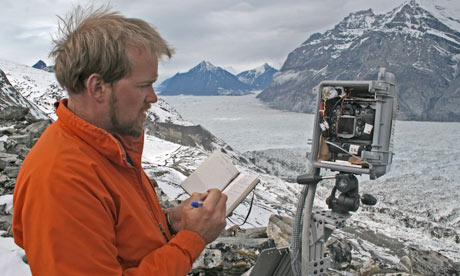
    Scientist Jason Box during an expedition in Greenland

    Climate scientist Jason Box during an expedition in Greenland in July 2008. Photograph: Byrd Polar Research Center

    Last July, a record melting occurred on the Greenland ice sheet. Even in some of the highest and coldest areas, field parties observed rainfall with air temperatures several degrees above the freezing point. A month before, it was as though Greenland expert Jason Box had a crystal ball; he predicted this complete surface melting in a scientific publication. Box’s research then got broader public visibility after climate activist and writer Bill McKibben covered it in Rolling Stone magazine.
    The basic premise of Box’s study was that observations reveal a progressive darkening of Greenland ice. Darkening causes the white snow surface to absorb more sunlight which in turn increases melting. Given that this process is likely to continue, the impact on Greenland melt, and subsequent sea level rise, will be profound.

    There are several mechanisms that are known to darken arctic ice, including desert dust, pollen, soot from natural forest fires, and human biomass burning for land clearing and domestic use. Industrial, shipping, and aircraft pollution also play a role. Some of these effects are increasing. As climate change accelerates, more areas are being burned by wildfire each year. Box wondered how much increasing wildfires with resulting soot landing on the northern ice might amplify what scientists call a “positive feedback” – a self-reinforcing cycle – increasing Greenland melting. The cycle starts with initial warming, leading to more fires, more soot, and in turn more warming and more melt. The feedback is important, particularly in polar regions where observed warming is twice the rate of more southerly locations around the globe. Box calculates this effect has doubled Greenland surface melting since year 2000.

    The topic has become hot among ice experts as new observations of ice melt continue to outstrip projections from just a few years ago. Arctic sea ice, another key measure of global heating, is now 60 years ahead of worst-case projections from the last report by the Intergovernmental Panel on Climate Change in 2007. Arctic snow cover on land has also been declining more rapidly than projected, even faster than sea ice. While mass loss of the enormous Greenland sheet is difficult to measure, satellite data indicate it has doubled in the last decade. If this acceleration continues, sea level rise could be even higher this century than the 1 or 2 meters that mainstream scientists now project – possibly much higher. Despite a recent study that projected Greenland outflow glaciers to slow, surface melting has increased faster than ice flow. The albedo feedback is a critical piece of physics that enables surface melting to continue dominating the loss.

    To test his hypothesis, Box has assembled a team of scientists and communicators to collect and analyze samples from key locations on the ice sheet, and report those results directly to the public. The plan is to arrive in Greenland in late June, just as the peak melting season and fire season coincide. Box will be joined by Bill McKibben, who will be covering the research for Rolling Stone, and videographer Peter Sinclair, whose series of climate change videos on YouTube has gained high praise from climate scientists.

    The scientific team includes Sara McKenzie Skiles, a researcher at UCLA and the NASA Jet Propulsion Laboratory, and Marek Stibal, a biogeochemist at the Geological Survey of Denmark and Greenland. Dr Stibal will be looking at yet another potential source of darkening, the activity of microorganisms that produce their own darkening pigments, which may be increasing due to atmospheric warming and fertilization by pollutants.

    While government funding contracted, Box decided to push forward with a new approach, financing the research as a “citizen science” initiative, funded by internet crowd sourcing. His project is aptly named DARK SNOW and financial support is being collected online.

    It is exciting to watch emerging science collide with novel scientific fundraising initiatives. It is possible that this emergence will grow in the coming years as scientific projects grow in cost and complexity, while more traditional funding sources diminish. The costs of funding projects like DARK SNOW are miniscule compared to the costs we endure from climate-change-related weather disasters. The penny-wise pound-foolish attitude we’ve taken toward science funding is a complicated issue that I’ll deal with in a future post.

  • Australian team competes in Airbus ideas competition with low-emission jet fuel

    Australian team competes in Airbus ideas competition with low-emission jet fuel

    Your Friends’ Activity

    NEW! Discover news with your friends. Give it a try.
    To get going, simply connect with your favourite social network:

    Facebook
    • twitter
    • linkedin
    • google

    This feature allows you to discover news with your friends on Our Network.

    This means stories that are read and watched will be shared with your friends, and they’ll share things with you too.

    To try out Discover news with friends simply login with your favourite social network. You can login with Facebook, Twitter, Linkedin or Google+

    Give it a try! You can turn it off at any time.

    unexpected problems crop

    BRIGHT IDEA: The new A350 Airbus long-haul carrier does a taxiing test at the aérodrome of Toulouse-Blagnac. AFP PHOTO / ERIC CABANIS Source: AFP

    FIVE Australian students have challenged European aviation giant Airbus to consider a quantum leap to a future featuring sustainable bio-methane fuelled airliners.

    Flown to France this week by Airbus for the finals of the company’s prestigious Fly Your Ideas aviation design competition aimed at university students, the Royal Melbourne Institute of Technology team yesterday made their final presentation to a panel of industry experts at Airbus’ Toulouse headquarters.

    59d34aa2-d3b5-11e2-b860-d5a4f7ec6372

    The Australian team in France for the Airbus Fly Your Ideas challenge.

    Source: Supplied

    Their proposition is for a combination of LNG and sustainable bio-methane, dubbed Bio-LNG, to replace JetA1 fuel, which has the potential to reduce emissions by up to 97 per cent, depending on the mix, and slash airlines’ operating costs.

    From the Homepage

    Army scandal ‘worse than Skype’

    Army hit with email scandal  THE Defence Force has been rocked by a new scandal it says is bigger than the recent Skype affair, with almost 100 Army personnel under investigation.

    Victorians warned to brace for floods

    Melbourne Weather ROLLING COVERAGE: WILD weather – from flash flooding to 100km/h winds – prompts warnings for several Victorian regions including the metro area.

    ‘I had no idea this would go viral’

    David Carter UPDATE: THE chef who released the offensive menu depicting Julia Gillard as a quail says Mal Brough has his “full sympathy”.

    The lowest paid jobs in Australia

    The lowest paid jobs in AustraliaIT may be a stereotype that low paid jobs require little skill, but that’s not always the case. These are the country’s 10 lowest paying jobs.

    Jellyfish halts world-record swim

    Chloe McCardel A JELLYFISH sting has ended a Melbourne marathon swimmer’s audacious attempt to swim the Straits of Florida from Cuba to the US.

    Mackay family told about new search

    Mackay POLICE kept Donald Mackay’s family in the loop before beginning their fresh search for the remains of anti-drug campaigner last night.

    Drugs fuelled Satanic sex shop spree

    Sexyland sign A MAN blames party drug ice for sending him on a “satanic” armed robbery spree on a string of Melbourne sex shops and restaurants.

    How rapists ‘fake’ it out of jail

    How rapists ?fake? it out of jailVIOLENT rapists such as Jill Meagher’s killer are faking their way through sex offender programs only to reoffend on release from prison, a sexual violence expert warns.

    The aerospace engineering students, led by 21-year-old Luke Spiteri, also produced modelling to support the modification of existing aircraft wing tanks and the addition of underwing fuel pods to accommodate the cryogenic fuel.

    “We’re very happy with how we went,” Spiteri said. “It’s now down to the judges.

    “But just to be here is so rewarding. This has been an unforgettable experience.”

    The group, also including Mark Spiteri, Katherine Gregoriou, Martin Burston – all 21 – and James Herringer, 24, now have to wait until Friday to see if they have beaten the four other groups from Brazil, India, Malaysia and Italy who made the finals of the competition with its 30,000 euro prizemoney.

    More than 8000 students making up 618 teams from 82 countries entered this year’s competition.

    Dr Graham Dorrington, the RMIT team’s academic supervisor, said if Airbus really wanted to hear about potentially “disruptive” technology – radical ideas which challenged the status quo – then he believed the RMIT students had provided it.

    “If Airbus takes notice the future (of aviation) is secure,”he said.

    “And what I really want is for companies back home like Woodside to take note. If we can get the industry mobilised in Australia we can be ahead of the game and there’s a lot of bloody good people working in LNG in Australia.”

    Spiteri said his parents, John and Margaret of Albany Creek, were excited the team had made it as far as they had.

    “They are thrilled,” he said. “They know how much work we’ve put in over the past seven months.”

    The winning team will be announced at a ceremony held on Friday at UNESCO in Paris.

  • This 29 year-old analyst just gave up his whole life –Bradley Manning (AVAAZ)

    Hi all,

    This 29-year-old just gave up his whole life to blow the whistle on the US’s insane PRISM program — which has hacked all our emails, Skype messages and Facebook posts for years. If millions of us act urgently and get behind him, we can help press the US to crack down on PRISM, not Edward. Let’s stand with him before it’s too late:

    Sign the petition

    This 29 year-old analyst just gave up his whole life — his girlfriend, his job, and his home — to blow the whistle on the US government’s shocking PRISM program — which has been reading and recording our emails, Skype messages, Facebook posts and phone calls for years.

    When Bradley Manning passed this kind of data to Wikileaks, the US threw him naked into solitary confinement in conditions that the UN called “cruel, inhumane and degrading”.

    The authorities and press are deciding right now how to handle this scandal. If millions of us stand with Edward in the next 48 hours, it will send a powerful statement that he should be treated like the brave whistleblower that he is, and it should be PRISM, and not Edward, that the US cracks down on:

    https://secure.avaaz.org/en/stop_prism_fb_c/?bBYMjdb&v=25811

    PRISM is profoundly disturbing: it gives the US government unlimited access to all of our personal email and social media accounts on Google, Youtube, Facebook, Skype, Hotmail, Yahoo! and much more. They’re recording billions of our messages every month and the CIA can now or in the future use the information to prosecute, persecute, or blackmail us, our friends or our families!

    Edward was horrified by this unprecedented violation of individual privacy. So he copied large amounts of files, sent them to the Guardian newspaper for publication and escaped to Hong Kong. His bravery not only exposed PRISM, but has started a domino effect around the world, shining a light on secret spy programs in Canada, the UK and Australia in just days! Now he’s trapped in Hong Kong, waiting to be arrested. A global outcry could save him from extradition to the US, and encourage other countries to grant him asylum.

    We can’t let the US do to Edward what they did to Bradley Manning. Let’s urgently stand with him, and against PRISM:

    https://secure.avaaz.org/en/stop_prism_fb_c/?bBYMjdb&v=25811

    Sometimes the things our governments do are simply breathtaking. When heroic individuals like Edward have risked their own freedoms to bring scandals of this scale into light, the Avaaz community has come together to demand fair treatment — and won. When half a million of us joined with other organizations and activists calling on the US government to stop its cruel treatment of Bradley Manning, he was relocated to a medium-security prison and taken out of solitary confinement. If we act quickly, we might do better for Edward, and help him win the fight he’s bravely taken on, for all our sakes.

    With hope and determination,

    Ricken, Emma, Oli, Mia, Allison, Ari, Dalia, Laura and the whole Avaaz team

    PS – Many Avaaz campaigns are started by members of our community! Start yours now and win on any issue – local, national or global: http://www.avaaz.org/en/petition/start_a_petition/?bgMYedb&v=25795

    MORE INFORMATION:

    Edward Snowden: the whistleblower behind the NSA surveillance revelations (The Guardian)
    http://www.guardian.co.uk/world/2013/jun/09/edward-snowden-nsa-whistleblower-surveillance

    Edward Snowden Contact Glenn Greenwald Should Be ‘Disappeared’, Security Officials ‘Overheard Saying’ (Huffington Post)
    http://www.huffingtonpost.co.uk/2013/06/10/nsa-leaker-and-journalist-should-be-disappeared-overheard_n_3414346.html?utm_hp_ref=canada&ir=Canada

    NSA PRISM program taps in to user data of Apple, Google and others (The Guardian)
    http://www.guardian.co.uk/world/2013/jun/06/us-tech-giants-nsa-data

    Prism scandal: Government program secretly probes Internet servers (Chicago Tribune)
    http://www.chicagotribune.com/news/chi-nsa-prism-scandal-20130607,0,301166.story

    PRISM by the Numbers: A Guide to the Government’s Secret Internet Data-Mining Program (TIME)
    http://newsfeed.time.com/2013/06/06/prism-by-the-numbers-a-guide-to-the-governments-secret-internet-data-mining-program/

    Anger swells after NSA phone records court order revelations (The Guardian)
    http://www.guardian.co.uk/world/2013/jun/06/obama-administration-nsa-verizon-records

    Data-collection program got green light from MacKay in 2011 (Globe and Mail)
    http://www.theglobeandmail.com/news/national/data-collection-program-got-green-light-from-mackay-in-2011/article12444909/

    Greens unveil plan to require warrant to access phone and internet records (The Guardian)
    http://www.guardian.co.uk/world/2013/jun/11/greens-warrant-phone-internet-records

    Support the Avaaz Community!
    We’re entirely funded by donations and receive no money from governments or corporations. Our dedicated team ensures even the smallest contributions go a long way. Donate to Avaaz


    Avaaz.org is a 22-million-person global campaign network
    that works to ensure that the views and values of the world’s people shape global decision-making. (“Avaaz” means “voice” or “song” in many languages.) Avaaz members live in every nation of the world; our team is spread across 18 countries on 6 continents and operates in 17 languages. Learn about some of Avaaz’s biggest campaigns here, or follow us on Facebook or Twitter.

    You are getting this message because you signed “Join Avaaz!” on 2012-06-22 using the email address ngarthurslea@yahoo.com.au.
    To ensure that Avaaz messages reach your inbox, please add avaaz@avaaz.org to your address book. To change your email address, language settings, or other personal information, contact us, or simply go here to unsubscribe.

    To contact Avaaz, please do not reply to this email. Instead, write to us at www.avaaz.org/en/contact or call us at +1-888-922-8229 (US).