Author: Neville

  • Agricultural Hegemony (MONBIOT)

    Monbiot.com


    Agricultural Hegemony

    Posted: 06 Jun 2013 01:19 AM PDT

    Why do farmers’ groups indulge in such ridiculous scaremongering about the restoration of the natural world?


    By George Monbiot, published on the Guardian’s website 6th June 2013

    The dam is beginning to crack, faster than I would have believed possible. Britain, one of the world’s most zoophobic nations, is at last considering the return of some of its extinct and charismatic mammal species.

    While wolves, lynx, bears, bison, moose, boar and beavers have been spreading across the Continent for decades, into countries as developed and populous as ours, and while they have been widely welcomed in those places, here we have responded to this prospect with unjustified horror.

    Or perhaps I shouldn’t say “we”. The population as a whole tends to be more sympathetic to reintroductions than the tiny number of people who own most of the land*. Britain has one of the highest concentrations of landownership in the world, and the big landowners are often the most conservative members of the population. Unfortunately they are the ones who have power in the countryside.

    (*Erlend B. Nilsen et al, 7th April 2007. Wolf reintroduction to Scotland: public attitudes and consequences for red deer management. Proceedings of the Royal Society – B, Vol. 274, no. 1612, pp.995-1003. doi: 10.1098/rspb.2006.0369)

    Despite the best efforts of the landowners, some very determined people have been trying to bring to Britain a little of what has been delighting the people of other European nations. After years of obstruction, things are suddenly starting to happen.

    Following the successful beaver reintroductions in two parts of Scotland, the first release in Wales could be about to happen. The Welsh Beaver Project hopes to be able to reinstate some animals in the Rheidol valley in mid-Wales next year.

    In Scotland a group of biologists called the Lynx UK Trust has now applied for a licence to release lynx – a predator which should be welcome in a country where deer numbers have gone beserk.

    Unsurprisingly, the old guard – the landowners and the bodies which represent them – is doing all it can to prevent such reintroductions, and any wider rewilding.

    In response to the beaver plan, a spokesman for the National Farmers’ Union said:

    “I haven’t seen any evidence that they’ll contribute anything to the eco-system. The history as far as introducing mammals in particular is not a particularly good one. We’ve seen the grey squirrel, rabbits and even mink so in reality there isn’t much evidence to suggest they do any good at all.”

    When people make arguments as bad as this, you know they haven’t a leg to stand on.

    Unlike grey squirrels, rabbits and mink, beavers are native to the United Kingdom. They were hunted to extinction for their beautiful pelts, their meat and the chemical (castoreum) they secrete, which was of great value to the perfume industry. The last ones died out in the 18th Century. They are a keystone species, which means that they have a larger influence in the ecosystem than their numbers alone would suggest.

    Their dams, burrows and ditches and the branches they drag into the water create habitats for a host of other species: water voles, otters, ducks, frogs, fish and insects. In both Sweden and Poland, the trout in beaver ponds are on average larger than those in the other parts of the streams: the ponds provide them with habitats and shelter they cannot find elsewhere*,**. Young salmon grow faster and are in better condition where beavers make their dams than in other stretches***. The total weight of all the creatures living in the water may be between two and five times greater in beaver ponds than in the undammed sections****.

    (* Åsa Hägglund and Göran Sjöberg, 1999. Effects of beaver dams on the fish fauna of forest streams. Forest Ecology and Management: Vol. 115, nos 2–3 ,pp259–266. doi:10.1016/S0378-1127(98)00404-6.
    ** Krzysztof Kukuła and Aneta Bylak, 2010. Ichthyofauna of a mountain stream dammed by beaver
    Archives of Polish Fisheries. Vol. 18, no. 1, pp33-43. doi:10.2478/v10086-010-0004-1
    *** Douglas B. Sigourney et al, 2006. Influence of Beaver Activity on Summer Growth and Condition of Age-2 Atlantic Salmon Parr. Transactions of the American Fisheries Society, Vol. 135, no. 4, pp1068-1075. doi:10.1577/T05-159.1
    **** Robert J. Naiman, Carol A. Johnston and James C. Kelley, 1988. Alteration of North American Streams by Beaver. BioScience, Vol. 38, No. 11, pp. 753-762. http://www.jstor.org/stable/1310784)

    Beavers slow rivers down. They reduce scouring and erosion. They create small wetlands and boggy areas. They trap much of the load that rivers carry*, ensuring that the water runs more clearly.

    (* Robert J. Naiman, Carol A. Johnston and James C. Kelley, 1988. Alteration of North American Streams by Beaver. BioScience, Vol. 38, No. 11, pp. 753-762. http://www.jstor.org/stable/1310784)

    The NFU’s ignorance of these basic facts reinforces the longstanding suspicion that farmers’ leaders know next to nothing about the natural world. The self-styled “guardians of the countryside” are often less well-informed than the average urbanite.

    Similarly misleading claims surround the plans to reintroduce the lynx. This is what the National Farmers’ Union says:

    “Particular concerns would be the safety of livestock and the increased stress levels in livestock resulting from these predators as well as any impacts on local wildlife and biodiversity.”

    The lynx is an ambush hunter, which lives exclusively in woodland. It will enter open spaces only with extreme reluctance. If your sheep aren’t in the woods, the lynx poses no threat to them. Only where farmers fail to keep their sheep out of the woods (something they deliberately fail to do in some places, with devastating consequences for woodland ecology) are their animals at risk.

    As for the impacts of the lynx on wildlife and biodiversity, the lynx is part of our native fauna: in other words a component of our wildlife and biodiversity. Our wildlife has adapted to live alongside it. A specialist roe deer predator, it will help to control this overpopulated species, as well as some of the exotic species of deer (sika in particular) which are damaging forestry and the regeneration of woodlands in some parts of Britain.

    But that’s not the worst of the scaremongering by farmers’ groups. In response to my book Feral, the Farmers’ Union of Wales has claimed that my proposals for the rewilding of parts of the uplands “would be akin to the herding of American Indians onto reserves.”

    That’s quite a claim. As I’ve come to expect from these organisations, the FUW has produced not a stick of evidence to support it.

    What is the fiendish device I’ve proposed to enable this act of genocide? Er, scrapping Rule 12 of the European Union’s Good Agricultural and Environmental Condition code. This rule forces farmers to clear the land of “unwanted vegetation” if they want to claim their subsidy payments. It’s a policy which has caused the pointless, taxpayer-funded destruction of habitats all over the EU.

    In other words, I’m suggesting that farmers should have a choice over whether or not they want to clear their land. If they don’t want to clear it or keep sheep on it, they can still claim their payments. Terrified yet?

    The other proposal I make is that the main subsidy they receive (the single farm payment) should be capped at 100 hectares of land. It’s outrageous that the dukes, sheikhs and speculators with the largest holdings are each receiving millions of pounds a year from taxpayers much poorer than themselves, merely by virtue of the amount they own.

    A cap would give small farmers an advantage over large ones, making it less likely that they will lose their land and livelihoods. Very much “akin to the herding of American Indians onto reserves” in other words.

    What we are seeing here is an example of how unaccustomed to challenge the farmers’ leaders have become. If their batty assertions were confronted more often, they might stop exposing themselves to ridicule. But so dominant are they in debates over rural policy, and so seldom are conflicting voices heard, that they have not had to temper their scaremongering fantasies with reality.

    Governments and other agencies treat farmers as if theirs is the only rural voice that counts. Yet they are a small minority even of the rural population. In Wales, farmers (both full- and part-time) account for 1.5% of the total population and just 5% of the rural population. A similar situation prevails across the rich world. Yet, in the countryside, they have 95% of the voice, and everyone else is marginalised from decision-making.

    You can see the impacts of this dominance in England’s impending badger cull. Professor John Bourne, who conducted the government-funded study which showed that badger killing is a waste of time and money, recalled what he was told by a senior politician:

    “Fine, John, we accept your science, but we have to offer farmers a carrot.  And the only carrot we can possibly give them is culling badgers” .

    For too long, farmers’ leaders have come to see their interests and that of the countryside as synonymous, and for too long the rest of us have accepted that view. It’s an aspect of what I call agricultural hegemony: the exercise of the cultural hegemony Antonio Gramsci identified, but in the countryside. It’s time we challenged it.

    George Monbiot’s book Feral: searching for enchantment on the frontiers of rewilding is published by Allen Lane.

  • Intermittency could be solved by storing excess solar as methane

    Intermittency could be solved by storing excess solar as methane

    June 06, 2013 | Written by Amanda H. Miller | Hits: 353
    digg

    inShare0

    1

    Project VGV aims to store excess solar as methaneAudi is the first company to develop a commercial scale plant converting excess renewable energy generation into methane gas for storage.

    Herman Pengg, head of renewable fuels for Audi, joined international nuclear energy attorney Corinne Lepage and University of New York Professor Robert Bell in a Planetworkshops Global Conference discussion about the new Project Volt Gas Volt that the latter two introduced last week in the European Parliament in Brussels.

    Project VGV converts excess solar and wind energy generation into methane that can be stored in the natural gas grid and used as heating fuel, to generate electricity or even as a replacement for vehicle fuels.

    Audi completed the world’s first industrial-scale installation of the technology this month and will use it as a demonstration of the technology’s viability in the market.

    Pengg explained the technology to Automotive Engineer in November.

    Audi has wind and solar electricity generation capacity. “(The technology) draws electricity whenever there is a surplus, balancing fluctuations in supply,” pengg said.

    The first step of the process converts the electricity to hydrogen through electrolysis. The process could stop there. But Audi is interested in developing an alternative fuel that can easily replace gasoline. And since there is no existing infrastructure for hydrogen cars, Pengg said Audi takes the process further. They combine the hydrogen with Carbon Dioxide to produce CH4 – methane. Since methane is the main component in natural gas, it can easily be used to replace gasoline.

    “This is what we call Audi e-gas,” Pengg said in November.

    He said then that Audi does not intend to become an energy producer. Once the car manufacturer proves the technology, he expects the industry to take over.

    Lepage and Bell have spoken about Project VGV in the last weeks as a sound alternative to nuclear power and other traditional electricity sources. This could be the grid storage answer the renewable energy industry has been looking for, they say.

    “A breakthrough in energy storage permits a constant flow of electricity,” according to a press release from the pair issued after the EU presentation, “allowing for a shift to 100 percent renewable energy sources, overcoming the major obstacle of intermittent flow of energy.”

    If excess renewable energy can be converted to methane and stored in the natural gas grid, it would not only make renewable energy a viable source for all energy needs, Lepage argued. It would also eliminate the need for the controversial hydraulic fracturing process used to extract natural gas.

    “With Project VGV, industry and government have the solution for a successful energy transition to optimize wind and solar energy,” Lepage said.


    Comments:

  • Warming Alaska, Canada glaciers send 100 gigatons of ice into ocean each year

    Warming Alaska, Canada glaciers send 100 gigatons of ice into ocean each year

    Molly Rettig

    June 6, 2013
    Share on emailEmail Print Text Size A +A

    The total loss of mass from melting glaciers is so giant it changes the earth’s gravity field and alters ocean currents around Alaska. In fact, parts of the earth can bounce up several centimeters when an ancient ice boulder lets loose. Loren Holmes photo

    Every summer, Alaska’s glaciers melt and send vast quantities of water gushing through silty gray rivers, past towns and villages and finally into the sea. Some glaciers calve directly into the ocean, instantly losing car-sized chunks of ice and wowing boats full of tourists.

    Melting glaciers are boosting ocean levels 0.71 millimeters a year, accounting for roughly one-third of total sea level rise, according to a recent study.

    “That’s the equivalent of draining the Great Lakes once a month each year,” says Regine Hock. She and colleague Anthony Arendt, both glaciologists at the University of Alaska Fairbanks Geophysical Institute, have contributed to an article in Science on the role of glaciers in sea-level rise. Alaska and Canada make up nearly half of that — purging 100 gigatons of mass annually from frozen storage into the ocean.

    Oceans rise an inch in 10 years

    The mass loss, which scientists call wastage, is so massive that it changes the earth’s gravity field and alters ocean currents around Alaska. It’s so heavy that parts of the earth can bounce up several centimeters in response. Alaska scientists were part of an international team that calculated the ice loss of glaciers around the world from 2003-2009 using satellite data and ground measurements.

    “When many people think about sea level rise, they only think about the big ice sheets in Greenland and Antarctica. They don’t think these smaller ones can contribute anything,” says Hock.

    The other two-thirds of total sea level rise come from equal parts melting ice sheets and the warming and expansion of oceans. Overall, oceans have risen 2.5 millimeters a year since 2003.

    “In 10 years, that’s an inch. That’s quite a lot,” says Hock.

    It trickles in from the state’s favorite glaciers — Gulkana in the Alaska Range, Exit in Seward, Portage on the Kenai Peninsula, Mendenhall in Juneau, Columbia on Prince William Sound, and several throughout the Wrangell mountains.

    Where does it go?

    “Most of the meltwater ends up in streams and eventually makes its way to the oceans,” Hock says. This affects not just the ocean but the overall hydrology of the earth. Communities in the Andes, for example, rely on glacial runoff for water during the dry summer season. The more ice that’s lost, the smaller their water source.

    Salmon affected

    Glacier water is cold and fresh, which affects the temperature and chemistry of rivers and oceans — and can impact fisheries and ecosystems. “Salmon and other species are really sensitive to stream composition. If the temperature changes just a few degrees, that might affect whether salmon can spawn,” Arendt says.

    Glacier mass changes have traditionally been estimated by field measurements of individual glaciers. “It’s really old school,” Arendt says. Scientists dig a snow pit in the winter and measure the snow accumulation, calculate its density, and then convert it to water equivalent. This tells them the annual growth of the glacier.

    To calculate melting, they drill a stake into the ice at the beginning of summer and measure the height sticking above the surface. An end-of-summer measurement reveals how much was lost. This depth is converted to water equivalent and extrapolated to the whole basin. The melt has greatly outpaced snowfall, according to these observations. But because of logistics, there are only a handful of such field sites over Alaska’s vast ice-covered region.

    To capture broader changes, the new study combined conventional field measurements with satellite data. One tool was measuring the gravitational force exerted by glaciers.

    From Newton, we know that greater mass means larger gravitational force. When a satellite crosses a large mass (like an ice sheet) it speeds up a little because of the greater force. Over areas with less mass, the satellite slows down. By tracking satellite positions over time, you can estimate changes in the ice sheet.

    They determined the volume loss by measuring the distance between a satellite and the glacier.  “You bounce a laser off the surface and it tells you the height. You come back at a later time and map that height again,” says Arendt.

    What does this mean for the world — and Alaska?

    Shrinking glaciers, shrinking tourism?

    Some coastlines will be hit harder than others, depending on which glacier regions melt the most. Sea levels will actually drop in Alaska, as the weight of glaciers is lifted and the earth rises relative to the water. “As the glaciers disappear, and you take off that load, it allows the earth’s crust to rebound in response,” Hock says.

    Smaller glaciers, like those in the Brooks Range, will disappear faster than bigger, high-elevation glaciers like those in the St. Elias Mountains. As glaciers shrink, so could tourism.

    Understanding glacier wastage can help predict flooding in river communities and plan energy projects. “With hydropower coming online, these companies need to know how much water will be transported into these watersheds and how that will change in the future,” Hock says.

    Read the full article, “A Reconciled Estimate of Glacier Contributions to Sea Level Rise: 2003-2009” here.

    Molly Rettig is a science writer with the University of Alaska Fairbanks who is filling in for Ned Rozell this summer. 

    Share on emailEmail Print Text Size A +A
  • Biodiversity offsets rely on ongoing biodiversity

    In a recent interview, the Opposition environment spokesperson Greg Hunt promised to reverse biodiversity decline in five years if the Coalition wins the forthcoming election. Is this goal achievable? Not the way we’re going. Our investment in enhancing biodiversity is not keeping pace with the factors…

    6gndvy4f-1369713951
    “Averted loss” biodiversity offsets rely on ongoing biodiversity declines to work. Kenneth Pinto

    In a recent interview, the Opposition environment spokesperson Greg Hunt promised to reverse biodiversity decline in five years if the Coalition wins the forthcoming election.

    Is this goal achievable? Not the way we’re going. Our investment in enhancing biodiversity is not keeping pace with the factors driving biodiversity declines.

    We continue to lose biodiversity by clearing vegetation for mining, urban development and farm management. Queensland’s rate of clearing alone has recently averaged about 100,000 hectares each year, and looks set to increase. Even our national parks have come under attack.

    Is it possible to continue to clear land, but also stop biodiversity decline? In theory, perhaps. This is the apparent promise of biodiversity offsetting, an increasingly popular policy approach. But are our current offset policies really designed to halt declines? We argue the answer is no.

    No net loss compared to what?

    In Australia, the federal government and all state governments have biodiversity offset policies either in place, or in development. Offsetting is done by trading a biodiversity loss in one location with an equivalent gain in another. Biodiversity offset policies usually aim to achieve “no net loss” of biodiversity.

    To what extent can biodiversity offsets contribute to halting biodiversity decline? As usual, the devil is in the detail.

    Leaving aside the vexed issue of how we actually measure biodiversity, let’s consider what is actually meant by “no net loss” of biodiversity.

    The crucial question here is, “no net loss compared to what?” Most people probably imagine that the answer is no net loss of biodiversity compared to what was there before the impact. But this is not usually the case.

    Instead, the real intention of most biodiversity offset policies is to achieve no net loss compared to what would have happened in the absence of the impact and the offset. This is often referred to as the counterfactual.

    Calculating the compensation

    We can see why this definition of “no net loss” emerges if we consider the two ways that offsetting can be done.

    First, gains can be achieved through improving existing habitat, or creating habitat from scratch. For example, we could create new wetland habitat for a threatened frog to compensate for a development that destroys its current wetland habitat.

    Although there are many limitations to such restoration offsets, they can neutralise damage to some elements of biodiversity.

    Threatened native grasslands to the west of Melbourne, a place where offsets require ongoing biodiversity declines to work Ryan Chisholm
    Click to enlarge

    Second, we can protect existing habitat as an offset. This is known as an “averted loss” offset, and is the more commonly-used approach.

    The assumption here is that protecting against clearing or degradation results in a gain for biodiversity compared to what would have happened without the protection. Calculating this gain requires choosing some sort of “business as usual” rate of decline, based on data on vegetation clearing or degradation of habitat quality.

    The gain then occurs because the offset results in better outcomes than would have occurred under the counterfactual “business as usual” scenario. This gain, together with the loss from an impact, provides the “no net loss” outcome.

    One of the challenges with this approach is in estimating the counterfactual. It is often (unfortunately) a reasonable assumption that biodiversity will continue to decline. The problem arises when estimating what that rate of decline might be. Since we do very little biodiversity monitoring in Australia, there can be considerable uncertainty around the “business as usual” baseline to which we might compare our offset outcome.

    But there are is another important consequence of averted loss offsetting that might not be immediately obvious.

    Averted loss offsets only work if biodiversity keeps declining

    The crucial point about averted loss offsetting is that it can entrench the baseline rate of decline. That is because the gains from the offset and the losses from the impact are only required to add up to the decline that would otherwise have occurred.

    So without additional conservation actions, this approach to offsetting simply ensures current declines continue, at the same rate. This outcome is not a policy failure — it is the way the policy is designed to work.

    Allowing this type of averted loss offsetting is therefore an admission that ongoing decline is the norm for our biodiversity. Worryingly, policies structured this way could also provide a perverse incentive to ensure declines continue. This is because without declines, offsets based on “protection” are not possible.

    For example, part of the disquiet around increasing protection of vegetation, such as through the Wild Rivers declarations on Cape York, is linked to the potential loss of opportunity to sell offset “credits”. The less of our vegetation we protect, the easier it is to find offsets.

    So biodiversity offsets policies that rely heavily on “averted loss” offsetting cannot in themselves reverse declines; they are not designed to. Whether it is fair to expect developers to be responsible not only for negating their impact, but also contributing to improving the lot of biodiversity, is debateable. But we should be aware that offsets are not a panacea. At best, our averted loss offsets will achieve a continuing decline of biodiversity.

    At worst, they may provide an incentive for the decline to continue.

  • Dresden hit as 100,000 people across Germany fight floods

    Dresden hit as 100,000 people across Germany fight floods

    River Elbe more than 6 metres above normal level as military and national disaster team work frantically to hold back floodwaters

    • Associated Press in Dresden
    • guardian.co.uk, Friday 7 June 2013 05.32 AEST
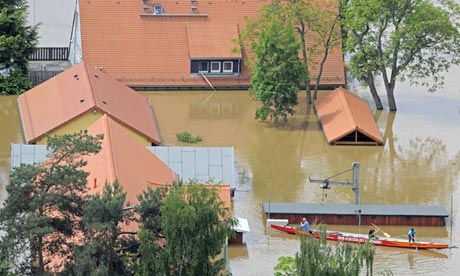
    People paddle in a boat between houses flooded by the river Elbe in Dresden

    People paddle in a boat between houses flooded by the river Elbe in Dresden. Photograph: Jens Meyer/AP

    The river Elbe flooded on Thursday in the eastern German city of Dresden, sparing the historic centre but engulfing wide areas of the Saxony capital.

    Residents and emergency crews had worked through the night to fight the floods in Dresden. The German military and national disaster team sent more support in a frantic effort to sandbag levees and riverbanks as floodwaters that have claimed 16 lives since last week surged north.

    “Everybody’s afraid but the people are simply fantastic and sticking together,” said Dresden resident Silvia Fuhrmann, who had brought food and drinks to those building sandbag barriers.

    The Elbe hit 8.76m around midday – well above its regular level of 2m. Still, that was not high enough to damage the city’s famous opera, cathedral and other buildings in its historic centre, which was devastated in a flood in 2002.

    Germany has 60,000 local emergency personnel and aid workers, as well as 25,000 federal disaster responders and 16,000 soldiers now fighting the floods.

    Farther downstream, the town of Lauenburg – just southwest of Hamburg – evacuated 150 houses along the Elbe, n-tv news reported, as the floodwaters roared toward the North Sea.

    In the south, the Bavarian city of Deggendorf was hit by a third levee break on Thursday, with floods gushing into neighbourhoods. Scores of homes remained underwater and authorities warned that a dam was still in danger of bursting.

  • Europe struggles with worst floods in decade

    Europe struggles with worst floods in decade

    AFPJune 6, 2013, 9:18 pm

    BITTERFELD, Germany (AFP) – Germany pushed on with frantic efforts to secure saturated river dykes with sandbags Thursday, bracing for a surge of the worst floods in over a decade that have claimed 12 lives and forced mass evacuations across central Europe.

    Vast stretches along the Elbe river basin have turned into a sea of brown water in the Czech Republic and downstream in eastern Germany, with only red-tiled roofs sticking out of the muddy water in many abandoned villages and towns.

    The picture of devastation was similar along the mighty Danube, which has jumped its banks in Germany’s southern Bavaria state and Austria and sparked large-scale disaster preparations in Hungary, where the water was expected to peak in coming days.

    In northeast Germany, thousands of volunteers, many organised through social media, firefighters, aid workers and troops have filled millions of sandbags to hold back the torrent which has risen from two to above eight metres (six to above 26 feet).

    Thousands worked through the night or kept a nervous watch on flood barriers while recalling dark memories of the 2002 floods that killed scores across central Europe and caused a clean-up bill running to billions of euros (dollars).

    Fears were centred on Bitterfeld in Saxony-Anhalt state where two lakes, one higher than the other, loom dangerously close to a city that during the communist East Germany era became notorious as a heavily polluted industrial centre.

    Local officials have warned that a breach in the lake defences could spark a “mini-tsunami” that could engulf the city, and officials have twice attempted to blow holes in the lake dyke away from the city, with limited success.

    Chancellor Angela Merkel has promised 100 million euros ($130 million) in immediate flood relief across Germany, and Finance Minister Wolfgang Schaeuble promised on Thursday that more money would follow.

    Dresden, with more than two million people, said the peak of 8.75 metres was reached on Thursday, with flood waters lapping through the mud-caked living rooms and trashed gardens of thousands of outlying homes.

    However, the old inner city — dubbed the “Jewel Box” for its baroque and rococo churches, opera and buildings — was secured by flood barriers installed after the even higher 2002 flood.

    People also breathed a cautious sigh of relief as water levels eased in Halle, where Elbe tributary the Saale had reached its highest level in 400 years the day before and authorities have urged 30,000 people to flee.

    Upstream in the Czech Republic — where five days of flooding killed at least eight people and forced some 20,000 evacuations — rescue workers in rubber dinghies were supplying isolated families who lack drinking water, power or gas.

    In the industrial centre of Usti nad Labem near the German border, where 11,000 people were told to evacuate, looters targeted empty homes and businesses, and a waiter at a pub-restaurant told how he came face to face with three robbers at night.

    “I entered the corridor and got a blow. They broke my nose, my side is sore and there’s something wrong with my ribs,” Ladislav Kratochvil told the DNES daily.

    The capital Prague held up well thanks to 17 kilometres of temporary aluminium barriers, and city trains were running again, but people in Usti bemoaned their poorer flood defences.

    “It’s a shame. If they were a metre higher, it would have been enough,” a police officer told the DNES. “It went fast, the water rose really quickly.”

    In Austria, where two people have died in the floods, the Danube town of Korneuburg just north of Vienna reported an all-time record river level of 8.06 metres.

    In nearby Nussdorf a river cruise ship with some 120 tourists onboard was stranded in the middle of the river Thursday, an AFP photographer witnessed.

    Down the Danube in Hungary, preparations moved into high gear to prepare Budapest for the wall of water coming along one of Europe’s longest waterways which empties into the Black Sea in a delta in Romania and Ukraine.

    Prime Minister Viktor Orban has warned large-scale evacuations were likely because of “a real threat to human life” but has pledged that “with good cooperation, we can protect everyone”.

    An “anti-catastrophe team” with 10,000 volunteers and close to 12,000 police and troops was on stand-by, while some 300 people had been evacuated so far.